WHEN MY DAUGHTER AND SON-IN-LAW LURED ME AND MY HEART-SICK WIFE INTO THE WINE CELLAR
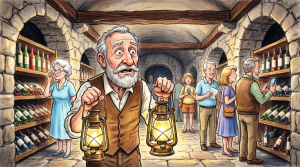
The moment the deadbolt slid home on the far side of the wine-cellar door, I did not pound on the oak. I did not shout my daughter’s name. I did not waste breath on anger.
I stood very still in the dark and listened.
Above us, on the kitchen floor, I heard the hard click of Celeste’s heels crossing the black walnut planks I had installed myself thirty-seven years earlier. Heard the softer, heavier step of her husband following behind her. Heard one muffled sentence, then the hush that comes when people believe they have finally taken control of a room.
Beside me, Eleanor found my arm in the dark.
Her fingers were cold. They had been cold for months, ever since her heart started misbehaving in small, ugly ways that doctors described with calm words and stern eyes. Manageable, they said. Watchful, they meant. She gripped me hard enough that I could feel her fear through my sweater, and because I have been her husband for forty-one years, I knew exactly what that grip was asking.
What now?
I leaned close enough to feel the chill of her cheek and whispered, “Don’t make a sound.”
She drew a shaky breath.
“They think they’ve won,” I said. “They haven’t.”
Eleanor did not ask me what I meant.
That is something people misunderstand about long marriages. They imagine that after four decades together you learn each other’s habits, and that is true, but it is the shallowest part of the truth. What you actually learn is timing. Tone. The exact weight of a silence. The difference between fear held in the body and fear surrendered to. The sound your husband’s voice makes when he is improvising and the sound it makes when he is not improvising at all.
The tone I used in that cellar was low, level, and utterly free of panic.
Eleanor loosened her grip just a little.
That trust—hers in me, mine in her—is the only inheritance that has ever meant anything.
But to understand why I did not panic in the dark, you need to understand the house. Because the house is the whole story. The house is what my daughter wanted. The house is what her husband thought he understood. The house is what I built, what I protected, and what in the end protected us back.
I built it in 1987.
Not hired someone. Not managed contractors. Not “oversaw the construction” in the way wealthy men say when they pick tile samples twice and then disappear until the roof is on. I built it. I poured the foundation in the spring mud with my own hands. I framed the walls. I ran the wiring. I laid the stone on the exterior one stubborn course at a time until my shoulders ached and my palms split and my mother, who was still alive then, told me I was trying to prove something to the world that the world had never asked to see.
She was not wrong.
I was thirty-four that year and had just taken an early pension from the state after eleven years as a structural engineer. “Early retirement” makes it sound glamorous, and it wasn’t. I was tired of working on bridges and public buildings for men who took credit for other people’s calculations. I had saved hard, lived cheaply, and seen a chance to step away while I was still young enough to use my own hands for my own life instead of theirs.
Eleanor was thirty-one and seven months pregnant with our first and only child.
We had agreed on one thing with more seriousness than any vow we ever made in church: before this baby came into the world, she would have a home worth coming into.
We bought two and a half acres in a small town in western Connecticut, in the kind of place where people waved from porches and remembered your dog’s name and, in those years, did not yet lock their doors until bedtime. The lot had a slight rise from the road and a stand of birches along the back edge that turned almost silver in winter. I stood there the first morning after we signed the papers, boots sinking into wet ground, and saw the whole house in my mind at once.
Four bedrooms.
A sunroom facing south to catch the low winter light.
A broad kitchen with room for a long table.
A basement divided in two—storage on one side, something cooler and more deliberate on the other. At the time I called it a cellar because that sounded civilized. In truth, during the early years, it held canned peaches, storm lanterns, extra detergent, and our tax returns.
The wine came later.
The house took fourteen months.
Eleanor painted while I was still hammering. She would stand in the front room with a brush in her hand and a belly under one of my shirts, laughing because I had somehow managed to get mortar in my hair again. We moved in six weeks before Celeste was born, the front walkway not yet set, the upstairs hall still smelling of varnish, half the grass outside nothing more than mud and seed and hope.
It did not matter.
The first night in that house we ate soup from a pot balanced on two cardboard boxes because the kitchen chairs had not been delivered yet. Eleanor leaned back against a stack of unopened dishes and said, “Arthur, it feels finished.”
And I said, “No, it feels started.”
That was the right word.
A good house is not finished when the walls are painted. It begins then.
I knew every inch of it. Every beam, every line load, every slight compromise where reality had not entirely matched drawing. I knew which third stair from the landing would creak in damp weather. I knew the exact angle of sunlight in the sunroom in late October. I knew where the basement stayed coolest in August and where the furnace noise carried through the ductwork if you stood in the downstairs hall after midnight.
That kind of knowledge matters. Men forget this. They assume ownership is paper and signatures and bank accounts and not also memory stored in the body. They think a house belongs to whoever holds the deed. Often it belongs more deeply to the person who knows where the floor slopes by half an inch or which window frame swells in August humidity.
I knew the house the way a sailor knows his own vessel.
Eleanor came to know it differently. She painted every room before the trim was even dry. She chose curtains that made the winter light look warmer. She planted peonies near the back porch and once, in the second spring after we moved in, sat on the half-finished deck steps with Celeste on her lap and said, “This house already knows us.”
Maybe that sounds foolish to you. It didn’t to me then and it doesn’t now.
Celeste was born in early summer, small and furious and pink in the face. I remember holding her in the nursery we had painted pale yellow because we hadn’t wanted to know beforehand whether we were having a son or a daughter, and feeling the sort of awe that makes a man both stronger and more afraid in the same instant.
For years she was sunlight.
I do not say that because she is my daughter and nostalgia is a liar. I say it because it is true. She ran before she walked properly. She loved questions more than answers. She climbed onto everything. She brought me screws and washers from the garage in her tiny fist and called them “important pieces.” Eleanor used to say Celeste moved through the world as if the world had been set there specifically to entertain her.
At six, she laughed so hard she snorted, and once lost both front teeth in the same month and spent an entire summer looking like a delighted little outlaw. At nine, she insisted on selling lemonade at the end of the driveway and doubled the price if the weather was especially hot, which at the time I found enterprising and Eleanor found slightly alarming. At twelve, she asked me why Aunt Susan’s son was going to inherit his father’s business when Aunt Susan did most of the work, and I remember thinking, she notices things.
Children give you their character in pieces long before you understand which pieces matter.
Celeste had drive. She had charm. She had quick instincts about people and status and advantage. She was never cruel as a girl, not exactly, but she was always measuring. Gifts. Praise. Reactions. If another child got the bigger slice of cake, Celeste noticed. If a teacher complimented someone else first, Celeste noticed. When she won, she glowed. When she lost, she did not cry. She recalculated.
Eleanor called it ambition.
In less charitable moods, she called it hunger.
Not the hunger of children who have known want. We never let Celeste want for anything important. Not food, not safety, not education, not affection. Hers was the other kind. The kind that appears in people who have had enough and decide enough is an insult.
Still, she was ours. And because she was ours, we spent years translating that hunger into more flattering words.
Driven.
Capable.
A born leader.
You would be amazed what parents can rename when the child in question still hugs them goodnight.
When Celeste was in college, the cellar began to become what it was always meant to be. Eleanor developed a taste for Burgundy in her forties. A friend of hers had taken her to a tasting in New Haven, and she came home with three bottles wrapped in tissue paper and a look in her eye that usually meant either she was about to redecorate a room or ask me to spend money.
“We need proper storage,” she announced.
“For your new expensive hobby?”
“For our future refinement.”
I built climate-controlled racks along the north wall that winter and hung a heavier oak door at the cellar entrance. The exterior bolt was Eleanor’s idea. “For temperature consistency,” she said. “And because it looks handsome.”
I humored her because I loved her and because she was right on both counts.
I never imagined that bolt would one day be turned against us.
Celeste met Derek Holloway when she was twenty-six.
He was seven years older, a commercial real estate developer from Fairfield County, and from the first dinner I had with him I could tell he belonged to that class of man who is smooth because smoothness is a professional tool. He wore a watch that cost more than my first truck. He spoke casually about square footage and municipal approvals and “unlocking value” in places other people overlooked. He laughed at exactly the right moments. He called Eleanor ma’am the first two times he met her, which I saw for what it was immediately: not respect, but strategy dressed as charm.
I did not dislike him at once.
That took four months.
At first he was merely polished. Then I noticed the way he looked around a room. Not at people. Through them. Assessing. Estimating. A person, to Derek, was never just a person. They were leverage, access, an obstacle, a conduit, a contact, a use case waiting to be named.
He married Celeste eleven years ago in a vineyard wedding so expensive that even Eleanor, who likes beautiful things as much as anybody, said quietly during the reception, “This all feels like it costs too much to be joyful.”
They bought a house in Westport that was very nice. Too much glass. Too little soul. They drove very nice cars. Took very nice vacations. Posted very nice photographs from terraces and ski lodges and marinas. None of it was ever quite enough. You could see that from the way they returned from each upgrade already discussing the next one.
The Westport house had a mortgage.
Our house did not.
By 2023, the county assessor valued our place—house, acreage, outbuildings, and frontage—at just under one point four million dollars.
I knew the number.
I also knew the look that came over Derek’s face whenever the number entered conversation. Men have looked at land like that since there was land to steal. The appraisal had put a gleam in him. Not admiration. Appetite.
It started, as such things usually do, under the banner of reason.
Derek called me one Tuesday in October and said he wanted to “talk about estate planning.”
He used the phrase protecting your assets.
He used the phrase avoiding probate.
He said he had a colleague, a tax attorney, who specialized in helping older couples transfer property to their children in ways that saved tremendous sums and prevented “future complications.”
I told him I already had an attorney.
Her name was Patricia Okafor. She had handled our affairs for nearly twenty years. She had drafted my will, updated our health directives, and knew the history of every major decision I had made since Eleanor’s first heart scare. More importantly, Patricia was not susceptible to polished men using complexity as intimidation.
Derek said, in a tone designed to sound helpful, that Patricia was more of a generalist and this sort of intergenerational transfer really required a specialist.
I said I would think about it.
I thought about it for approximately thirty seconds.
Then I called Patricia.
I can still hear the way she became quiet when I repeated Derek’s language. Not surprised. Just attentive. There is a silence good attorneys have that is different from ordinary listening. It is the silence of someone already moving facts into place.
“Arthur,” she said finally, “I want you to hear me clearly. Do not sign anything anyone places in front of you without calling me first. Not a power of attorney, not a quitclaim deed, not a transfer document, not a gift affidavit. Nothing.”
“I understand.”
“Do not let them rush you with the language of family.”
I smiled without humor. “You know them too well.”
“I know people too well,” she said.
When I told Eleanor, she cried.
Not loudly. Eleanor has never cried loudly in her life. She sat in the sunroom with her hands folded in her lap and let tears run down her face in a perfectly composed line until she finally said, “I always knew.”
“Knew what?”
“That one day they would stop pretending.”
It is one of the crueler things about marriage that sometimes the person beside you has seen the fracture forming before you have and has chosen, out of loyalty or hope, not to point at it until it opens.
The pressure built over the next several months.
Celeste began calling more often. Visiting on weekends she had never visited before. Bringing expensive wine, flowers for Eleanor, pastries from the sort of bakery where a loaf of bread is displayed like sculpture. She became, briefly and almost unbearably, the attentive daughter we had once had in glimpses before Derek and ambition and the machine of wanting more.
“Mom, you shouldn’t be lifting this,” she’d say, taking grocery bags from Eleanor’s hands.
“Dad, that gutter on the west side needs attention,” she’d say, as if she had not ignored every gutter on the property for fifteen years.
She talked about our future with the soft solemnity of a person rehearsing concern.
What if there were an emergency?
What if winter got harder?
What if maintenance became too much?
What if one of us fell?
Derek handled the numbers, as men like him prefer to do. He had a way of turning arithmetic into accusation.
Property taxes, Arthur. Heating a four-bedroom house at your age? Insurance premiums alone are absurd. Deferred maintenance is a silent killer on legacy properties. You’re asset-rich and liquidity-poor. That’s not security.
He said the family should think strategically.
He always said the family when he meant himself.
Eleanor’s health had begun to tilt by then. Nothing dramatic enough to become a clear event, which in some ways is worse. Her cardiologist used the word manageable in the careful, practiced voice doctors use when they want to be honest without frightening you into collapse. She tired more easily. Her ankles swelled if she stood too long. The cold made her hands ache. Sometimes I would wake at three in the morning and feel her breathing not wrong exactly, but different. More deliberate. As if her body had quietly become a thing she had to negotiate with.
So I took over more.
Shopping. Yard work. The furnace filters. The endless, invisible maintenance of a life. Eleanor had always moved through domestic labor with a competence so fluid it was easy to forget it had weight. When that weight shifted to me, I did not resent it. I only noticed that Derek noticed it too.
He saw her vulnerability and read opportunity.
That was when I made the decision about the trust.
Eighteen months before the night in the cellar, I sat in Patricia’s office while rain tapped against the windows and told her, in the most matter-of-fact voice I could manage, that I wanted the house protected against pressure from within the family.
Patricia folded her hands and said, “From your daughter or her husband?”
“Yes.”
She did not flinch.
“There are ways,” she said.
And there were.
We restructured the property into an irrevocable trust with terms so clear and so carefully designed that any attempt to transfer, borrow against, or seize the house outside the trust’s directives would trigger immediate legal challenge. We recorded what needed to be recorded. We placed copies where copies belonged. Patricia drafted explanations in plain language in case I needed someone less legally trained to understand them quickly under stress.
“Do you want Eleanor involved in every detail?” she asked.
That question took me longer.
Not because I doubted my wife. Never that. But because Eleanor, when she knows danger is coming, starts living toward it. She braces. She watches doors. She sleeps less. I did not want her to spend the remainder of her good years waiting for our daughter to become capable of the worst thing.
“Not yet,” I said.
Patricia studied me. “All right. But if the day comes, she’ll need more than reassurance.”
“She’ll have it.”
Which brings me to the hidden wall.
I built the cavity in 1988, the year after we moved in, for reasons that would have sounded paranoid to anyone who didn’t know engineers well. I had been reading about fire loss, theft, local break-ins, and long-term document preservation. I thought in contingencies the way other men think in moods. I did not see disaster as melodrama. I saw it as load on a structure. Something to calculate for.
At the far end of the cellar, behind a section of stone veneer that matched the rest of the wall perfectly, I built a concealed recess twenty-two inches wide and fourteen inches deep, hidden behind a fitted panel held by an interior catch. Not a movie contraption. Nothing theatrical. Just exact carpentry and patience.
For years it held passports, insurance copies, old deeds, cash in sealed sleeves, the practical bones of a life.
Then, when Derek began using phrases like transfer efficiency and intergenerational advantage, I updated the contents.
By January of this year, the hidden cavity contained a fireproof document box. Inside that box were certified copies of my will, the trust certification, the current deed record, Patricia’s explanatory letter, emergency contact sheets, bank information Eleanor would need if I died before she did, and one small prepaid phone I kept charged and sealed in a waterproof sleeve.
I had not told Eleanor.
Not to deceive her. To spare her the bracing.
If the day never came, she would never have spent a night imagining it.
If it did, I would put the box in her hands.
That, at least, was the theory.
The meeting happened in late January, on a Saturday so cold the birches looked carved out of bone. The temperature never rose above eleven degrees. Frost had thickened at the kitchen window corners. Eleanor had baked cinnamon bread that morning because she was trying, as she often did, to make civility easier for everyone else to choose.
Celeste and Derek arrived just after ten with a leather folder and faces composed into concern.
We sat at my kitchen table—the black walnut slab I had built thirty years earlier from a tree felled three miles away after a storm. Derek placed the documents in front of me and began to explain them in the tone of a man who has practiced sounding patient while assuming compliance.
The core document was a transfer deed. Full ownership to Celeste, with what he described as a “protective life-estate arrangement” that would supposedly allow Eleanor and me to remain in the house for the rest of our lives.
Supposedly.
I read every page.
I took my time.
Derek’s jaw tightened almost imperceptibly each time I turned a sheet back to reread a clause. Men who rely on momentum hate detail. Detail slows the theft.
When I finished, I placed the papers on the table and looked at my daughter.
“Celeste,” I said, “did you know a life estate can be challenged or effectively neutralized under certain conditions by the deed holder?”
She looked at Derek.
That, more than anything, answered my question.
Derek said smoothly, “In practical terms, Arthur, that wouldn’t happen. This is a family arrangement.”
I ignored him.
“Did you know?” I asked her again.
Celeste’s eyes hardened in a way that always startles me because I can see both the child she was and the woman she has become at the same time.
“No,” she said. “But Derek did the research.”
“Of course he did.”
I set the papers down.
“I’m not signing this.”
The room changed.
Not all at once. That would have been cleaner. It happened the way old wallpaper peels in a damp room—first at the edge, then a little more, then suddenly you see what’s been underneath the whole time.
Derek stopped pretending patience.
He said I was being irrational. Said I was letting stubbornness cost the family hundreds of thousands of dollars. Said Eleanor’s health made this exactly the kind of situation responsible people planned for rather than leaving to chance. He used the word irresponsible twice and oversight once. He spoke the language of logistics because that was how he disguised greed from himself.
Celeste said, “We’re trying to help.”
Then, “You never trust me.”
Then, “This is exactly why families break.”
Which was interesting, because to my ear families break less from distrust than from entitlement dressed up as devotion.
I said calmly that everyone should go home and sleep on it.
That is the thing I replay most often now. Not the bolt. Not the darkness. The moment Derek stood up from the table and his eyes moved, just briefly, to the cellar door.
He knew the room. He had been down there before, selecting bottles for dinner with the casual proprietary way of a man who already thinks in future possession. He knew the oak door. He knew the external bolt. What he did not know—what no one knew except me and later Patricia—was what waited at the far end of that cellar behind the stone.
Celeste went to the bathroom. Derek stepped into the hall and made two calls in a voice low enough to imply secrecy and loud enough to imply importance. Eleanor and I sat with the last of the coffee cooling between us, saying almost nothing. At our age silence is not emptiness. It is information.
When Celeste returned, her expression had settled into something flatter.
“Can we just reset?” she asked. “Pick a bottle, have lunch, stop making this a war?”
A peace offering.
A phrase so false I almost admired its nerve.
Eleanor, who was cold and tired and who has always wanted people to choose better if given one more chance, said yes before I could answer.
That, too, I have replayed. But you cannot blame a gentle woman for believing in decency. That is not where the fault lies.
We all went downstairs together.
The cellar smelled the way it always had in winter—stone, old oak, cork, the faint electric dryness of the climate unit. I walked toward the Burgundy rack and selected a bottle of Corton I had been saving. Eleanor rubbed her arms against the cold. Celeste stood too straight. Derek hung back near the doorway.
I turned to hand the bottle across.
Then the door closed.
I want to be precise here, because precision matters.
Derek did not lock us in from the inside. He stepped backward out of the cellar just as Eleanor and I moved toward the racks. I heard the heavy door swing, then the metal scrape of the bolt from the kitchen side.
Darkness.
The overhead bulb had been switched off at the upstairs panel.
Derek’s voice came through the wood, muffled but perfectly clear.
“The house is ours, Arthur. Celeste’s name is on the deed transfer, and we have a notary Monday morning. You can cooperate, or you can spend the weekend down there. Your choice.”
Then a blur of lower voices. One of them Celeste’s.
Then footsteps moving away.
Eleanor caught my arm.
“Arthur,” she said, and beneath the fear was something worse—fatigue. “It’s freezing. I don’t have my medication.”
“I know.”
The darkness was complete. Not metaphorically. Literally complete. The sort of dark in which the body begins inventing shapes because it cannot bear the absence of them.
“Give me four minutes,” I said.
I crossed the cellar without hesitation.
There are advantages to building your own house. Panic is for unfamiliar spaces. I knew exactly how many steps to the back wall. I knew where the floor dipped near the old crate stack. I knew the angle at which the faux-stone panel needed pressure to trip the catch.
I had tested it twice the previous year. Once in daylight. Once with my eyes closed.
The first try missed. The second found the seam. On the third, the catch released with a tiny internal click that, in that darkness, sounded to me more beautiful than church bells.
I pulled the panel open.
My fingers found the metal box first and the phone beneath it.
I switched on the phone’s flashlight.
Eleanor made a sound I had never heard from her before—part relief, part astonishment, part hurt already softening into understanding. The white beam cut across the racks, the stone, the crate near the back wall where I had meant years ago to store apples and never did.
“What is that?” she whispered.
“A reason not to panic.”
I set the box on a stack of old wine cases and opened it. Patricia’s letter sat on top, exactly where I had placed it. I handed it to Eleanor and watched her read by the flashlight while I kept the beam steady.
Her eyes moved quickly. Then more slowly. Then she looked up at me.
“They can’t take it,” she said.
“No.”
“The house is already protected.”
“Yes.”
Her shoulders dropped—not from exhaustion, though there was plenty of that, but from the release of a specific fear. Not the fear of being cold or trapped. The fear of helplessness.
That is what the box was for.
Not just paper. Agency.
“I need to make two calls,” I said.
The first was to Patricia.
She answered on the second ring because I had called her the evening before and told her, “Tomorrow may be the day,” and Patricia is the kind of attorney who understands tone as well as fact.
“Arthur?”
“It’s happening.”
Her exhale was brief and controlled. “Are you safe?”
“We’re locked in the cellar. Eleanor’s cold and without her medication.”
“Listen to me. The injunction packet is drafted. If they try to execute anything Monday, the notary will have a cease-and-desist before he sits down. You call 911 now. I’ll start the rest.”
“Thank you.”
“Arthur,” she said before I hung up, “don’t let them pull you into arguing facts through the door. Save it for the officers.”
“I know.”
The second call was to 911.
I told the dispatcher, as evenly as if I were reporting weather, that my wife and I had been locked in the basement of our own home by our daughter and son-in-law, that they were attempting to fraudulently transfer real property, and that my wife had a cardiac condition and required access to medication.
The dispatcher asked whether we were safe at that moment.
I looked at Eleanor sitting on an old wooden crate with the document box on her lap and Patricia’s letter in her hand. Her face was pale from cold but steady.
“We are safe,” I said. “But please hurry. It’s cold.”
After I gave the address, the dispatcher told me officers and medical personnel were en route.
We waited.
Fourteen minutes.
I know because I watched the phone screen and counted the seconds the way I once counted curing time on concrete footings and load intervals on bridge stress tests. Not because I was afraid of the number, but because I have spent a lifetime respecting what time does to structures under strain.
Eleanor read Patricia’s letter twice. Then she set it down and said, in a voice astonishingly composed under the circumstances, “How long ago did you build that wall?”
“1988.”
“In case of what?”
“In case of people.”
That almost made her smile.
The cold bit hard through the stone and the floor. I took off my sweater and wrapped it around her shoulders. She protested once, automatically. I ignored it. We sat close together on opposite sides of the crate like two conspirators waiting for a better world to reassert itself.
At one point we heard footsteps above us and Derek’s voice, louder now, angry in a way that told me he had realized silence below did not mean surrender. I did not answer him. Patricia had been right. Facts belong in records, not in shouting matches through wood.
Then came the knock at the front door.
Even through the basement and the thick old house, I knew the sound of authority entering a place that does not want it. More knocks. A muffled exchange. A longer silence. Then footsteps crossing the kitchen and the unmistakable scrape of the deadbolt drawing back.
The door swung open. Light flooded the stairs.
A young police officer stood there with a flashlight in one hand and a face that changed as he took us in—my wife pale and wrapped in my sweater, the cold, the box, the oak door open behind him.
“Sir,” he said, “are you Arthur Whitmore?”
“I am.”
“Can you come upstairs, please? And ma’am, the paramedics are right outside.”
I helped Eleanor stand.
I will tell you now something I have not told many people: the moment I stepped out of that cellar and back into my kitchen, I felt not triumph but insult. Not because they had tried to take the house. Because they had done it under my roof, at my table, with my wife’s medication upstairs and my daughter’s silence where her conscience should have been. Some acts are more intimate than violence. That was one of them.
The next several hours were complicated in all the ordinary, bureaucratic ways that serious wrongdoing becomes complicated once professionals arrive.
Eleanor went to the hospital. Her blood pressure was elevated, and the paramedics, rightly, would not let me debate them. I rode with her as far as the driveway and then stayed because the detective wanted a statement immediately and Patricia, who had already arrived in spirit if not in person, texted: Stay. Facts first. Hospital after.
So I stayed.
I gave my statement first to the responding officer, then to a second officer who handled the property-fraud angle, and later that evening to a detective with a yellow legal pad, soft voice, and a talent for asking the exact question that forces a timeline into clarity.
Derek was arrested that night on charges that began with unlawful restraint and grew from there once the forged deed materials surfaced. He had indeed prepared documents in advance. He had indeed arranged for a notary Monday morning. He had indeed acquired what purported to be my signature on draft transfer paperwork, though where exactly he got that sample and how much Celeste knew in advance became a knotted matter for the courts.
Celeste was taken in for questioning and released.
That sentence looks neat on paper. It was not neat to live through.
She stood in my kitchen with a blanket around her shoulders that one of the officers had given her because she claimed to be cold. She would not meet my eyes. Derek, being Derek, had moved almost instantly into legal outrage, his instinctive refuge. Celeste had moved into something harder to interpret. Not innocence. Not exactly guilt. A sort of shocked vacancy, as if the reality of police, hospital, fraud, statements, and handcuffs had arrived before she had emotionally caught up with what she had agreed to do.
One of the officers asked her, “Did you know your parents were being confined downstairs?”
She said, “I thought he was just trying to make a point.”
There are sentences so weak they become monstrous.
By nine that evening, after the second statement and the detective’s final clarifications, the kitchen was empty again. The house had resumed its own sounds. The refrigerator hummed. The furnace clicked. Somewhere in the living room an old floorboard settled.
I made coffee I did not need and sat at the black walnut table with my hands around the mug until it went cold.
What I felt then was not victory.
It was the deep, almost physical sensation of structure holding load.
That may sound abstract. It isn’t. Engineers know the difference between a thing that survives because it got lucky and a thing that survives because it was built for stress. The trust held. The records held. The hidden box held. The phone held charge. Patricia held the legal flank. The police held the line between theater and crime.
The system I had built for the day I prayed would never come had borne the exact weight it was designed to bear.
There is satisfaction in that. Quiet, grave, unglamorous satisfaction.
There is also grief.
I will not pretend otherwise.
Celeste is my daughter.
I held her the day she was born. I walked the floor with her through fevers and nightmares. I taught her how to ride a bicycle on the long gravel shoulder near the birch trees. There is a photograph on the mantel of her at six, grinning with both front teeth missing because she had run into the porch railing and somehow found the whole event hilarious. That photograph has not moved, and it will not move while I am alive.
Whatever she became, whatever Derek sharpened in her or merely gave permission to surface, she was also that child.
People like stories better when there is a clean villain and a clean break. Life almost never grants that. What life gives you, if you live long enough, is the burden of carrying incompatible truths without dropping either one.
Eleanor spent two nights in the hospital for observation.
Her cardiologist, a woman I trust because she has never once lied to us with optimism, told me she would be fine. “Physically,” she added, which was honest of her.
I drove back and forth between the hospital and the house, sleeping badly in intervals too short to count. Patricia filed the civil injunction first thing Monday morning. The notary Derek had scheduled arrived at his office to find a legal order and a very unhappy attorney already waiting. The forged deed transfer was voided before it had a chance to metastasize into something harder to untangle. The trust terms held exactly as Patricia had drafted them to hold.
“Your timing was excellent,” she told me over the phone.
“I learned from professionals.”
“You learned from paranoia.”
“Preparation,” I corrected.
She laughed, and it steadied me.
When Eleanor came home on Wednesday afternoon, I had a fire going and soup on the stove. The house smelled of onions and thyme and the cedar logs I save for cold weeks. She came in slower than usual, one hand on the doorframe, and then stopped in the sunroom where the late winter light always pools warmest.
She looked around at the walls she had painted in 1987. At the chairs we had chosen together. At the windows facing two and a half acres of bare Connecticut winter, all gray light and skeletal branches and frozen ground that remained, despite everything, ours.
“You knew this was coming,” she said.
I stood beside her. “I hoped I was wrong.”
She was quiet.
Then: “How long ago did you build that wall?”
“1988.”
She turned her face toward me slowly. “You built this whole house,” she said, “and inside it you built us a way out.”
I did not answer immediately because some sentences deserve silence first.
Finally I said, “I built contingencies.”
“That is the least romantic version of what I just said.”
“It’s the most accurate.”
She smiled then, tired and sad and real. “Arthur, after forty-one years I know what your accuracy is made of.”
I brought her the soup. We sat in the sunroom and listened to the fire settle. We did not speak much because survival creates its own kind of quiet. Not emptiness. A dense, lived-in quiet. The kind two people earn.
Eleanor forgives more easily than I do.
Three weeks after she came home, she wrote Celeste a letter. I was not asked to read it and did not ask. Marriage at our age depends as much on the privacy you still grant each other as on what you share.
Celeste never wrote back.
At least not then.
That silence injured Eleanor in a place no cardiologist can image.
I saw it in the way she folded dish towels. In the extra beat she took before answering the phone. In the way her gaze sometimes drifted to the mantel photograph and then away again, too quickly, as if touching a burn. Some grief is not loud enough for outsiders to respect. That does not make it smaller.
The town heard the story, of course.
Towns like ours do not need newspapers when they have church parking lots, pharmacists, and men who know the volunteer fire chief. By the second week everyone had some version of it. Some had us trapped “for hours in a freezing dungeon,” which was dramatic but not strictly wrong. Some had Derek trying to force our signatures at gunpoint, which was nonsense. One particularly inventive version had Celeste scaling in through the sunroom windows with a locksmith.
The question people asked most often, once the initial shock wore off, was why I had kept the wall, the documents, the phone, and the trust details from Eleanor.
Didn’t that bother her?
Didn’t she mind?
I answered the same way every time.
I am an engineer.
Engineers do not design structures and then pray they never fail without calculating what failure would look like. We build for forces we hope never arrive. Wind loads. Snow loads. Impact tolerance. Material fatigue. The possibility that something beautiful will one day be tested by something ugly.
I prepared for a disaster I prayed would not occur.
I kept the particulars from Eleanor not because I doubted her, but because I did not want her spending years braced for a collapse that might never come. I wanted her to live in peace until peace became impossible. Then, if the day arrived, I wanted to hand her certainty, not anxiety.
When I told Eleanor this directly, she listened without interrupting. Then she said, “I understand. But if there is ever anything like that again, I would prefer to know.”
I said, “There won’t be a next time.”
She said, “I know. But still.”
That is marriage too. The correction of even justified secrecy by the person you meant to protect.
So in March, on a cold Sunday afternoon, we spread every document across the black walnut table.
Patricia’s files.
The trust papers.
The deed records.
The account summaries.
The updated will.
Every contingency plan. Every key. Every emergency contact. Every copy of every record that mattered.
And yes, the new will contained a very specific exclusion of both Celeste and Derek from any inheritance beyond what law required already, along with a substantial gift to a local organization that helps older adults navigate elder abuse, coercion, and financial exploitation.
When I explained that clause to Patricia, she laughed and said, “Arthur, in twenty-two years of practice, I have never had a client respond to attempted theft by immediately funding a charity.”
I said, “That’s probably because most of your clients didn’t spend decades building things designed to last longer than the threat.”
She said, “You are intolerably pleased with yourself.”
“Only selectively.”
“She’s a good attorney,” Eleanor said after Patricia left.
“She is.”
“More importantly, she answers on the second ring.”
“She does.”
There are, I discovered, many forms of gratitude.
The house is still standing.
That is the most important sentence in this story.
I walk through it most mornings before Eleanor wakes up. Down the hall. Through the sunroom. To the basement door. Back through the kitchen. Out to the porch if the weather allows. It is habit now, but also ritual. The habit of a builder and the ritual of a survivor are often the same thing. I check what does not need checking because once, for one brutal afternoon, what was secure had to prove itself under pressure.
It always does.
The floors creak in the same places. The furnace kicks on with the same slight delay. The sunroom still catches that low afternoon light in a way that makes Eleanor stand still when she enters it. The birches still look like bone in January and silver in November. The table still holds weight. The walls still do what walls are for.
I start the coffee.
I listen.
I think about all the people who have sat in this kitchen over the decades. Neighbors. Cousins. Work friends. Priests. Plumbers. A six-year-old girl with no front teeth laughing so hard milk came out her nose. That girl and the woman she became are both mine to remember. There is no clean editing available to a parent. You do not get to keep only the versions of your child that comfort you.
I think too about Eleanor’s hand on my arm in the dark—cold, fierce, asking the question she did not need to speak because after forty-one years I knew it already.
Will it hold?
Yes, I wanted to tell her then. Yes, because I built it to.
Not just the house.
The wall.
The trust.
The plan.
The life inside it.
People love the locked-door part of this story when they hear it. They always lean in there. The cellar. The bolt. The hidden wall. The phone. They think that is where the suspense lives.
They are wrong.
The real story is everything that happened before the bolt slid shut.
The years of noticing.
The decision to call Patricia.
The refusal to sign.
The trust restructured quietly eighteen months ahead of crisis.
The cavity built decades earlier because I understood that the world does not become dangerous only when danger announces itself.
Real security is not a locked door. I know this better than most now.
A locked door is only a test.
Real security is what you put in place before someone turns the key against you. It is forethought. Paperwork. Redundancy. Copies. Calm. It is the stubborn refusal to let other people define your life as an asset to be extracted simply because they finally found a way to count it.
Real security is a prepaid phone in a wall no one else knows exists.
Real security is an attorney who has already drafted the injunction the night before because she trusts your instincts and you trust hers.
Real security is a wife who reads the letter you hand her in the cold dark and steadies because truth, once placed in her hands, weighs more than fear.
They thought they could take this house.
They forgot that I built it.
And more than that, they forgot that long before a door is locked, a wise man has already decided what will happen if someone tries.

