Part 1
At 1:58 a.m., the house felt like it was holding its breath.
Texas summers don’t cool down at night. They just change tactics—heat that stops pressing on your skin and starts crawling under it, turning the air into something you have to swallow. My childhood bedroom had faded floral wallpaper and a ceiling fan that spun like it was working overtime but never actually helping. The fan made everything feel louder: the creak of the floorboards, the hum of the AC, the distant rattle of a dishwasher that had never been properly fixed.
I lay on my back, eyes open, staring at a glow-in-the-dark star stuck to the ceiling from when I was twelve. I’d come home on leave thinking I could handle a few days. Handle the forced smiles. Handle Evelyn’s syrup-sweet voice. Handle Dylan pretending he was the king of the house, even though the only thing he’d ever conquered was a six-pack.
That afternoon, he’d burned my dress uniform in the backyard like it was a joke everyone deserved to watch. My father, Thomas, had held my arm like I was the problem—like my grief was inconvenient. And Evelyn had looked on with that quiet satisfaction she wore like perfume.
I’d locked myself in my room afterward and texted Sergeant Ruiz one word: Urgent.
Ruiz didn’t text back in emojis or exclamation points. She texted like the Army had trained her to treat chaos as a checklist.
Don’t engage. Document. If you feel unsafe, use the SOS shortcut.
I had, months ago, set my phone so that if I typed SOS into a certain contact thread, it would immediately send my location to three people: Ruiz, my platoon buddy Marisol, and a legal hotline number Ruiz trusted. It would also start an audio recording in the background. Ruiz called it “turning feelings into data.” I called it the only thing that made me feel like I wasn’t losing my mind.
At 1:59, I heard the whisper in the hallway.
Not a voice, not yet. Just the sliding sound of someone trying to stay quiet but failing because drunk bodies don’t do subtle.
Then Dylan spoke, and the words landed like a dirty hand on my neck.
“Think you’re somebody now, little soldier girl?”
I didn’t answer. I’d learned young that silence sometimes saved you. It was a rule in our house, unspoken but carved into the walls: don’t poke the bear, don’t correct Evelyn, don’t make Thomas choose.
My heart was a frantic drum, but my body stayed still. I listened for my father’s footsteps, for Evelyn’s voice, for any sign that an adult in this house would do what adults were supposed to do.
Instead, Dylan slammed his shoulder into my door.
The doorknob rattled. The doorframe groaned. My stomach dropped with a cold certainty that this wasn’t the usual dinner-table cruelty or hallway insults. This was something else—something that had been building behind Dylan’s eyes for months, maybe years.
He hit the door again.
“Open it,” he hissed. “Open it, Kenya.”
I slid off the bed and moved to the side of the door, like Ruiz had taught us on the training field—never stand in the direct line. The problem was, I wasn’t on a training field. I was barefoot in a room with a poster of the Andromeda galaxy and a dresser that still had a chipped corner from the time Dylan had kicked it during one of his “bad moods.”
The door exploded inward.
The sound was enormous. Splintering wood, metal popping loose, the whole world cracking open like a cheap shell. The door slammed into the wall so hard the picture frame above my desk jumped.
Dylan stood in the ruined doorway, breath thick with beer, face twisted into something that didn’t look like a brother or even a person. It looked like hunger. In his hand was a Philips-head screwdriver, the kind you’d find in a junk drawer, but in his grip it might as well have been a knife.
He lunged.
I moved without thinking, a half-step sideways, hands coming up to control his wrist. For a second I almost got it—almost got the leverage, almost got the angle.
But Dylan was bigger, heavier, and fueled by rage that didn’t care about technique. He yanked his arm free and slammed me backward. My shoulder hit the wall. The drywall flexed. The Andromeda poster crinkled behind my head.
I had nowhere to go.
He drove the screwdriver forward.
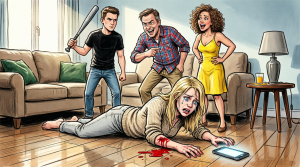
It missed my face by inches and punched into my right shoulder with a force that turned the world white. I heard a crack—not like a pop, not like something small. Like something important breaking. Pain detonated through my collarbone and down my arm, sharp and immediate, stealing my breath.
My scream came out raw, ugly, nothing like the disciplined voice I used at formation.
Dylan leaned in close, his eyes glassy and bright. “You want to act tough?” he slurred. “Act tough now.”
The screwdriver pinned me to the wall. My body shook. Blood began to run warm down my arm, soaking into my shirt.
Footsteps pounded in the hall.
Hope—stupid, desperate hope—flared in me so fast it almost hurt worse than the wound.
My father appeared first, hair messy, eyes half-lidded like he’d been dragged out of sleep. Evelyn came right behind him, silk robe tied neatly, lipstick perfect even at two in the morning as if she’d practiced how to look composed in emergencies.
“Dad,” I choked, my voice breaking. “Help me.”
Thomas stared at the screwdriver protruding from my shoulder like it was someone else’s problem. His mouth tightened in a familiar line—the one he wore when bills came in or when Evelyn cried about how hard her life was.
Evelyn tilted her head. Her gaze flicked to the blood and then back to my face, and a smirk touched her mouth like she couldn’t stop it.
“Oh, Kenya,” she cooed. “Stop being dramatic.”
Thomas exhaled, long and tired. “Dylan’s drunk,” he muttered, not to me but to Evelyn, like I wasn’t even there. “You know how he gets.”
Then they laughed.
Not hysterical laughter. Not even loud. Just a small, shared chuckle, the kind people make over a joke they’ve heard before. The sound hit me harder than the screwdriver. It told me everything: they were not shocked. They were not afraid. They were not coming to save me.
Something in my chest snapped cleanly, like a cord finally cut.
My left hand shook as I reached into my pajama pocket for my phone. My vision tunneled at the edges. Every heartbeat pushed pain through my shoulder.
Three letters. That’s all I needed.
SOS.
My thumb hit send.
The phone vibrated once—confirmation—and in that small buzz I felt something shift. The scared girl who had spent her life waiting for kindness didn’t have time anymore. In her place was a soldier who understood a different kind of battlefield.
Dylan yanked the screwdriver out with a wet jerk, and the world lurched. I slid down the wall, leaving a smear of blood on the wallpaper like a signature.
Evelyn stepped back, lips pursed as if I’d spilled something on her rug.
“See what you did?” Thomas said, voice full of irritation. “You always make everything bigger than it is.”
The room spun. My phone slipped from my fingers onto the floor. Somewhere far away, a sound began to rise—sirens, maybe, or my own pulse roaring in my ears.
The last thing I saw before the darkness took me was Evelyn’s face, calm and pleased, as if this was the ending she’d been waiting for.
Then everything went black.
Part 2
I came back to the world in fragments.
A beep. A soft hiss. The smell of antiseptic. Light so bright it felt like it was burning my eyelids.
When I opened my eyes, the ceiling wasn’t floral wallpaper. It was white tile and fluorescent panels. My throat was dry. My shoulder was wrapped in thick gauze, and my right arm sat in a sling that made the entire side of my body feel like it belonged to someone else.
A nurse noticed me stirring and moved quickly, her shoes quiet on the polished floor. “Hey there,” she said, voice gentle. “You’re in the hospital. You’re safe.”
Safe.
The word didn’t fit in my mouth. It felt like a language I used to speak and had forgotten.
A moment later, a man in plain clothes stepped into view. Detective Alvarez, his badge clipped to his belt, hair combed back too neatly for a night shift. He pulled up a chair and sat like he’d done this a hundred times, but his eyes were sharp with the kind of attention that didn’t drift.
“Kenya Mack?” he asked.
I swallowed. “Yes.”
“I’m sorry we’re meeting like this.” His tone was calm, professional, not pitying. “Do you remember what happened?”
I stared at the blanket. The image of my father’s face, the laugh, Evelyn’s voice like honey and poison—everything tried to surge up at once.
“I remember,” I said.
Detective Alvarez nodded. “We got a call at 2:03 a.m. A neighbor reported screams. At 2:04, we got an automated emergency ping from your phone with your location. At 2:06, officers arrived. Paramedics followed.”
My stomach turned. “My phone… it worked?”
“It worked,” he confirmed. “Saved your life.”
The nurse adjusted my IV, then stepped out, leaving us in a bubble of quiet.
Alvarez leaned forward slightly. “Your stepbrother, Dylan Hart, is in custody. He’s claiming it was an accident. That you ‘fell into him.’”
A bitter laugh almost escaped me, but it turned into a cough that made my shoulder throb. “He kicked my door down.”
Alvarez didn’t flinch. “Your father and stepmother are saying you overreacted. They said you’re ‘dramatic.’ Those were their words.”
My fingers curled into the blanket. “That’s what she always says.”
Alvarez studied me for a moment. “I’m going to ask you something, and you can take your time. Has there been prior violence in that home?”
My mind tried to protect itself by retreating—like it always did—into small safe corners. But in the past, those corners were where Evelyn’s voice lived. I was tired of living with her inside me.
“Yes,” I said. “Not always… like this. But yes.”
The beeping machine beside me kept time while I told him about the little things. The slow, steady erosion. The way Evelyn could humiliate me in a room full of family and make it sound like concern. The way Dylan could ruin anything I cared about and call it a joke. The way Thomas would look away, always, like if he didn’t witness it, he didn’t have to act.
As I spoke, a memory surfaced so clear it was like I was there again.
Thanksgiving, four years ago.
I was fifteen, holding an acceptance letter from the University of Texas at Austin’s summer astrophysics program like it was proof I wasn’t worthless. The house had smelled like turkey and cinnamon and other people’s confidence. I’d slid the letter across the table to my father with hands that trembled.
For one breath, he’d smiled—an actual smile—and I’d felt my whole body light up.
Then Evelyn had taken the letter and read it aloud to the room, her voice bright and fake.
“Aria has been accepted to a special support camp,” she’d said, emphasizing different like it was a punchline.
The table had erupted in laughter, the kind that makes your skin feel too tight. Dylan had laughed the loudest, like he wanted everyone to know he approved.
And my father, after the guests left, had stood in my doorway and told me I’d embarrassed Evelyn and needed to apologize.
That was the night I tore the letter into pieces and threw it away, because in our house success wasn’t celebrated. It was punished.
When I finished talking, Detective Alvarez sat back, quiet for a moment. “We have something else,” he said carefully. “That SOS you sent—it wasn’t just a text. Your phone recorded audio for several minutes afterward.”
My head snapped up. “It did?”
“It did,” Alvarez said. “We’ve secured the file. We also have officer bodycam from the scene. We’re putting everything into evidence.”
My heartbeat stumbled. Not from fear this time. From something colder.
Data is ammunition.
Ruiz’s words echoed like a steady drum.
As if she’d been summoned by the thought, my phone buzzed on the tray beside the bed, screen lit with a message.
From Ruiz: I’m on my way.
Ten minutes later, she walked into my room in civilian clothes, hair pulled back, eyes focused like she was stepping into a briefing. She didn’t hug me right away. She didn’t do pity. She did presence.
She looked at my bandaged shoulder and her jaw tightened. Then she looked at me. “You sent the signal,” she said.
I nodded, throat burning. “I did.”
“Good.” She pulled a chair close. “Now we finish it.”
Detective Alvarez stood. “Sergeant, thank you for coming. Ms. Mack is going to need support.”
Ruiz held his gaze. “She’s got it.”
When he left, Ruiz finally reached out and touched my left hand—gentle, steady. “Listen to me, Mac,” she said softly. “You’re going to feel a lot of things. Rage, grief, guilt, all of it. But none of those feelings are evidence. Evidence is what wins.”
I swallowed hard. “They laughed.”
Ruiz’s eyes flashed. “Let them. We’ll play it back.”
By noon, the Army liaison officer had visited. Paperwork started. A temporary protective order was mentioned. I signed forms with my left hand, awkward and slow.
That afternoon, the nurse helped me sit up and eat soup I could barely taste. My shoulder burned in waves, but underneath the physical pain was something else—a clarity I’d never had before.
In my head, my father’s voice tried to rise.
You’re making this bigger than it is.
I imagined Ruiz standing in front of that voice like a wall.
No, I thought. It was always this big. I just never had a witness.
Part 3
Two days later, I left the hospital with my arm in a sling and a bruise-colored exhaustion that made the world feel slightly unreal. Ruiz drove me straight to her apartment instead of back to my father’s house. She didn’t ask if I wanted to. She just did it like it was a tactical decision.
Her place smelled like chili powder and old books. Gunnar, her aging German Shepherd, pressed his head against my knee like he was taking attendance. I sat on her couch with ice packs and pain meds and listened to the quiet—real quiet, not the tense, watch-your-mouth kind.
Ruiz laid out my phone, a legal pad, and a cheap black notebook on the coffee table. “We start building a timeline,” she said. “Every incident you can remember. Dates if you have them. If not, seasons. Holidays. Anything that anchors it.”
I stared at the blank page. “I’m not sure I can—”
“You can,” Ruiz said, voice firm. “You’ve survived worse than a pen.”
So I wrote.
Thanksgiving: acceptance letter humiliation.
The “therapy” pitch Evelyn tried to sell me on during my first leave.
Finding casino demand letters in Thomas’s desk drawer.
Dylan “accidentally” destroying my things.
The uniform.
Then the 2 a.m. attack.
Each entry felt like dragging a heavy object into the light and finally seeing its shape. It was horrifying. It was also a relief.
That night, David Chen called.
Ruiz had told me about him—former JAG, now part of a nonprofit legal group that helped service members. I expected someone smooth and comforting, the way lawyers on TV talk. Chen sounded like a man who didn’t have time for anything except facts.
“Private Mack,” he said. “I’ve reviewed what Sergeant Ruiz sent. The photos. The bank records. The initial police report.”
My stomach tightened. “Is it enough?”
“It’s a start.” His voice was measured. “But you have something most people don’t. You have an emergency recording. That changes everything.”
He instructed Ruiz to bring me to his office in Austin the next morning. I barely slept, not because of nightmares—though they came—but because my mind kept replaying Evelyn’s laugh, then overlaying it with the idea of it being played back in a courtroom.
I wanted that. I wanted it like oxygen.
The drive to Austin hurt. Every bump in the road sent a jolt through my shoulder. But Ruiz drove steady, and she kept one hand on the steering wheel like she’d driven into worse places than downtown traffic.
Warriors Aegis operated out of a brick building with creaky stairs and a receptionist who offered water without asking questions. Chen’s office smelled like coffee and paper. He was smaller than I expected, in a dark suit with a crisp tie, eyes sharp as glass.
He didn’t start with sympathy. He started with strategy.
“Show me everything,” he said.
I opened my folder. The voice memo where Evelyn threatened me after I mentioned Dylan’s debt. Photos of the grease-smeared uniform in Dylan’s closet. Copies of the casino letters. Bank statements showing transfers I’d sent because Evelyn had guilted me into “helping family.”
Chen didn’t react the way people usually did when they heard my story—no gasps, no pity. He listened like a mechanic diagnosing an engine. When he finished, he set the papers down with careful precision.
“Your stepbrother committed aggravated assault,” he said. “Your stepmother and father enabled it. There’s also a pattern of coercion and financial abuse. If the prosecutor has a backbone, there may be charges beyond Dylan.”
My chest tightened. “My dad—”
Chen held up a hand. “Your father is not the main character of your life. The law doesn’t care about his feelings. It cares about actions.”
Ruiz’s mouth twitched, like she approved.
Chen leaned back. “We’re going to do two things. One, cooperate fully with law enforcement. Two, we’re going to control the civil side. Property. Assets. Any inheritance or equity they’ve tried to use as leverage.”
I blinked. “They want the house. They want anything I have.”
“Then we make it expensive,” Chen said.
He outlined a plan that made my stomach flip: bait them into a meeting under the pretense I was finally “coming around.” Let them think I’d sign documents to help with Dylan’s debt. Get them into a controlled room—with a police officer present, with a neutral witness, with everything recorded.
“A trap,” I whispered.
“A lawful one,” Chen corrected. “Your stepmother thinks she’s smarter than everyone. People like her love paperwork because they think it’s a weapon. We’re going to turn it into a mirror.”
Ruiz watched me carefully. “You don’t have to do this,” she said quietly. “We can go straight to charges and court.”
I thought of Evelyn’s laugh. Of my father’s sigh. Of Dylan’s grin.
“Yes,” I said. “I want them to sit across from me and realize they can’t rewrite reality anymore.”
Chen slid a legal pad toward me. “Then you call her.”
My hands were steady, which surprised me. In a quiet part of my brain, I recognized the feeling: the calm that comes right before action, the same calm I’d felt on the rope at basic training when the voices from home tried to pull me down and I climbed anyway.
I dialed Evelyn.
She answered on the second ring. “What do you want, Kenya?”
I forced my voice to shake. “Mom,” I said, tasting poison on the word. “I’ve been thinking. I… I was wrong. Family is everything, right?”
There was a pause—short, but I could almost hear her greed waking up.
“That’s right,” she said, voice suddenly warm. “I knew you’d come to your senses.”
“I’ll sign,” I whispered. “I’ll help with Dylan’s debt. I’ll do what it takes.”
Evelyn exhaled like she’d been holding her breath for months. “Good girl,” she murmured. “Your father will be so relieved.”
I swallowed. “My military advisor says we have to do it at a lawyer’s office in Austin. It’s… procedure.”
“Of course,” she said quickly. Too quickly. “Whatever you need.”
When I hung up, the room felt oddly quiet, like the air had shifted.