“Maya… what happened?”
She looked up slowly.
For a second, I didn’t know if she had recognized me or if I was simply too tired to react. His eyes fell on me with a strange mixture of surprise and resignation, as if seeing me there was one more cruelty of fate, one of those that make no noise, but end up breaking what little is left.
Her lips barely moved.
—Arjun…
Hearing my name in his voice disarmed me.
It didn’t sound like a reproach. Not even as a relief. It sounded like an old string about to break.
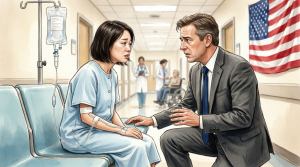
I moved closer and crouched in front of her. His wrist was marked by the IV tape. His skin was so thin that you could almost see the blue of the veins. Her short, uneven hair showed a small scar near her temple. I knew, before anyone told me anything, that whatever was going on was much more serious than I could imagine.
“What are you doing here alone?” I asked, my voice trembling. Why didn’t you tell me anything?
Maya lowered her gaze.
“You didn’t have to know.
That answer hit me harder than I expected.
Because he was right.
I had given up being the man who asked, the man who stayed, the man who had the right to know.
“Where is your family?” I insisted.
She was slow to respond.
“My aunt came the first week. Then he stopped being able to come. He lives far away. The others… they are busy.
I wanted to say something, but at that moment a nurse appeared with a folder in her hand. He looked at us, alternating his gaze between Maya and me.
“Are you a relative?”
I opened my mouth, but nothing came out.
Exesposo.
What a useless word in a hospital corridor.
Maya answered for me.
“No. Just… someone I know.
The nurse nodded, no doubt accustomed to relationships much more broken than ours.
“Mrs. Maya, in a while they are going to take it up again for more studies. It should not stand up on its own.
The nurse walked away.
I still didn’t move.
“Maya,” I said at last, “please tell me the truth.
She closed her eyes.
And then something happened that I didn’t expect: he didn’t start explaining anything to me. He just reached under the light sheet that covered his legs and pulled out a beige folder, folded in a corner. He held it for a few seconds, as if the weight of those papers were too much for his fingers, and then handed it to me.
I opened it.
The first thing I saw was the hospital’s headline and a word that took my breath away:
Oncology.
I kept reading.
Leukemia.
Advanced phase.
Treatment started months ago.
My vision blurred.
I read again, convinced that I had misunderstood. My eyes moved over the letters, but my mind refused to accept what I was seeing. Part of me expected to find some error, another name, a provisional diagnosis, anything that would undo that horror.
But no.
It was his name.
It was his age.
It was his illness.
And the dates…
The dates destroyed me.
Maya had started with medical tests before I uttered the word divorce.
The first studies coincided with those weeks when she was quieter, more distant, more absent. I had thought it was sadness. Or resentment. Or the natural wear and tear of a relationship broken by the loss of two pregnancies.
I hadn’t wanted to see that it was fear.
A fear that carried his blood inside.
“No,” I murmured, unable to look up from the paper. It can’t be.
“Yes, you can,” she said, very quietly. You saw that it did.
I felt my stomach twist. The hallway, the people, the smell of disinfectant, everything became distant, as if I had been locked inside a glass bell.
“How long did you know?”
“Not entirely at first. They just knew something wasn’t right. Then the analyses began, the marrow, the more specific studies… and finally they confirmed it to me.
I looked at her.
“And you didn’t tell me anything?”
For the first time, his eyes hardened a little. Not with open rage. With that silent pain that had always been more hers than tears.
“When, Arjun?” he asked. When you were late and said you were tired? When you stared at your cell phone so you wouldn’t look at me? Or the night you asked me for a divorce and had already decided that my sadness was too much weight for your life?
Every word was fair.
Not exaggerated. Not cruel.
Fair.
I didn’t know what to answer.
Because the truth was there, naked between the two of us: I had ceased to be a refuge for her long before she signed the papers. At some point, as she carried the grief for our unborn children and the fear of something dark growing inside her body, I became yet another absence.
“I didn’t want you to stay out of pity,” he continued. It was humiliating enough to feel like I was losing you without being able to hold on to myself. When I learned the diagnosis… I understood that if I told you something, I would never know if you were coming back out of love or compassion.
I felt an excruciating burning behind my eyes.
—Maya, yo…
But there was no sentence that could repair that.
Not in a hospital.
Not in front of an oncology folder.
Not two months late.
I plopped down in the plastic chair next to his. I covered my face with both hands and stood there, breathing heavily, while a wave of guilt rose inside me so great that I almost broke in two.
It wasn’t just that she was sick.
It was that she had gone through all this alone.
Consultations. Fear. Hair falling out. The needles. Vomiting. The nights. Medical consents. The trembling signature on sheets that no one should sign without a familiar hand by their side.
Alone.
And I, meanwhile, had dedicated myself to surviving in a cowardly way, calling freedom the emptiness that I myself had created.
When I raised my head, Maya was looking down the hallway, as if she no longer had the strength to even watch me fall apart.
“Why are you in this hallway?” I asked, trying to understand something specific so as not to drown completely. Shouldn’t you be in a room?
It took her a while.
—I was discharged temporarily three days ago. But last night I had a fever again. I came alone to the emergency room. They are waiting for a bed.
“Alone?”
He nodded.
I stood up suddenly.
“No. Not anymore.
I went to the nurse’s desk, spoke to the first person I met, asked, insisted, signed what was put in front of me, paid a deposit that I didn’t even know if I was supposed to pay. I didn’t care. I just wanted to get her out of that corner of the hallway, that impersonal corner where she seemed like one more shadow among too many shadows.
One resident explained to me that the hospital was overcrowded, but that they would do their best to move her to a less crowded area soon. I went back to Maya.
She looked at me wearily.
“You don’t have to do all that.
“Yes, it is necessary.
—Arjun…
“Don’t ask me to leave.”
For the first time all morning, something trembled in his expression. Not exactly tenderness. Not yet. It was rather the bewilderment of someone who had already become accustomed to not expecting anything.
“I didn’t come out of obligation,” I said, as if I needed to tell myself, too. I came because I saw you and understood, too late, the magnitude of what I did.
She closed her eyes.
“Don’t say things that are only born of guilt.
“It’s not just fault,” I replied. It’s horror. It’s shame. It is… knowing that while you were falling, I was taking care not to feel uncomfortable.
Maya pursed her lips.
And then he asked, with a softness that hurt more than a scream:
“Can you look at me now?”
I couldn’t take it anymore.
I knelt by his chair in the middle of that corridor full of unknown people and rested my forehead against his cold hands. I didn’t care who saw us. I didn’t mind making a fool of myself. I didn’t care about pride.
I cried.
I cried with that kind of awkward cry that comes out when you no longer have a way to defend yourself. I cried for the abortions, for the small fights, for the silent dinners, for the day I chose my tiredness over their pain. I cried for all the signs I didn’t want to see because it would have been too demanding to love well.
Maya didn’t push me away.
He didn’t comfort me either.
He just let my shame finish sinking me.
Hours later they managed to move her to a small shared room. I managed to talk to the haematologist on duty. He explained to me the basics, the urgent, what had already been done and what was missing. I heard words I never thought I would learn: remission, relapse, marrow, compatibility, neutropenia, risk of infection, cycles, guarded prognosis.
Each term was a stone.
I asked about their payments, their treatment, their companions. I found out that she had sold almost all of her jewelry, used her savings, tutored online while she could, and even hid several symptoms so as not to miss important appointments. The doctor, a young woman with deep dark circles, looked at me with the calm harshness of someone who has seen too many similar stories.
“Patients alone learn to minimize themselves very quickly,” she said. They ask for forgiveness even for needing help.
I felt a spear pierce me.
That first day I didn’t leave.
I called work and lied saying it was a family emergency. Perhaps for the first time in months, the lie seemed to me like a small version of too big a truth: yes, it was an emergency. The most devastating of my life. I went to a pharmacy, bought what was missing, spoke with a social worker, called her aunt, organized the immediate.
At dusk, Maya was asleep due to the effect of the medications. I saw her breathing with slight difficulty, her face buried in the hospital pillow, so fragile that it was difficult for me to reconcile that image with the woman who years ago laughed in the kitchen while we tried to cook together on Sundays.
On his nightstand was a blue notebook.
I wasn’t going to touch her. I really didn’t plan to. But a leaf peeked out between the pages, and when I adjusted the glass of water it fell to the floor.
I bent down and picked it up.
It was a list.
At the top it said: “Things I must not forget if I get worse.”
The lyrics were Maya’s. Small. Orderly.
I read the first thing:
“Do not call Arjun. He has already made his life.”
I felt my heart stop.
Below were other notes. Hospital numbers. Medication name. Password to an email account. And at the end, a line that completely knocked me down:
“If the worst happens, someone should tell him that I never blamed him for not knowing how to love me when I didn’t know how to ask him to save me.”
I had to sit down.
The whole world became unbearable inside that small room.
Not because she was dying—though that possibility was already haunting me like a shadow—but because even in her grief she had been compassionate to me.
I didn’t deserve that mercy.
The next morning, when he woke up, he found me in the chair next to his bed, disheveled, wearing the same clothes as the day before and a cup of cold coffee in my hands.
He looked at me for a few seconds.
“You didn’t leave.
I denied.
“No.
There was a long silence.
Then she asked:
“Why?”
I looked at her.
And this time I didn’t respond with big sentences, because I had already understood that words can come too late and still pretend too much.
I told him the only clean truth I had left:
“Because I finally saw what was in front of me all this time. And even though I don’t have the right to call me your husband anymore… I don’t want to go back to being the man who leaves you alone in a hallway.
Maya didn’t smile.
But her eyes, for the first time since I saw her, ceased to seem completely empty.
And at that moment I knew that the truth that had collapsed in that hospital was not only the disease.
It was discovering that I had lost the woman who gave me the most peace in life long before the divorce… and that, if there was still a minimal possibility of redeeming something, it would not be with promises of love or with belated guilt.
It would be staying.
Day after day.
Even if she would never be mine again.
Even if forgiveness did not come.
Even if the ending was not what I wanted.
Because sometimes you don’t break down when you discover that the person you loved is sick.
Sometimes she collapses when she finally understands how deeply he had left her alone.