My grandfather flew six hours to attend my brother’s wedding—but my parents sat him behind the trash cans. My mother hissed, ‘That old beggar will embarrass us.’ When I spoke up, she slapped me and threw me out. 20 minutes later, his private jet landed.
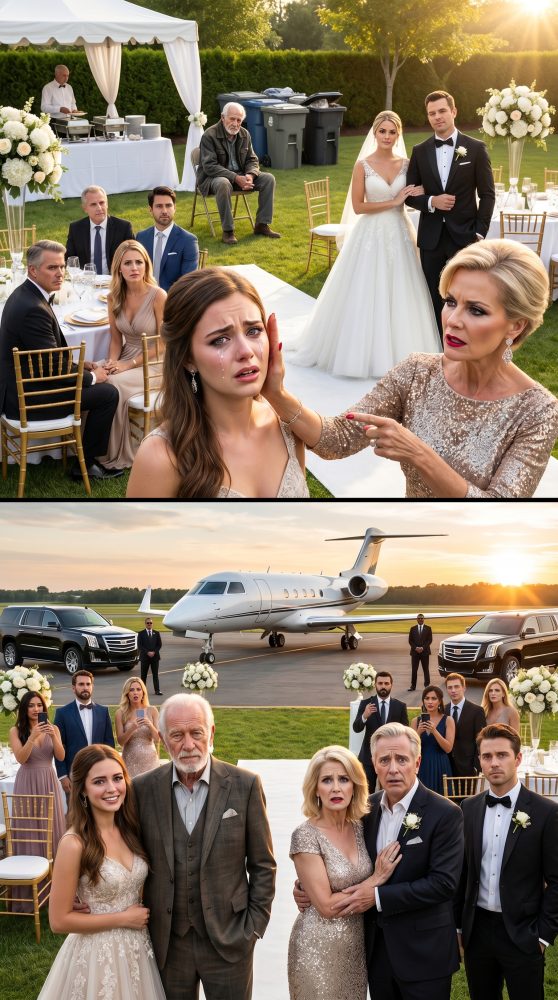
My mother slapped me so hard my earring tore free, and the sound cracked across the wedding lawn louder than the violin quartet. Before the sting even settled, she pointed to the gate and said, “Get out if you want to defend that old beggar.”
The guests pretended not to stare. Crystal glasses glittered under the afternoon sun. White roses climbed the gold archway. My brother Daniel stood near the altar in his custom tuxedo, jaw tight, saying nothing while my grandfather sat alone behind two green catering bins that smelled like spoiled fruit and champagne dregs.
Six hours. That was how far he had flown to be here.
He had arrived in a dark wool coat, carrying the same scuffed leather bag he always used, the one my mother hated because it looked “cheap.” He hugged me first, gently, like I was still ten and coming home bruised from school. “You look strong,” he said. “That matters more than pretty.”
Then my mother swept in, diamonds blazing at her throat. “Not there,” she snapped when he moved toward the family section. “We don’t need the bride’s family asking questions.”
Grandfather had blinked once. “Questions about what, Elena?”
“About why Daniel’s grandfather looks homeless.”
I had heard cruel things from her before. But that landed like a knife. My grandfather was seventy-eight. His shoes were old because he liked them old. His watch was plain because he hated showing off. He lived quietly, spoke softly, and never once in my life asked anyone for anything.
Still, the wedding planner obeyed my mother. A server dragged a folding chair across the gravel path and placed it near the service lane, half-hidden behind the floral waste and stacked cardboard. Like he was something to be concealed until photographs were done.
“Mom,” I said, “that is disgusting.”
Her smile never moved. “Then sit with him.”
So I did.
For ten minutes, I sat beside him behind the trash cans while expensive guests floated past with shrimp towers and laughter. Daniel looked over once, then away. My father adjusted his cuff links and avoided us completely. My future sister-in-law, Vanessa, whispered something into Daniel’s ear, and they both smirked.
Grandfather rested his hands on the cane across his knees. “You don’t need to burn for me, Mira.”
“I’m already burning.”
His eyes moved toward the sky, calm and unreadable. “Good. Fire has its uses.”
That was when my mother marched over, furious that I was ruining the image. Her perfume hit before her words did. “You always do this,” she hissed. “You always choose embarrassment.”
“He is your father-in-law.”
“He is a stain.”
I stood. “No. He’s the only decent person in this family.”
Her hand flew before I finished. The slap snapped my head sideways. Gasps rose nearby. Then my father grabbed my elbow, hard enough to bruise, and shoved me toward the exit path. “Leave. Now. Don’t come back and ruin your brother’s day.”
I stumbled, caught myself, and turned. Grandfather had not moved. But there was something different in his face now, some ancient stillness that chilled me more than shouting ever could.
Then he reached into his old leather bag, took out a phone I had never seen before, and made one quiet call.
“Bring it in,” he said.
Only that.
At first, nobody noticed.
The quartet resumed. Guests relaxed. My mother smoothed her silk dress and smiled the brittle smile she used after violence, as if cruelty were merely another detail she had arranged correctly. Daniel took Vanessa’s hand. The officiant cleared his throat. The wedding moved on, convinced it had crushed the only dissent.
I stood outside the main seating area near the iron gates, cheek throbbing, fury sharpening every breath. One of the valets glanced at me with pity. Another looked past me and suddenly straightened.
A distant roar rolled across the sky.
Not thunder. Engines.
The guests lifted their heads one by one. Glasses paused midway to painted mouths. Even the violinists faltered. Above the far line of trees, a sleek white jet circled low, sunlight flashing across its body like a blade.
Daniel frowned. “What the hell is that?”
Vanessa laughed nervously. “Probably some rich idiot trying to show off.”
Then Grandfather stood.
Not slowly. Not shakily. He rose with the effortless authority of a man who had spent his life being obeyed. The cane was no support at all; it was posture, old habit, maybe theater. He stepped away from the trash bins, and for the first time that day, people actually looked at him.
A black convoy entered through the service road: three luxury SUVs, polished like mirrors. Security men stepped out first, all tailored suits and earpieces, moving with trained precision. One came straight to my grandfather and bowed his head.
“Sir. We’re ready.”
My mother’s face drained of color. “Sir?”
Grandfather ignored her. He looked at me instead. “Mira, come stand with me.”
So I did.
The wedding planner, trembling now, hurried over with a stack of seating charts. “I’m so sorry, there must have been a misunderstanding—”
“There was,” Grandfather said. “You mistook kindness for weakness.”
My father recovered first, because greed always gave him courage. He forced a laugh and strode forward with both hands open. “Arthur, come on. Let’s not be dramatic on Daniel’s wedding day.”
Arthur.
He only used Grandfather’s first name when he wanted money.
Grandfather’s gaze cut through him. “You already made it dramatic when you fed your father’s father to the flies.”
A murmur spread through the guests. Vanessa’s mother whispered to someone. A businessman from the front row suddenly stared very hard at my grandfather, then at the jet, then back again. Recognition moved through the crowd like an electric current.
Of course. They knew the name.
Arthur Vale.
Founder of Vale Aeronautics. Investor in defense logistics, medical transport, and half the redevelopment projects along the coast. The man whose companies employed thousands, whose philanthropy funded hospitals, whose interviews were so rare people argued over his age online because no one could pin him down. He had vanished from the public eye after my grandmother died and let everyone assume he was retired, diminished, irrelevant.
My family knew exactly who he was.
That was the filthiest part.
They had spent years pretending he was poor because he dressed modestly and refused to bankroll their vanity. They mocked his coat, his house, his old car. They told relatives he was “confused” and “living off savings.” They hid him from useful people and dragged him out only when they wanted signatures, introductions, donations. When he refused, they called him stingy.
“You told people he needed help,” I said, looking at my parents.
Mother snapped, “He likes playing poor!”
Grandfather smiled without warmth. “No, Elena. I like knowing who worships money.”
Then one of the security men handed him a folder.
He gave it to me.
Inside were copies of bank transfers, emails, and a draft contract. My father’s company letterhead. Daniel’s name. Vanessa’s family trust. My mother’s messages. They had been negotiating behind Grandfather’s back for weeks, telling the bride’s family that Arthur Vale would announce a major investment partnership during the reception. They had used his name, his reputation, and even forged language suggesting his support.
Daniel’s mouth opened. “That was Dad’s idea.”
My father rounded on him. “Shut up.”
Grandfather’s eyes turned to ice. “Wrong answer. All of you targeted the wrong person.”
The ceremony never happened.
It unraveled in public, the way rotten silk tears all at once.
Grandfather nodded to one of his attorneys, a woman in navy who had arrived with the convoy and now stepped forward holding a slim tablet. “Since my family enjoys spectacle,” he said, voice carrying clearly across the lawn, “let us have truth.”
She read calmly.
Cease-and-desist notices had already been filed that morning against my father’s company for fraudulent use of Arthur Vale’s name and image in private investment discussions. A complaint for attempted inducement under false representation was ready to be submitted. The venue contract, paid through a holding company tied to my father, was in breach because the event had misrepresented sponsorship and insurance coverage. The bank financing Daniel had quietly secured for his “luxury hospitality venture” depended on Arthur’s supposed backing; once withdrawn, the loan would collapse by sunset.
Vanessa stepped backward as if the grass had turned to fire. “Daniel… you told me your grandfather approved everything.”
Daniel’s face went waxy. “He was supposed to. Eventually.”
My mother lunged toward Grandfather. “You would destroy your own family over a seating mistake?”
“No,” he said. “Over character.”
She looked around wildly, searching for sympathy, but the guests had shifted. Wealthy donors, city officials, business owners, all suddenly very interested in distance. Nobody wanted to be photographed beside liars who publicly humiliated the man they had spent years trying to court.
My father tried the old trick then: rage. “You can’t prove intent.”
The attorney turned the tablet and played an audio file.
My mother’s voice came through crisp and merciless from a planning call three nights earlier. Seat him out of sight. Arthur always dresses like a scavenger, and once the papers are signed, he can sulk all he wants. Daniel just needs one photo with him if the investors ask.
Silence dropped like an ax.
Vanessa stared at Daniel as if seeing a stranger. “You used your own grandfather as bait?”
He reached for her. She recoiled.
Then came the final cut.
Grandfather looked at me. “Would you like to do it?”
I understood at once. For years I had worked quietly in his legal foundation, helping audit family grant requests because he trusted my judgment and said I noticed patterns others missed. Two months earlier, I had flagged irregularities in charitable funds routed through shell vendors connected to my father’s company. We had waited, watched, gathered. Today had not created their downfall. It had merely chosen the stage.
So I faced the crowd, my family, and the bride’s horrified relatives.
“My father diverted nonprofit funds into event consulting accounts,” I said. “My mother approved invoices. Daniel signed one of the authorizations. We have the paper trail. Investigators were being notified tomorrow. Grandfather suggested waiting to see whether any of them still had a conscience.”
I touched my swollen cheek. “Now we know.”
Security stopped my father when he tried to rush me. Venue staff, suddenly efficient, asked the guests to step back. Vanessa removed her engagement ring with fingers that did not shake at all and placed it in Daniel’s palm.
“You deserve each other,” she told my parents, then walked out beneath the flower arch they had worshipped all day.
My mother finally broke. “Mira, please. Tell him not to do this.”
I looked at the woman who had slapped me for defending an old man she had mistaken for disposable. “I’m not doing anything,” I said. “I’m just not saving you.”
Three months later, the photographs from that day had vanished from society pages, replaced by court notices, bankruptcy filings, and one quietly savage article about reputations built on borrowed names. My father lost the company. My mother lost every committee seat she had clawed her way onto. Daniel lost Vanessa, the loan, and the last illusion that charm could outtalk evidence.
I moved into the coastal house with Grandfather for a while, where the mornings smelled like salt and cedar instead of perfume and lies. He taught me how to fly in one of his smaller planes. The first time we lifted through cloud into clean blue light, he glanced at me and smiled.
“Still burning?” he asked.
I looked down at the shrinking world below and felt, for the first time in years, something better than anger.
“No,” I said. “Just free.”

