PART 1
The night before my wedding, my mother left me a voicemail at exactly 11:43 p.m.
I remember the time because I was sitting cross legged on the couch in my apartment, wearing an oversized gray T shirt and staring at my phone as if it might suddenly offer me a different version of my life if I stared long enough.
The place smelled faintly of hairspray from my trial earlier that afternoon, mixed with lemon dish soap because I had already cleaned the kitchen twice to quiet the storm inside my chest. My veil hung over the back of a chair, my heels waited by the door like obedient witnesses, and a half packed tote sat on the floor filled with safety pins, tissues, lipstick, and the marriage license I kept checking every twenty minutes as if it might disappear.
Then the voicemail played.
“Claire, it is not too late to cancel. Do not embarrass this family like this.”
Click.
No greeting. No softness. No trace of love. Just the same clean, precise disapproval my mother had delivered my entire life, as if honesty were a weapon she believed she wielded generously.
I played it three times because my brain refused to accept that a mother could make her daughter’s wedding eve sound like a professional scandal.
Four minutes later, the front door opened.
Elliot stepped inside with the quiet heaviness of someone who had just finished a long hospital shift. His jacket carried the cold damp smell of outside air, and something faintly clinical clung to him in a way I had learned to associate with his job without ever fully understanding it.
He took one look at my face.
“What happened?” he asked.
I handed him my phone without a word.
He listened once, expression unreadable, then handed it back.
“We can call it,” he said calmly. “We go to City Hall on Monday. Just us. No audience for this.”
For a moment, I wanted that more than anything.
Not because I doubted him, but because I was exhausted from bleeding in front of people who treated it like entertainment.
But then something inside me straightened.
“No,” I said. “I want the wedding.”
He leaned against the counter and watched me carefully, giving me space the way he always did.
“I want them to know what they chose,” I added.
He nodded once. “Then we do it your way.”
By then, I already knew none of them were coming.
Sixty eight invitations had gone out to my side. Parents. My brother Jason. Aunts, uncles, cousins, colleagues, and the extended network of people who had watched me grow up and judged me quietly along the way.
Not one RSVP came back yes.
I had called the caterer two weeks earlier from my car outside a pharmacy, crying so hard my voice barely worked as I canceled sixty eight meals.
On the wedding day, I got dressed alone.
The bridal suite at the conservatory venue smelled like flowers and hot curling irons. A large mirror stood against the wall, reflecting a version of me that looked composed if I did not think too hard.
The coordinator, a kind woman named Melissa, zipped my dress carefully.
“You look beautiful,” she said gently.
I nodded because it was easier than speaking.
I had told her not to rearrange the seating.
Thirty four empty chairs would remain exactly where they were.
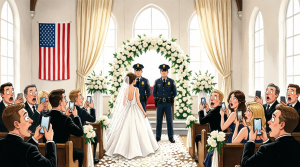
At 4:02 p.m., the doors opened and the string quartet began to play.
I stepped forward and saw it immediately.
The left side of the aisle was completely empty. White chairs decorated with ribbons sat untouched, catching the afternoon light like a quiet accusation.
The right side was full. Elliot’s family filled every seat, warm and present, his mother already crying openly, his father sitting upright with emotion carved across his face.
And at the end of the aisle, Elliot stood waiting.
When he saw me, his expression shifted, something raw moving through it.
I started walking.
Each step echoed louder than it should have. The empty chairs felt like eyes. The silence pressed in.
Still, I kept going.
At the altar, he took my hands, steadying them without making a show of it.
His vows were simple.
“I cannot promise easy days or perfect timing,” he said quietly. “But I can promise you that everything I have is yours. I see you, Claire. I have always seen you.”
When it was my turn, I forgot everything I had planned.
“You are enough,” I said. “You have always been enough, and I choose you every day.”
We kissed.
Everyone on his side stood and applauded.
No one stood on mine.
For one brief moment, it did not matter.
At the reception, it did.
An entire table sat untouched, place cards perfectly arranged for people who had chosen not to come.
At 7:23 p.m., everything changed.
A man near the dessert table collapsed suddenly, hitting the floor with a sound that cut through the music like glass breaking.
Panic spread instantly.
Elliot moved before anyone else.
He dropped beside the man, voice sharp and controlled.
“Call 911 now. Male, early sixties, possible cardiac arrest.”
A woman nearby rushed forward.
“Doctor Hayes, I have an AED in my car.”
Doctor.
The word hit me like a physical blow.
Another man joined him.
“Want compressions?”
“Yes. Two inches deep, keep pace, switch every two minutes.”
The room moved around him, following his instructions without hesitation.
When EMTs arrived, one of them said, “Dr. Hayes, we’ve got it from here.”
Doctor.
My husband.
I stood there holding my bouquet, realizing with sudden clarity that I did not actually know who the man I had just married really was.
PART 2
If you want to understand why that single word shattered something inside me at my own wedding, then you have to go back to a night fourteen months earlier in a hospital waiting room that smelled like fluorescent lights and exhaustion.
It was 2:17 in the morning at Jefferson Medical Center, and I had been sitting in a row of hard green chairs long enough for my legs to go numb and my patience to dissolve into something thin and sharp. My roommate, Lauren, was behind the double doors after a bike accident, and even though they told me twice she would be fine, hospitals had a way of stretching fear into something that ignored logic completely.
I was staring at my phone without reading anything when a pair of worn black boots stopped in front of me.
“You have been here a while,” a man said. “Have you eaten anything yet?”
I looked up and saw him for the first time.
Dark hair, tired eyes, security uniform, and a presence that felt grounded in a way that did not match the chaos around us.
“No,” I said. “The vending machines are broken.”
He glanced toward them like they had personally offended him.
“Stay here,” he said.
I almost laughed because it sounded absurd, but I did not move anyway.
He came back six minutes later with a sandwich and a cup of coffee.
“I borrowed from the staff room,” he said simply.
The sandwich was cold in the middle, the coffee tasted burnt, and somehow it was the best thing I had experienced all night.
“Thank you,” I said. “You did not have to do that.”
He shrugged like it was nothing.
“You looked like you needed it.”
We talked for a few minutes, nothing dramatic or romantic, just a quiet pocket of calm in a place built for emergencies.
He told me his name was Elliot Hayes, that he worked nights handling operations and safety issues, and that he preferred nights because that was when things actually mattered. I told him about Lauren and my job in publishing, and he listened in a way that made me feel like my words were not just filling space.
At one point, a nurse walked past and started to say, “Doctor,” before catching herself and correcting mid sentence.
He did not react, but I noticed.
I filed it away and ignored it.
Three days later, he found me online.
I still do not know how.
His message was simple.
“Hope your friend is okay. If she is, would you like to get coffee sometime?”
I stared at my phone, feeling something unexpected spark to life.
Lauren leaned into my doorway with her wrist in a brace.
“Is that the hospital guy?” she asked.
“Apparently also an internet detective,” I said.
“Say yes,” she told me.
So I did.
Our first date was at a crowded food market on a rainy afternoon, and he was already there when I arrived, standing with his hands in his pockets like he had been waiting without impatience. We ate, we talked, and several times his phone buzzed with messages that he answered quickly in clipped, technical language that did not feel like casual texting.
“What kind of security job is that?” I asked once.
“The kind that keeps things running,” he said with a small smile.
It was an answer, but not really.
I let it go.
That became a pattern.
Over the next months, we fell into something steady and quiet, built from small moments instead of grand declarations. He showed me parts of the city that felt lived in rather than curated, and he listened more than he spoke. He disappeared sometimes with short explanations, always calm, never dramatic.
“I have to go,” he would say, already reaching for his jacket.
“Work?” I would ask.
“Yeah.”
And then he would be gone.
At his apartment, I found medical textbooks stacked beside the couch, heavy and filled with notes.
“You read these?” I asked once, holding one up.
“I like understanding how things work,” he said.
“That is not a real answer.”
“It is the one you are getting.”
He said it lightly, and I laughed, even though a question lingered beneath it.
When I told my parents about him, the reaction came exactly as expected.
“What does he do?” my mother asked.
“He works in hospital security,” I said.
There was a pause long enough to say everything.
“I see,” she replied.
They invited us to dinner anyway.
The house I grew up in was immaculate and suffocating in its perfection, and Elliot stood there holding a bottle of wine like he belonged nowhere near the expectations waiting inside.
At dinner, my parents spoke about academic achievements and social circles, carefully steering conversation toward status without naming it directly.
Then a neighbor mentioned her son’s ongoing medical issue.
Elliot set down his fork.
“Has anyone checked for vestibular neuritis?” he asked.
The table went silent.
“How would you know that?” my mother asked.
“I work in a hospital,” he said.
That answer satisfied no one, least of all her.
The tension grew from there, subtle but unmistakable, building in quiet comments and calculated politeness.
Two weeks later, my father sent a letter.
Four pages.
Carefully written, devastatingly precise, describing my relationship as a mistake.
That same week, I heard Elliot on the phone at two in the morning saying, “If oxygen drops below eighty eight, intubate immediately. I will be there in twelve.”
Security guards did not talk like that.
I knew it.
I chose not to ask.
Months later, I picked him up from work and saw him walk out wearing scrubs.
A nurse called after him.
“Doctor Hayes, the family in Bay Three wants to thank you.”
He did not stop.
“She is new,” he said when I asked.
“And confused.”
I let it go again.
Because loving him felt easier than questioning him.
Then came the wedding invitations.
Then came my family’s refusal.
Then came the empty chairs.
And now, standing in my own reception hall, watching strangers call my husband doctor, I realized that every small unanswered question had been leading here.
At 8:10 p.m., after everything settled, he came back from the hospital.
“Is the man okay?” I asked.
“He is alive,” Elliot said.
Then I asked the question that had been waiting for over a year.
“Why were they calling you doctor?”
He looked at me for a long moment before answering.
“Because I am one.”
The world shifted.
“I am a trauma surgeon,” he continued quietly. “Chief of trauma surgery.”
I leaned against the wall because my body needed something solid.
“You let me believe you were security,” I said.
“I did not lie about working in operations,” he replied. “I just did not tell you everything.”
“That is not the same thing.”
“I know.”
“Why?” I asked.
He hesitated, then answered honestly.
“Because when I met you, you saw me as just a person, not a title. I did not want to lose that.”
I was angry.
I was also painfully aware of what he meant.
“My parents would have loved you for all the wrong reasons,” I said.
“I know,” he answered.
“I am still angry.”
“You should be.”
We went home that night with more truth than we knew how to hold.
The next morning, the world found out too.
PART 3
The next morning, everything that had been private between us became public in a way neither of us could control or undo.
I woke up to my phone vibrating violently against the nightstand, the sound sharp and insistent enough to pull me out of sleep before my mind could prepare for what waited on the other side of the screen. When I finally unlocked it, I saw dozens of missed calls, unread messages, and notifications stacking over each other like a system failure that refused to stabilize.
“Something is wrong,” I said, my voice still thick with sleep and confusion.
Elliot was already awake beside me, propped on one elbow with that same alert stillness he carried into emergencies, and he reached for my phone with quiet caution as if he already understood the scale of what we were about to see.
A video had been posted less than twelve hours earlier.
It was short, shaky, and filmed vertically, capturing the exact moment he dropped to his knees beside the man at our reception while guests shouted and moved around him in confusion. The audio caught fragments of voices calling him doctor, the flash of the AED, and the calm authority in his instructions that cut through panic like a blade.
The caption read, “The groom at my friend’s wedding just saved my dad’s life and everyone kept calling him doctor, who is he?”
By the time we watched it, the video had already spread far beyond the original post.
Comments flooded in faster than I could read them, and each one added another layer to a version of my husband I had only begun to understand hours earlier.
“That is Elliot Hayes,” someone wrote. “He saved my brother after a highway accident last year.”
Another comment appeared beneath it. “I trained under him during residency and he is one of the best trauma surgeons in the country.”
Then another. “He developed the emergency response sequence half of us use now, this man is a legend.”
I felt my chest tighten with every line.
Elliot took his phone and opened his own messages, his expression tightening in a way I had never seen before.
“This is going to get worse before it settles,” he said quietly.
He was right.
By mid morning, a formal statement had been released by the hospital confirming his role as Chief of Trauma Surgery and director of a regional trauma network, and from that point forward, the story no longer belonged to us.
It belonged to everyone.
News outlets picked it up. Social media amplified it. Old patients shared stories and photos, describing moments when he had saved their lives or guided their families through impossible nights. Nurses wrote long posts about his discipline and his relentless standards. Former residents described him as brilliant, demanding, and deeply committed in ways that shaped their entire careers.
I sat at the kitchen table and read until my eyes burned.
“I should be proud,” I said finally, my voice trembling despite my effort to steady it. “I am proud, but I feel like I am the last person who knew.”
Elliot stood across from me, hands resting against the counter as if grounding himself in something solid.
“I never meant to make you feel outside of my life,” he said.
“I know,” I answered, because I did know, even if that truth did not soften the impact.
That same afternoon, my mother started calling.
Then my father.
Then my brother.
Their messages came in waves, each one layered with urgency, apology, or attempts to reconnect, but the timing made everything feel hollow in a way that stripped their words of meaning.
My brother sent a message that read, “I did not know, I swear, I am sorry.”
I stared at it without responding.
Because suddenly the problem was not what they knew or did not know.
It was what they had chosen when they believed he was ordinary.
The situation escalated further when someone leaked my mother’s original email refusing to attend the wedding, and within hours, it spread just as widely as the video that made Elliot famous.
Now the world had both sides of the story.
The man dismissed as beneath the family, and the truth of who he actually was.
Strangers dissected my parents’ words online, quoting them, criticizing them, and turning their private judgment into public condemnation. My mother’s professional circles began to fracture under the pressure of attention, and my father’s colleagues reacted with the quiet cruelty of academic environments that pretended to be civilized while feeding on reputational damage.
I turned my phone face down on the table.
“I cannot do this,” I said.
“You do not have to,” Elliot replied.
So we left.
We drove north without telling anyone, escaping to a quiet cabin owned by one of his colleagues, where the air smelled like pine and the silence felt so complete that it took two days for my body to stop expecting noise.
For those two days, we lived simply.
We cooked, walked, and sat in front of a small wood stove while the world outside continued without us. The distance allowed everything to settle enough for the real questions to surface.
On the third day, I finally asked one.
“Why did you not trust me with the truth?”
He sat across from me, holding a mug of coffee between his hands as if it anchored him to the moment.
“I trusted you with everything that mattered emotionally,” he said. “I did not trust the world that came with my title not to change what we had.”
“That is still a choice you made for both of us,” I replied.
He nodded slowly.
“Yes, and I was wrong to make it alone.”
That answer did not fix anything, but it removed the need to argue.
“I am still angry,” I said.
“I know,” he answered.
“And I still love you,” I added after a long pause.
His expression softened in a way that made the silence between us feel less fragile.
“I know that too,” he said quietly.
When we returned to the city, reality waited for us.
My mother’s life had shifted under the weight of public scrutiny, and when she called again, her voice no longer carried the sharp confidence I had grown up with.
“Your father collapsed,” she said one afternoon, her words breaking apart under pressure. “They are taking him to the hospital, please come.”
Everything in me reacted instantly.
Elliot did not hesitate.
“We are going,” he said, already reaching for his keys.
At the hospital, my mother looked smaller than I had ever seen her, her composure replaced by something raw and unguarded. When a nurse informed us that my father was in surgery and that Elliot had already been involved in stabilizing him, the weight of everything that had happened settled into something undeniable.
Later that night, Elliot stepped out of the operating area, exhaustion etched into every line of his face.
“He is stable,” he said.
My mother looked at him with a mixture of relief and something deeper.
“You saved him,” she whispered.
Elliot’s expression remained steady.
“We did our job,” he replied.
That moment changed something fundamental in the room.
Not because it erased the past, but because it forced everyone to confront it without illusion.
In the weeks that followed, apologies came in forms I had never seen before.
My mother wrote letters without defensiveness. My father attempted honesty without intellectual framing. My brother reached out with messages that revealed more about his character than any silence ever had.
I did not respond immediately.
I needed time to decide what forgiveness meant to me, separate from what I had been taught it should look like.
Eventually, I met my mother for coffee.
She apologized without excuses, acknowledging not only what she had done, but why she had done it, and for the first time, I believed she understood the damage she had caused.
“I saw him as a category,” she said. “I never saw him as a person, and I treated you the same way.”
I listened, then set my boundaries clearly.
“No pretending this is normal,” I said. “No rewriting what happened, and no disrespect toward him ever again.”
She agreed without hesitation.
My father was different.
When I finally met him months later, the conversation was quieter, heavier, and more final.
“You do not get access to me now that you understand what you lost,” I told him. “You showed me exactly how conditional your love was, and that knowledge does not disappear.”
He accepted that in silence.
“I would have been wrong either way,” he admitted.
“Yes,” I said. “That is exactly the point.”
We left that meeting without resolution, and I understood something clearly for the first time.
Closure did not require reconciliation.
It only required truth.
A year later, on our anniversary, Elliot took me back to the hospital waiting room where we first met.
We sat side by side with bad coffee and a shared memory that now felt like the beginning of something we had built deliberately rather than accidentally.
“I almost walked away when I found out the truth,” I admitted.
“I know,” he said.
“But I did not,” I continued. “Because what we have is real, not built on titles or expectations.”
He nodded slowly.
“I wanted that from the beginning,” he said.
“And now you have it,” I replied.
That night, when we returned home, I looked around our apartment and saw the quiet evidence of a life chosen carefully.
Not perfect.
Not easy.
But honest.
People still ask if I forgave my family.
I tell them the truth.
“No.”
Because forgiveness was never the point.
Peace was.
And I built that instead.

