My grandfather, Thomas Hail, was the quietest man I ever knew.
That is not the same thing as saying he was gentle. People confuse those two qualities all the time. Gentleness makes itself visible. It reaches out. It reassures. My grandfather was quieter than that.
He was the kind of man who entered a room and somehow made it smaller without taking up any more space than necessary. He moved carefully, spoke only when he had something to say, and carried silence around him the way some people carry cologne or authority. He didn’t fill empty places with chatter because he didn’t seem to believe emptiness was a problem.
He lived in a weathered little house on the edge of a town in Ohio that most people passed through on their way somewhere else. Cracked sidewalks. Chain-link fences. Porch swings with rust on the chains. The kind of town where you could still buy pie at the diner for less than a fancy coffee in Washington and where everybody knew which kid belonged to which family even if they pretended they didn’t.
His house sat at the end of a narrow street behind a maple tree that dropped red leaves all over the front walk every October and clogged the gutters every November. The siding needed paint. The porch steps leaned just enough to make strangers careful. The mailbox door had to be lifted as you opened it or it jammed. To me, it always felt like the safest place in the world.
There were no medals on the walls.
No framed citations.
No sepia-toned photographs of a younger him in uniform standing beside machines or in front of flags. If you came into his house without knowing anything, you would think he had lived a small, practical, ordinary life. A chipped mug by the sink. Stacks of newspapers folded neatly on the coffee table.
A brown recliner with one arm polished smooth by decades of use. A kitchen clock permanently three minutes fast because, he once told me, “three minutes can save you from looking foolish.” The only hint that he had ever belonged to anything beyond that town was the way he made his bed so tightly you could bounce a quarter on it and the way he folded a dish towel after drying his hands—once lengthwise, once again, edges lined up exact.
When I was little, I asked him about the military the way children ask about all adult things they know are important but haven’t yet learned to describe. Not what was it like, because I didn’t know enough for that. More things like, “Were there ships?” and “Did you have to eat bugs?” and “Did they yell at you?” He would smile, just a small lift at one corner of his mouth, and say, “That was a long time ago, sweetheart.”
My parents took that silence as proof that nothing much had happened.
To them, he was difficult. Too private. Too stubborn. Too poor to be useful and too quiet to be interesting. My mother had inherited his eyes and absolutely none of his restraint. She liked things explained, categorized, displayed, and emotionally accessible on her preferred timeline. My father liked people more when they translated easily into status. Grandpa did neither.
He lived in a house too small to impress anyone, wore old work jackets until the cuffs gave out, and answered personal questions the way some men answer baited hooks—with stillness. At family dinners, he sat at the far end of the table like a guest who had arrived by mistake and then stayed because leaving would make everyone more uncomfortable than his presence did.
My brother used to joke that Grandpa’s special skill was making people uneasy without moving a muscle. No one corrected him. Not my mother, who hated conflict until it could be outsourced.
Not my father, who considered people his own age fair game if they hadn’t achieved anything he could brag about. Not me, at first, because when you are young you think silence from adults means complexity you’re too small to understand. Later I realized silence sometimes just means cowardice in nice clothes.
I was the only one who never found my grandfather difficult.
I found him precise. Exact. Safe in a way that had nothing to do with softness and everything to do with consistency. He never promised anything he didn’t mean. He never said he’d call and then forgot. He never laughed at my questions just because I was young. When I was eleven and told him I wanted to climb the maple in his yard, my mother said I’d tear my dress and my father said it was silly.
Grandpa said, “Then you’d better learn how to test the branches before you trust them.” He spent the next hour teaching me where to put my feet and how bark feels right before it gives. That was how he was with everything. He didn’t stop me from trying. He taught me how to know what could hold.
Maybe that is why I joined the Marines.
No, that isn’t exactly right. I joined because at nineteen I wanted out of my hometown, out of the half-finished life my parents had already written for me, out of the assumption that I would choose something neat and civilian and easy to summarize at church lunches.
But I also joined because my grandfather was the only adult in my life who looked at me and saw not a girl making noise but a person who might actually mean what she said.
When I told my parents I was talking to a recruiter, my father laughed and said, “The military is what people do when they don’t have better options.” My mother asked whether this was “just a phase” because I’d always been “so intense.” My brother asked if I’d get to shoot anything and then lost interest before I answered.
Grandpa just asked, “Why Marines?”
I remember that afternoon like a photograph. I was sitting at his kitchen table, elbows around a mug of coffee too strong for me, sunlight through the lace curtain making everything look older and cleaner than it was. He had his reading glasses low on his nose and one hand resting on the newspaper. He did not smile. He did not warn me. He asked why.
“Because if I’m going to do something hard,” I told him, “I want it to mean something.”
He was quiet so long I thought maybe I had failed some invisible test. Then he nodded once and said, “Good reason. Most people choose hard things because they’re running from themselves. Make sure you’re running toward something too.”
I carried that line into boot camp and then into everything that came after.
When I shipped out, my parents drove me to the bus station because that was the socially required thing to do, but they spent the whole ride speaking in the careful practical tones people use when they’ve decided not to endorse a choice but don’t want witnesses to accuse them of cruelty later. My mother reminded me to call.
My father reminded me not to sign anything “stupid.” My brother said, “Try not to come back all brainwashed.” Grandpa didn’t come to the station. He was waiting in my little Ohio town when I came home on leave the first time, standing on his porch in a brown jacket, one hand in his pocket, the other holding the screen door open like I had just gone to the store for milk.
He never once asked whether I regretted it.
He only asked, every time, “You sleeping enough?” or “You eating right?” or “How are your feet?”
People who have been through something real ask real questions.
My parents never did understand my career. That’s not even the right phrase. Understanding implies effort. They never asked enough to become confused. As far as they were concerned, I was simply “in the Marines.”
A generic condition. A uniform. A moving target on a Christmas card list. If I said I was deploying, they said be careful. If I said I’d been promoted, my mother asked whether that meant I’d be “moving again.” If I mentioned an award, my father called it “good for the résumé.” I learned to stop translating my life into a language they treated like weather reports.
Grandpa never asked much, but he always listened when I spoke.
That mattered more than I knew at the time.
Then he got sick.
I was stationed two states away when the call came. Not from my mother. Not from my father. Not from my brother, who somehow always knew when family emergencies became everybody else’s labor. The call came from his neighbor, Mrs. Kessler, who had known him for thirty years and me since pigtails.
“He collapsed in the kitchen,” she said. “They’ve taken him to County. Honey, I didn’t know who else to call.”
There are kinds of fear your body remembers even before your mind names them. I had been through drills, casualties, convoy stress, training accidents, and that call still made the world sharpen down to one sentence.
No one had shown up.
I put in for emergency leave that same night.
The drive back to Ohio was long and ugly and full of rest-stop coffee and gas station lights. When I finally walked into the county hospital just after dawn, still in travel clothes and feeling like my bones were packed with road dust, the place smelled like stale coffee, floor cleaner, and the specific clean sadness hospitals produce when they can’t save someone but are still expected to keep the sheets crisp.
He looked smaller than I had ever seen him.
That is one of the cruel tricks of illness. It takes a person you have known as complete and leaves them arranged inside themselves differently, as if their own body has been asked to move out of the way of its damage.
My grandfather had never been a big man, but he had always felt substantial. Compact. Dense with withheld things. In that hospital bed he looked narrow and nearly transparent under the blanket, skin gone papery around the temples, oxygen line under his nose, hands resting too quietly on the sheet.
Then he opened his eyes and saw me.
And he smiled.
It wasn’t a dramatic movie smile. Just that tiny lift at one corner of his mouth, the same expression he wore when I brought him good pie or used a word correctly at age thirteen and he didn’t want to embarrass me by being proud too openly.
“Guess you’re the one who didn’t forget me,” he whispered.
I went to him fast then, sat by the bed, took his hand. It felt warm and dry and lighter than it should have. I told him I’d called my mother, that she and Dad would come, that Tyler probably just needed to sort work out. I heard myself saying it and hated the thinness of the lie, but some reflex in me still wanted him to die believing better of them than they deserved.
He gave a small shake of his head.
No anger in it. No disappointment. Not even surprise. Just recognition.
“They won’t,” he said softly.
He was right.
I stayed with him two days.
My parents called once. My mother sounded inconvenienced, then guilty about sounding inconvenienced, which is somehow worse. My father asked whether the doctors had “said anything useful,” as if illness were an underperforming contractor.
Tyler texted, “Keep me posted,” and then followed it three hours later with a thumbs-up emoji when I told him Grandpa was resting. No one came. No one offered. No one asked whether I had eaten, slept, or wanted relief.
The nurses were kind. One of them, a woman named Denise with a Baltimore accent and eyebrows that could have disciplined kings, brought me vending machine crackers and extra coffee and pretended not to notice when I sat in the chair all night instead of using the family lounge. She called him Mr. Hail and adjusted his blankets the way good nurses do, as if dignity can still be strengthened by corners tucked properly.
On the second morning, while snow started weakly against the hospital window, Grandpa woke enough to squeeze my hand.
“In the drawer,” he said.
“What drawer?”
“Bedroom. Top right. Handkerchief.” Each word seemed to cost him something. “Keep it.”
I bent closer. “What is it?”
He looked at me through half-lidded eyes and said the strangest thing. “The ring knows better than the papers.”
Then he slept again.
He died just after four that afternoon.
Quietly. No drama. No last-minute epiphany. No miraculous rally. Just one long breath that didn’t come back, the monitor changing its mind about what mattered, and Denise pressing her lips together before she touched my shoulder and told me she was sorry.
When I called my mother, she let out a small sigh and said, “At least he’s not suffering anymore.”
That was all.
No: Do you need help?
No: Are you okay?
No: What did he say at the end?
Just relief, packaged as mature acceptance.
Nobody offered to handle the funeral. Nobody even asked whether he had made arrangements. My father said he was “snowed under” at work. My mother said hospitals made her anxious. Tyler said, “This week’s bad.” I handled it myself because there was no one else and because some jobs refuse to ask whether you are ready.
The funeral was on a Thursday in a small church whose boiler rattled through the hymns.
Five people came if you counted the priest and Mrs. Kessler. A neighbor from three houses down sat in the back with his cap in both hands. Denise from the hospital slipped in during what I later learned was her lunch break and stood quietly near the side wall, still in scrubs. My parents did not come.
My brother texted, “Sorry, busy week.” I did not answer him. I stood in black with my hands folded and listened to the priest talk about peace and service and the hope of reunion, and all I could think was how obscene it felt that the quietest man in our family had left the world with less attention than most people gave a broken washing machine.
After the burial, I went back to his house alone.
It was strange how quickly a home becomes vulnerable once its owner is no longer inside it to radiate shape. The rooms felt the same and not the same. His jacket still hung on the hook by the door.
The mug from the morning he collapsed was still by the sink with a tea stain drying in a brown ring at the bottom. The newspaper on the coffee table was folded open to the sports page. If I closed my eyes, I could almost hear him moving in the bedroom, clearing his throat, adjusting the blinds.
I packed slowly because speed felt disrespectful.
Most of what was there looked ordinary. Old jackets that smelled faintly of cedar and winter. VHS tapes with labels in his square handwriting. A chipped white mug with a crack down one side. Cans of soup arranged by type in the pantry because he liked systems more than abundance.
A box of fishing lures. A flashlight repaired with tape instead of replaced. Stacks of newspapers tied with twine in the basement because “you never know when old paper comes in handy,” which I used to think was nonsense and now understand was a category of faith.
In his bedroom I opened the top right drawer.
Inside, beneath two folded undershirts and a flashlight battery, lay a worn white handkerchief tied into a bundle.
I knew what was inside before I opened it because I had seen it on his hand for most of my life.
The ring.
It was not flashy. That is important. If it had been some jeweled heirloom or heavy gold signet piece, my parents would have pawed through his things years ago asking about resale value. It was solid silver, thick and worn smooth at the edges by decades of use.
The outer face was plain except for a faintly raised circle like an old seal rubbed almost into anonymity. On the inside, hidden unless you turned it carefully under the light, was a symbol engraved deep enough to outlast skin: a small compass rose with one point blackened, and beneath it three letters I couldn’t make sense of when I was little and never stopped wondering about later.
I had asked him once, maybe at twelve, what the engraving meant.
He had turned the ring on his finger, looked at it for a second, then said, “It reminds me who I am.”
Not where he’d been.
Not what he’d done.
Who he was.
That answer had irritated me at the time because children prefer concrete mysteries. As an adult, kneeling on his bedroom floor with the handkerchief in my lap and the whole house too quiet around me, it made me want to cry harder than I already was.
I took the ring.
Not because I thought it was worth anything. Not because I imagined secrets blooming inside it. Just because it was his, and I suddenly understood with animal clarity that if I left it behind, my mother would call it junk, my father would call it clutter, and some estate cleaner would toss it into a cardboard box with spare batteries and rubber bands.
I slipped it onto my right hand. It was too big for my ring finger, snug on my middle finger. Heavy in a way that felt grounding rather than decorative. I wore it out of the house and never took it off again.
Three weeks later, my parents sold his house.
I wish I were exaggerating.
They had legal authority as next of kin, and once the funeral was done they moved with the efficiency of people who had long considered the matter not tragic but administratively inconvenient. A realtor came. The porch was swept. The old recliner disappeared. I found out because Mrs. Kessler left me a voice mail saying, “Honey, I thought you should know they’ve got strangers measuring the place.”
I called my mother, and she said, “It’s just a house.”
No, I wanted to say. It’s the place one good man spent his last decades in because none of us earned his confidence enough to make him choose otherwise. It’s the porch where he watched me leave for boot camp and come back a Marine.
It’s the kitchen where he taught me to hold a knife correctly and the living room where he said almost nothing while making me feel seen. But grief makes some arguments too heavy to carry into useless conversations. So I let her talk. Then I hung up. Then I went back to base, back to routine, back to pretending the world still fit its original dimensions.
Routine helps until it doesn’t.
I was invited to the veterans ceremony three weeks after the funeral. A formal recognition event—flags, speeches, polished shoes, careful applause. The kind of military function that manages to feel sincere and performative at once.
I wore my dress uniform because that was the assignment, pinned everything exactly, polished the boots until my face came back from them in dim reflections, and without thinking much about it slid Grandpa’s ring onto my finger as I was leaving quarters. By then it had become part of the choreography of my day. Watch. Dog tags tucked. Ring. Cover.
The hall was full of brass and practiced dignity.
Rows of chairs. Senior officers in dark uniforms. Retired veterans in dress blazers with old unit patches sewn to the breast. Spouses in navy and black. Civilians from the support offices trying very hard to understand where to stand.
The flags at the front were lit with a reverence that made fabric look like memory. Somebody had arranged white flowers near the podium. The air smelled faintly of starch, floor polish, and the coffee they always serve at these things no matter the hour.
I was in the middle of a polite conversation with a lieutenant colonel about base housing repairs when a general stopped in front of me.
Not because of my name.
Not because of my rank.
Because of the ring.
He was a large man in the way some older officers are—not heavy, but built as though his body had once been entirely for use and had only recently been allowed to become ceremonial. Silver hair cut close. Face weathered by years outdoors and under fluorescent light both. Four stars on his shoulders. He looked first at my hand, then at my face, then back at the ring as if one of those things had to be lying and he was deciding which.
The color drained from his face so fast it genuinely frightened me.
“Where did you get that?” he asked.
His voice wasn’t loud, but it cut through the room anyway because something in it sounded like impact.
I glanced down at the ring, then back at him. “It belonged to my grandfather.”
“What was his name?”
“Thomas Hail.”
He stared at me another second. Swallowed. Looked around the hall as though suddenly aware there were too many witnesses for whatever needed to happen next.
“We need to talk,” he said quietly. “Right now.”
The lieutenant colonel excused himself so fast he nearly tripped over his own courtesy. The general motioned me toward a side corridor. We passed through a door into a smaller room off the main hall, one of those bland support spaces with folding chairs stacked against the wall and a table draped in navy linen waiting for refreshments that hadn’t arrived yet.
The general closed the door behind us.
For a second neither of us spoke.
Then he looked at the ring again, and when he raised his eyes to mine they held something I had not expected from a stranger in uniform—grief.
“Did your grandfather ever tell you,” he asked, “why he refused the Medal of Honor?”
The room tilted.
I actually laughed once, because there are questions so impossible your body rejects them with the wrong sound. “What?”
He didn’t repeat himself. He just kept looking at me with that same pale, stunned expression, waiting to see whether I would answer in a way that restored the world.
“My grandfather,” I said slowly, “never talked about any medal.”
The general exhaled, long and unsteady. He pulled out the nearest folding chair and sat in it abruptly, like his knees had made a decision without consulting the rest of him. For a man with four stars on his shoulders, it was an almost shockingly human movement.
“My name is General Samuel Mercer,” he said. “And your grandfather saved my life in 1968.”
I sat too because my legs had decided standing was no longer the best available strategy.
He told me the first piece carefully, as if any abruptness might make me bolt.
My grandfather had not been simply “in the military.” He had been a Marine reconnaissance operator attached to a joint special operations advisory team during Vietnam. The unit had no public patch, no official roster anyone outside a locked circle would ever have seen, and no surviving photographs that could safely have been displayed in family living rooms even decades later. Their work was cross-border, deniable, ugly in the way politics makes combat ugly when it wants the results without the record. The ring on my hand, the one with the compass rose and the blackened point, had belonged to only seven men. It was not issued. It had been made later, privately, by the survivors of one mission and worn only by those who came back from it.
“Your grandfather wasn’t just part of that team,” Mercer said. “He was the reason any of us got out.”
My skin felt too tight.
I looked down at the ring again, and for the first time in my life it did not feel merely heavy. It felt alive with all the context withheld from it.
General Mercer continued. In June of 1968, he had been a twenty-three-year-old second lieutenant attached on temporary orders to a reconnaissance team operating along a corridor that officially didn’t exist in paperwork meant for public eyes. The mission had gone catastrophically wrong—bad intelligence, compromised extraction, ambush on the fallback ridge. Their radio operator died first. Then the medic. Mercer himself had taken shrapnel to the leg and chest early in the retreat and gone down hard enough that two men had tried to drag him and nearly gotten killed doing it. Air support was delayed. Communications were bad. Two local scouts who had led them through the terrain were already dead. The team leader had ordered withdrawal twice.
My grandfather had gone back three times.
The general said it without theater, which made it far more devastating. Not heroics. Not myth. A sequence. One man refusing the arithmetic of who counted and who did not.
“He carried Duffy out first,” Mercer said, naming a man I had never heard of in a tone that made me feel I should have known him all my life. “Then he went back for me. Then he went back again because he heard one of the scouts still moving. He got hit doing it. Wouldn’t leave until the body came out.”
I closed my eyes for one second. The ring pressed into my skin.
“The citation went up for the Medal of Honor,” Mercer said.
I opened my eyes again. “Went up?”
“It was recommended. Multiple signatures. Multiple witness statements. But the operation was classified, and the official story they wanted to write for the award left out the scouts, left out the border, left out the chain of decisions that got those men killed in the first place. They were willing to decorate him if they could rewrite the truth into something clean.”
I stared at him.
“He refused.”
It should have surprised me. It didn’t.
“He told the commandant,” Mercer said, voice lower now, as though he were hearing it again, “that he wouldn’t wear a medal built on a lie. Said he wasn’t going to stand in dress blues while the boys who bled beside him stayed unnamed because their existence was politically inconvenient.”
My throat tightened so sharply it hurt.
“They downgraded the whole matter,” Mercer went on. “Buried most of it. Quiet commendation. Restricted file. Men like him didn’t fit the version of heroism they preferred if he also insisted on naming the dead they wanted erased.”
I thought of my grandfather standing at the kitchen sink in his little house, drying a mug with exact hands, saying only that the ring reminded him who he was.
I thought of all the times he had laughed off questions, all the years my parents took that silence as evidence of insignificance. I thought of the house sale and the chipped mug and the handkerchief in the drawer, and suddenly I felt sick with how close the world had come to throwing him away twice.
“Why are you telling me this now?” I asked.
Mercer looked at the ring. “Because the records were declassified this summer. Because we have spent forty years trying to correct what was buried. Because I thought he was dead years ago and only learned otherwise when the review board reopened old survivor statements. We sent letters. They came back unanswered. Then I see that ring on your hand and suddenly Thomas Hail is not only real again—he has a granddaughter in dress blues standing in front of me.”
Letters.
My mind snagged on that. Letters. To where? To whom? My parents had handled Grandpa’s mail more than once after his health started failing. They lived twenty minutes away.
They “checked in” when utilities needed paying or paperwork needed translating. I felt anger rising again, cold this time and surgical. Had they ignored those too? Tossed them? Decided they were junk from another era like everything else about him they found inconvenient?
Mercer must have seen something change in my face.
“There’s more,” he said carefully. “A lot more. Official records. Testimony. Photographs. A footlocker in military archives that was never returned because he declined the ceremony and then never answered correspondence. We were still trying to determine next of kin.” He paused. “Are you his legal next of kin?”
I almost laughed again, but not from disbelief this time. From the bitter absurdity of legal language arriving so late to a family that had never once used it honestly. “His daughter is alive,” I said. “My mother.”
Mercer nodded slowly, and whatever he saw in my face must have filled in the rest.
“She didn’t come to his funeral,” I said. “Neither did my father. Neither did my brother.”
The general said nothing for a long moment. Then: “I’m sorry.”
The apology sat differently because it wasn’t trying to fix anything. Just witness it.
That was the first room in which I understood how little I had known about the quietest man I loved most.
The second room was much harder.
Mercer arranged access within forty-eight hours. Not because rules ceased to exist for generals—they don’t, or at least not the good ones—but because he had spent decades learning exactly which rules were real obstacles and which were merely old dust on drawers.
We met at an archive facility outside Quantico, a low secure building with no grandeur to it at all, just badges, fluorescent light, and the smell of climate control working too hard. An archivist in white gloves brought out a metal footlocker with THAIL stenciled unevenly across the front in yellow paint so faded it looked almost imagined.
“Is that how he spelled it?” I asked.
Mercer gave a sad half-smile. “No. It’s how supply did.”
Inside was a life no one in my family had bothered to suspect.
Faded photographs of young men in fatigues, some smiling, some unsmiling, all with that brittle alertness soldiers wear when cameras feel almost superstitious in dangerous places. Folded maps annotated in pencil. Letters from survivors. A citation packet thicker than my fist, stamped and restamped as it moved through review channels over years and administrations.
A field notebook wrapped in waxed cloth. A bundle of correspondence addressed to Thomas Hail that had never been delivered because he stopped answering official mail after 1971. And there, tucked into the top tray, another handkerchief bundle almost identical to the one in his bedroom drawer. When Mercer untied it, six rings lay inside.
All silver. All worn. All with the same compass rose and blackened point.
“The team had these made after the war,” he said. “Seven total. One for each man who came back. The blackened point meant north no longer guaranteed home.”
I don’t know why that line broke me when the Medal of Honor question hadn’t. Maybe because it was so specific. So absurdly human. Men young enough to still believe metal could hold meaning, inventing a symbol because the official language around them was too false to trust.
I picked up one of the other rings and turned it over. Inside each was a name.
MERCER.
DUFFY.
CANO.
REYES.
HOLLIS.
BENNETT.
And one space worn smooth, the engraving nearly erased by decades of a thumb rubbing over it. THAIL.
The field notebook was worse and better and more intimate than any citation.
My grandfather’s handwriting. Tight. Efficient. Small enough to fit more onto a page if he had to. Coordinates. Supply notes. Weather references. Then, in later pages, short lines that weren’t meant to be read by command at all.
Duffy won’t sleep more than twenty minutes at a time.
Mercer still jokes when he’s scared.
Scout boy calls me old man though I’m twenty-seven.
Cannot stop hearing the radio after it goes quiet.
Do not leave them. Do not let them vanish because someone needs clean paperwork.
I read that last line three times before I could see the rest of the page.
Mercer stood a little distance away while I went through the file. He did not hover. He knew enough about discovery to let it happen in private even inside a room with witnesses.
There were statements too. Men describing what Thomas Hail did that day on the ridge. One written by Mercer himself as a lieutenant, the penmanship still wild and hurried at the edges.
Another from a corpsman who survived because my grandfather handed him the last morphine syrette and then went back downslope under fire. One line from a review officer, typed and underlined: Subject displays profound disregard for personal survival when others remain in the field.
There was also a letter.
Not from a general. Not from the Marine Corps. From my grandfather, unsigned, never sent, folded into the citation packet as if he had written it to explain why he would not accept what they were offering and then changed his mind about whom the explanation was for.
If you are asking me to stand under lights and take a medal for that day, then you are asking me to tell a story that leaves out men whose names deserve air.
You are asking me to smile while pretending the border did not matter, the scouts did not bleed, the bad intel was weather, and command did not already decide which dead could be named safely. I will not do it. If the country needs a hero more than it needs the truth, let it find one elsewhere.
I had to sit down after that.
All my life I had thought of him as quiet because he was private, or wounded, or simply old-fashioned enough to consider silence a virtue. Maybe all of that was true. But in that archive room I began to understand another piece of it: he had refused the terms on which his story was allowed to exist. Once a person does that often enough, the world starts calling them difficult because it cannot call itself dishonest without losing face.
When I finally looked up, Mercer was watching me with the expression of someone who had been carrying reverence for another man so long it had become a form of fatigue.
“He saved six of us,” he said. “And then he spent the next forty years refusing every version of the story that made him easier to celebrate.”
“Why didn’t he tell me?”
Mercer considered that. “Maybe he wanted you to know him as the man who was there, not the man other people tried to turn into symbol. Maybe he thought if he opened the whole thing, it would own him again.” He hesitated. “Or maybe he never thought anyone in the family cared enough to hear the hard version.”
That hurt because it felt true.
I took copies of everything I was allowed to copy. The ring on my hand felt hotter now, as if knowledge altered the temperature of metal. When I got back to base that evening, I sat on my bunk with the folder in my lap and called my mother.
She answered on the fourth ring sounding distracted.
“What?”
There was no hello.
“I spent today at Quantico,” I said. “With a general named Samuel Mercer. I know who Grandpa was.”
Silence. Then, cautiously: “What is that supposed to mean?”
“It means he was recommended for the Medal of Honor. It means he turned it down because the official citation lied about the men who died beside him. It means the Marine Corps has been trying to reach the family for months and apparently no one thought that mattered.”
Another silence, longer.
Then my father’s voice in the background: “Who is it?”
My mother covered the receiver badly enough that I still heard her answer. “It’s her.”
That was the moment I knew they had ignored the letters. You don’t say it’s her like that if the content of the call surprises you. You say it like that when the inconvenient daughter has once again dragged something half-buried into the center of the room.
“I didn’t know what those letters were,” my mother said too quickly when she came back on.
“Did you open them?”
“No—well, your father looked at one because it had military markings and—”
I closed my eyes. There it was.
“Put him on.”
My father took the phone with his usual confidence, but something underneath it sounded raw. “Listen,” he said, “before you make this into a whole thing—”
“A whole thing?”
“He didn’t want attention. You know that.”
“No,” I said. “He didn’t want lies.”
He was quiet.
That startled me more than argument would have. My father was never quiet unless he had either won or lost completely. There was no middle register.
Finally he said, “What do you want from us?”
I looked down at the copies in my lap. The unsigned letter. The statements. The map. The men saved. The men lost. The man at the center of all of it who had died with only me in a plastic hospital chair by his bed.
“The truth,” I said. “And for once, I don’t need you to help me get it.”
The military wanted to correct the record.
That phrase sounds straightforward until you see what record correction requires. Review boards. Legal next-of-kin notifications. Historical verification. Reopened citations.
Families who disagree about whether the dead belong to memory, prestige, or privacy. Mercer warned me that none of it would move quickly, and he was right. But he also told me something else.
“If Thomas Hail left this world still refusing the easy version of himself,” he said, “then the least we can do is make sure the hard version survives.”
The first obstacle was my mother.
As his daughter, she was legally next of kin for any official posthumous award or memorial adjustment unless she declined or delegated. For one exhausted week I thought that would be the end of it. Not because she would say no out of conviction, but because she disliked complexity and anything involving the military beyond a folded flag and a casserole. Then the local paper got wind of the review.
That changed everything.
Not because my mother suddenly understood her father. Because she understood visibility.
A reporter called the house. Then another. An old photograph surfaced from the archives—a grainy image of a younger Thomas Hail half-turned away from the camera with mud on his face and a radio handset in his fist. Someone from the veterans’ council reached out. My father, who had spent years speaking about Grandpa as though he were an unfortunate relic, began saying things like “My father-in-law never talked about his service much” in the solemn tone of a man auditioning for grief.
I wanted to hate them more for that, but by then I was too tired for hatred. Tiredness can be clarifying too.
Mercer handled the politics quietly. He visited my parents himself, in dress uniform, and by his own later admission was “not especially patient.” Whatever happened in that living room, the result was that my mother signed the delegation documents giving me authority to receive the recovered records and represent the family during the citation review.
She called afterward.
“You got what you wanted,” she said, but there was no fight in it.
“No,” I replied. “Grandpa did.”
The review process took nine months.
Nine months of interviews, sworn statements, historical analysis, redaction fights, and the strange bureaucratic violence of making the state admit it once failed a man it is now prepared to celebrate. Mercer kept me updated when he could. I read everything. Every testimony. Every after-action analysis. Every quiet line of dissent tucked in margins by officers who had known, even then, that Thomas Hail deserved more than the sanitized language he was being offered.
I also learned things that never made it into the citations.
How he sent money anonymously to the widow of one of the scouts for years until she stopped cashing it because her children were grown.
How one of the men he saved drank himself to death by forty.
How Mercer himself had named his first son Thomas and never once told the boy why until he turned eighteen.
How my grandfather, after leaving the service, chose the small Ohio town not because it was home exactly, but because it was far enough from military culture to let him become ordinary on purpose.
The more I learned, the less I felt I was discovering a stranger.
That surprised me.
People talk about hidden lives as if uncovering them always overturns what you knew before. In my case, it deepened it. The quietness. The steadiness. The refusal to accept false stories simply because they were convenient for powerful people. The way he looked at me when I told him why I wanted the Marines and asked only, why Marines? It all made more sense, not less. He had not been two different men—one secret and one ordinary. He had been the same man all along. The world had just insisted on different lenses depending on what it needed from him.
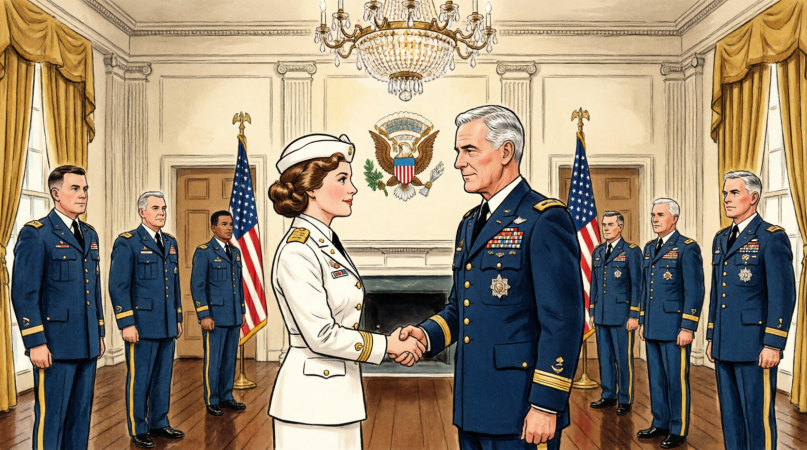
The ceremony to correct the record was scheduled for the following spring at the National Museum of the Marine Corps.
Not the Medal of Honor. Mercer had been honest about that from the beginning. Too much had been buried, too many political cowardices preserved in official memory, and although the board agreed the original recommendation had been mishandled, the practical resolution was an upgraded citation, a full public account of the mission, and a Navy Cross awarded posthumously under the corrected record with the names of the scouts finally included.
I should tell you I was disappointed. I wasn’t. By then I understood that medals matter differently to different people. The point was no longer prestige. The point was truth. The point was that the official version would no longer erase the men my grandfather refused to stand above.
My parents came.
Of course they did.
My mother bought a black dress and called me twice about what was “appropriate” to wear to such a solemn event. My father polished a eulogy in his head nobody asked him to deliver. My brother showed up late to the rehearsal dinner and shook Mercer’s hand too vigorously, the way men do when they hope recognition can be manufactured through proximity. I watched all of it with a kind of detached fatigue. They were doing what they always did when the world threatened to expose them: repositioning around the best available light.
But truth had a longer memory than performance this time.
The museum hall was all glass and stone and flags reaching upward in stillness. Marines in dress blues lined the front. Families of the other men from the mission had been found—sons, daughters, widows, one grandson older than I was who walked with a cane and wore his grandfather’s campaign ribbons pinned inside his coat. The two scouts’ names, finally released, were printed in the program. I held the paper with both hands and cried over those names in a restroom stall fifteen minutes before the ceremony because I thought of my grandfather refusing that old fake medal and understood, maybe for the first time completely, the exact shape of his refusal.
Mercer found me afterward, waiting just outside the women’s room like an old soldier pretending not to guard a flank.
“You all right?” he asked.
“No,” I said. “But the good kind.”
He nodded. “That’s about right.”
When the ceremony began, the hall settled into one of those silences that feel earned rather than imposed. The commandant spoke first. Then a historian. Then Mercer, who did not read from notes.
He stood at the podium in full dress and told the truth without ornament.
He named the mission. Named the location. Named the scouts. Named the dead. Named the failures of command and the failures of memory. Then he said Thomas Hail’s name and the room seemed to tighten around it.
“He was offered a version of honor that required him to accept a lie,” Mercer said. “He refused it. That refusal cost him public recognition in his lifetime. It did not cost him our respect. It did not diminish what he did. It made it greater.”
Then, because he was a better man than the institution that had once tried to simplify my grandfather, he added one more thing.
“When Gunnery Sergeant Thomas Hail died, only one member of his family came to his bedside, arranged his funeral, and kept the one object he wore every day because she understood it mattered even before she knew why. His granddaughter is the reason we are able to correct this record at all.”
Every eye in the room turned toward me.
I did not look at my parents. I could feel them somewhere behind and to the left, their shame or pride or regret suddenly irrelevant to the weight in my own chest. I stood because standing was the only possible response and because my grandfather had taught me, without ever saying it aloud, that if your name is called in a room where truth is finally being spoken, you rise.
The citation was read.
Not the false one. Not the cleaned-up version. The real one. Fire. Extraction. Return under enemy fire. Recovery of wounded personnel and deceased allied scouts. Disregard for personal safety. Leadership. Refusal to abandon the fallen. I heard the words like weather passing through history and landing, at last, where they had always belonged.
When Mercer placed the Navy Cross in its presentation case and handed it to me, his eyes were wet.
“He should’ve been here,” I whispered.
“He is,” Mercer said.
I know how that sounds. Sentimental. Convenient. But in that hall, with the ring heavy on my finger and the truth finally large enough to hold his silence without erasing it, it felt real.
After the ceremony, reporters hovered. Veterans approached. Strangers told me thank you for your service when they meant his and maybe mine too. My mother cried into a handkerchief she had almost certainly packed with the expectation of being seen crying. My father shook hands with men whose respect he had not earned but wanted to borrow. Tyler stood off to one side looking like someone who had wandered into a family he did not recognize.
I slipped away.
There is a point after public meaning when solitude becomes necessary, not optional. I went out to the museum terrace where the spring air was sharp and cold enough to wake every thought in my head. The ring caught the afternoon light. The Navy Cross case sat under my arm. For a few minutes I stood there alone and let grief and pride and anger and relief all exist without deciding which deserved the most room.
Then I heard footsteps.
My father.
He stopped a respectful distance away, which was new enough to hurt.
“I didn’t know,” he said.
I did not answer.
He looked out at the museum grounds rather than at me. “That sounds like an excuse. It isn’t meant to be. I really didn’t know.” A beat. “But I also never asked. And when the letters came… I thought they were another veterans’ thing that would turn into forms and fuss and obligations your mother wouldn’t understand.” He rubbed one hand over his mouth. “I didn’t think it mattered.”
There it was. The cleanest sentence he had ever said about himself.
I turned to look at him. He looked smaller than I remembered, which might have been the uniformed men inside or the ceremony or simply the fact that once a father is measured against the truth, he becomes a man very fast.
“It mattered,” I said.
He nodded. “I know.”
That should have been enough. But it wasn’t, not quite. There are apologies that repair and apologies that merely identify the damage accurately. I think, now, that most real life gives us the second kind and asks us to build our own peace from there.
My mother never apologized directly for not coming to the hospital.
She apologized instead for “how complicated everything became,” which told me she understood her guilt only through the inconvenience it caused. I stopped waiting for more. Tyler did better. He came to see me two months after the ceremony and admitted, awkwardly and with too much coffee in his system, that he had always followed the emotional weather in the house instead of checking whether it was fair. “I thought if Dad dismissed Grandpa, that meant there wasn’t much there to care about,” he said. “I didn’t realize that was me borrowing his laziness.”
That was the first useful sentence my brother had ever offered me.
The last piece of my grandfather came in a cardboard box from Ohio.
The buyer of his house had found it in the crawl space above the hall closet, shoved deep behind insulation and old winter blankets. Mrs. Kessler called me, breathless with outrage that anyone had almost thrown it out. Inside were odds and ends, nothing especially valuable, except for one envelope addressed in my grandfather’s handwriting.
For my granddaughter, if she ever asks the right question.
Inside the envelope was a single page.
Sweetheart,
If you are reading this, then either I am gone or you have gotten nosy enough to do me proud. There is more to my life than I ever told you, and less glory in it than some people may want to make. Men will always try to polish ugly things into honor once enough time has passed. Don’t let them. I did what I could, then I came home and tried to be decent. That is the whole of it.
The ring is yours if you still want it. It was given to me by men I would have gone back for even if no one had ever written a word down. If anyone ever recognizes it, listen before you decide. But remember: you do not owe anybody my story if they only want the shiny parts.
I was proud of you from the moment you learned to ask why before you learned to obey.
Love,
Grandpa
I sat on my apartment floor with that letter in my lap and laughed through tears because only Thomas Hail would leave behind a final note that began by insulting ceremony and ended by confirming that he had seen me all along.
That, in the end, was the deepest shock. Not the general. Not the citation. Not the ring. The deepest shock was discovering that the man my parents dismissed as nothing had understood me more clearly than any of them ever had.
I wear the ring still.
Sometimes strangers notice it. Most do not. That feels right.
The Navy Cross sits in a wooden case on a shelf in my apartment beside a photograph of my grandfather on his porch in Ohio, one hand in his jacket pocket, expression unreadable, maple leaves scattered around his boots. There is no giant patriotic shrine. No wall of martial glory. He would hate that. What he wanted, I think, was not adoration but accuracy.
So that is what I keep.
Not the myth of a silent hero too humble for the world.
Not the convenient story of a forgotten old man suddenly made important by military romance.
Not even the image of a grandfather transformed into legend by archival light.
I keep the truth.
He was the quietest man I ever knew.
He was also the bravest.
He refused honor that required dishonesty.
He died with almost no one there.
He was not nothing.
He was a man who knew exactly who he was and refused to let institutions, family, or grief translate that into a smaller shape.
And once I knew that, I stopped letting anyone do it to me either.
THE END