For forty years, I believed my greatest achievement was the life I had built within the stone walls of my historic estate in Connecticut. My late husband and I had amassed a considerable fortune, but after his passing, this sprawling, ivy-draped manor became my quiet refuge. I am Victoria, sixty-five years old, and a woman who learned long ago that wealth does not insulate you from heartbreak; it merely changes the currency.
My only son, Harrison, was the living proof of that lesson.
At forty, Harrison was a man entirely constructed of expensive veneers. When he arrived for our traditional Easter dinner, he stepped out of a leased Mercedes wearing a bespoke Italian suit that draped perfectly over his shoulders. Yet, underneath the tailored wool, the man was fraying. His eyes darted nervously around the foyer, taking inventory of the antiques, and a thin sheen of sweat gathered at his hairline despite the crisp April chill.
The atmosphere in the formal dining room was strained, heavy with the unspoken weight of our recent arguments regarding the estate’s trust. Harrison had been pressing me to liquidate assets, citing “investment opportunities” that sounded suspiciously like desperate gambles. I had refused.
He overcompensated for the tension with a sickeningly sweet, over-the-top affection. He poured my wine, complimented the roast lamb, and laughed a little too loudly at his own hollow jokes. Then, as the plates were cleared, he reached into his jacket pocket.
He slid a small, velvet-wrapped box across the polished mahogany table. It stopped inches from my hands.
“Mom, I know we’ve had our differences lately, especially about the estate’s management,” Harrison said, leaning forward. His voice was smooth, practiced. “But I wanted to make this Easter special. These are artisan, low-sugar chocolates. I spent weeks finding the right chocolatier who could accommodate your dietary needs.”
I looked at the box, then up at my son. I smiled, but I let the warmth stop short of my eyes. “You’ve always been so thoughtful when you want something, Harrison.”
He laughed, a dry, hollow sound that rattled in his throat. “I just want you to be healthy, Mom. Seriously. Promise me you’ll have them all to yourself? Don’t let the staff pick at them. They’re incredibly rich.”
“I promise,” I said, sliding the velvet box toward my wine glass.
The evening ended shortly after. Harrison claimed he had an early morning meeting and rushed out the door, his mind clearly a thousand miles away. He was in such a frantic hurry that he left his leather briefcase sitting on the velvet armchair in the hallway.
I intended to call him, to have him turn his car around. But the brass clasp of the briefcase was undone, and a thick stack of papers had spilled out onto the cushion. The top page caught my eye. Stamped in aggressive, bold red ink was the word: URGENT – FINAL NOTICE.
I sat down in the armchair, the silence of the great house pressing in on me, and began to read. They were notices from a private, offshore debt collection agency. The numbers blurred together, but the final sum at the bottom of the ledger was sharp and clear. Nearly three million dollars.
It was a staggering, insurmountable debt. More than his entire projected inheritance. More than enough to get a man killed by the wrong people. Or, as a cold dread settled in my stomach, more than enough to make a desperate man do the unthinkable.
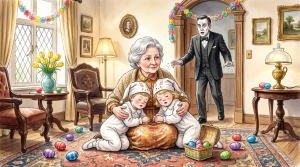
The morning sun filtered through the leaded glass windows of my kitchen, casting long, geometric shadows across the marble island. I sat on a stool, a cup of Earl Grey cooling in my hands. The velvet box sat open in front of me. Six beautifully crafted truffles rested in paper cups. They looked perfect. They looked deadly.
My phone buzzed against the marble, violently shattering the quiet. It was Harrison.
I took a slow, deep breath, reigning in the tremor in my hands, and answered. “Good morning, Harrison.”
“Hey, Mom,” his voice crackled through the speaker. It was thin, high-pitched, vibrating with a nervous energy that he couldn’t quite mask. “Just checking in. How are you feeling this morning?”
“I feel wonderful,” I replied smoothly.
“Good. That’s… good. So, how were the chocolates? Did you try the dark truffle last night?” He was breathing heavily into the receiver.
I looked at the untouched box. I needed to know. I needed to see exactly how deep the rot inside my son went. I initiated the test.
I took a slow sip of my tea. “Oh, I actually gave them to your kids, Harrison. Owen and Chloe came by early this morning with their mother. You know how the children love sweets, and I’m really trying to watch my weight. They were thrilled.”
For three agonizing seconds, there was absolute, dead silence on the line. I thought the call had dropped.
Then, a primal, jagged scream erupted from the phone, so loud I had to pull the device away from my ear.
“YOU DID WHAT?” Harrison’s voice shattered into a million frantic pieces. “You gave them to the kids? Victoria, tell me you’re joking! Did they eat them? Answer me!”
He didn’t call me Mom. He called me Victoria. I listened to the sound of my only child beginning to hyperventilate. He sobbed, a wretched, guttural sound of pure agony. It was the sound of a man who realized he had just accidentally murdered his own children.
“Harrison?” I asked, keeping my voice deceptively calm. “What’s the matter? They’re just chocolates.”
“Call an ambulance!” he shrieked, the panic tearing his vocal cords. “Victoria, call 911 right now! I’m coming over!”
Before I could say another word, the phone clattered against something hard, and I heard the distinct, terrifying roar of a car engine revving to the redline, followed by the violent screech of tires on asphalt. The line went dead.
The phone slipped from my fingers, clattering onto the marble island. My heart hammered against my ribs like a trapped bird.
The children were safe. They had never been here. Owen and Chloe were safely two towns over, spending the holiday weekend with their mother, Harrison’s ex-wife. I had used the lie as bait, a desperate cast into dark waters, and the monster that bit the hook was my own flesh and blood.
The shock lasted only a moment, quickly replaced by a cold, tactical clarity. I was no longer a grieving mother; I was a target standing in a kill zone.
I picked up the landline and dialed a number from memory. Dr. Vance, an old family friend and a retired forensic toxicologist. He answered on the second ring.
“Vance,” I said, skipping the pleasantries. “If I were to encounter an artisan chocolate that smelled faintly of bitter almonds, what would I be holding?”
There was a heavy pause. “Victoria, where are you?”
“Answer the question, Vance.”
“Cyanide,” he said grimly. “Potassium cyanide, likely mixed into a dark chocolate ganache to mask the bitterness. Do not touch it. Do not consume it.”
“Thank you.” I hung up.
I walked over to the box. I carefully pulled a pair of yellow latex dishwashing gloves from the sink cabinet and slipped them on. I picked up the dark truffle, placed it on a ceramic plate, and pressed the bottom of a heavy glass bowl down on it. The chocolate shell cracked, oozing a dark, rich filling.
The faint, unmistakable scent of bitter almonds wafted into the air.
My son didn’t just want my money. He wanted me gone by Monday morning so the estate would pass to him in time to stop the foreclosure on his life.
I began to move methodically through my own house. I checked the security panel in the hallway; the internal cameras had been manually disabled from the main router. I went to my master bathroom and checked my daily pill organizer. My blood pressure medication had been swapped with identical-looking capsules. He had built redundancies into his assassination plan.
I walked back to the kitchen, taking the velvet box and placing it squarely in the center of the marble island. I picked up the phone and dialed 911.
“Emergency, what is your location?” the dispatcher asked.
I didn’t report a poisoning. A poisoning would bring paramedics who would wait outside until the scene was secure. “My name is Victoria Miller. I need police at my estate immediately. There is a domestic disturbance. A man is en route to my location. He is highly unstable, violent, and I believe he is armed.”
I hung up and waited.
Ten minutes later, the violent crunch of metal on stone echoed through the property. I stood by the front window. I watched Harrison’s Mercedes slam directly into the heavy wrought-iron gates of my driveway, the airbags deploying in a cloud of white dust.
Harrison didn’t care. He kicked his door open and stumbled out. He popped the trunk, his hands moving with frantic desperation, and pulled out a heavy, steel lug wrench. He sprinted up the long, gravel driveway toward my front door, his face contorted in a mask of pure, murderous panic.
He didn’t bother knocking. Harrison swung the heavy steel wrench at the glass panel of my front door, shattering it into a thousand glittering pieces. He reached through the jagged hole, unlocked the deadbolt, and burst into the foyer, tracking mud and broken glass onto the Persian rug.
“Where are they?!” he bellowed, his chest heaving, his eyes wild and bloodshot. Tears streamed down his pale face, cutting tracks through the sweat. “Where are my kids, Victoria?!”
I stood perfectly still behind the kitchen island. I had removed the gloves. In my right hand, I held a single, untouched white chocolate truffle from the velvet box.
I looked at the man holding the wrench—the boy I had rocked to sleep, the teenager whose debts I had paid, the man who had just tried to erase my existence.
“They’re at the zoo, Harrison,” I said. My voice was eerily steady, bouncing off the high ceilings. “With their mother. They were never here.”
Harrison froze. He stood in the archway of the kitchen, the heavy wrench hanging loosely at his side. The frantic panic drained from his face, replaced by a terrifying, hollow realization. His jaw worked silently for a moment.
“You… you lied?” he whispered, his voice cracking. “You let me believe I…”
“I let you believe your own poison found its way into your bloodline,” I cut him off, my tone devoid of any maternal warmth. “I let you feel exactly what you were prepared to do to me. You were so ready to kill me for this house, Harrison. For money to pay off the thugs you owe.”
I set the white chocolate down on the marble next to the open velvet box.
“Now,” I said, locking my eyes onto his. “Tell me—is the cyanide only in the dark truffle, or is it in the white chocolate too?”
He stared at the candy as if a coiled cobra was resting on the counter. He took a step backward, shaking his head.
I slid the box across the smooth marble. It stopped inches from the edge, right in front of him. “If they’re so ‘special,’ Harrison, have one. Prove me wrong. Eat a chocolate right now, and I’ll sign the estate over to you today. All of it.”
He didn’t move. He looked at the chocolates, then at me, his eyes wide with the realization that he had confessed his crime for absolutely nothing.
A siren wailed in the distance, growing louder by the second. The police were turning onto my street.
The sound snapped Harrison out of his paralysis. The grief of a father vanished, replaced by the cornered desperation of a rat. He gripped the wrench with both hands, his knuckles turning white, and let out a guttural roar. He lunged across the kitchen, raising the heavy steel bar, aiming directly for my head.
“Police! Drop the weapon!”
The front doors were kicked wide open. Three officers burst into the foyer, their service weapons drawn and leveled at my son.
Harrison stopped dead in his tracks. He looked at the guns, then at the wrench in his hands. He knew it was over. The debt collectors would kill him if he went to prison; the state would lock him away forever for attempted murder.
He dropped the wrench. It clanged loudly against the tile floor. But he didn’t put his hands up.
Instead, Harrison lunged forward, slamming his hands onto the marble island. He grabbed a handful of the poisoned artisan chocolates—dark and white alike—and shoved them violently into his own mouth. He chewed frantically, swallowing the bitter confection in a desperate, cowardly bid to escape a life behind bars.
The chaos that followed was a blur of shouting, radios, and the violent thrashing of a man whose body was instantly rejecting the poison he had curated. The paramedics arrived moments later, tackling Harrison to the floor, forcing charcoal down his throat as he convulsed on my expensive rugs.
He survived. The paramedics were fast, and the emergency room doctors were skilled. But the massive dose of cyanide, combined with the lack of oxygen during his seizures, left him with severe, permanent neurological and organ damage. He would live, but he would live the rest of his life in a heavily guarded medical prison ward, a prisoner trapped in a failing body.
Two weeks later, I went to visit him.
I walked through the sterile, buzzing corridors of the state correctional medical facility. I didn’t go for forgiveness, and I certainly didn’t go for reconciliation. I went for closure.
I stood behind the thick, smudged plexiglass of the visitation booth. Harrison sat in a wheelchair on the other side. He looked twenty years older. His skin was a sickly, sallow yellow, his hair was thinning, and his hands trembled uncontrollably in his lap due to the neurological fallout of the toxin.
He looked up at me, his eyes wet with self-pity. He picked up the plastic phone with shaking fingers. I picked up mine.
“Why did you do it, Mom?” he rasped, his speech slightly slurred. “Why did you lie about the kids? If you had just given me the money… if you had just helped me with the debt, none of this would have happened.”
Even now, sitting in a prison wheelchair, he was the victim.
I didn’t flinch. I looked at him, feeling the last remaining thread of my maternal bond sever completely, falling away into the abyss.
“I spent forty years helping you, Harrison,” I said, my voice cold and hard. “I helped you through elite private schools. I bailed out your failed businesses. I paid for your divorce lawyers. But I will not help you kill me. You didn’t love me, Harrison. You loved my expiration date.”
I didn’t wait for his response. I hung the phone on the receiver, turned my back on the plexiglass, and walked away. I left his crying pleas muffled behind the heavy steel doors.
When I returned to the estate, I gave the staff strict orders. We dragged the mahogany dining table out to the gravel driveway. We piled the Easter linens, the velvet armchair, and the shattered glass from the front door on top of it. I poured the gasoline myself, and I struck the match. I stood in the cool night air, watching the flames consume everything that had been touched by that night.
The next morning, I called my lawyers. I took full legal and financial custody of Owen and Chloe’s futures. I established ironclad trusts that bypassed Harrison entirely, ensuring that not a single cent of our family wealth could ever be touched by him, or his creditors.
A week later, while preparing the estate for a quick sale, I went down to the impound lot to retrieve a few personal items the police had cleared from Harrison’s wrecked Mercedes.
I opened the trunk. Hidden beneath the spare tire was a plastic shopping bag. Inside was a second, identical velvet-wrapped box of chocolates. Taped to the top was a small, elegant card.
It was addressed to his ex-wife.
One year later.
The salty breeze of the Atlantic Ocean blew gently through the open windows of my new, bright cottage by the sea. I had sold the sprawling Connecticut estate to a developer. I didn’t need a museum anymore; I needed a home.
It was Easter Sunday. The sun was brilliant, painting the ocean in glittering shades of gold and blue. Outside, in the lush, fenced-in garden, Owen and Chloe were running through the tall grass, their laughter echoing over the sound of the crashing waves.
Inside the bright, sunlit kitchen, the air smelled of vanilla and melted butter. There were no velvet boxes this year. There were no underlying tensions, no forced smiles, and no hidden agendas.
We had started a new tradition. The marble counters were covered in flour, and I was baking sugar cookies from scratch with the kids.
I stood by the sink, watching my grandchildren chase a seagull away from the patio. I felt a profound sense of peace settle over my shoulders.
I used to think that being a mother meant swallowing whatever bitterness your children gave you, under the guise of unconditional love. I thought endurance was the hallmark of a good parent. I was wrong. Being a mother, a true matriarch, means protecting the next generation from the poisons of the current one, even if you have to burn the bridge behind you to do it.
Chloe ran inside, her apron dusted with flour, holding up a star-shaped cookie she had decorated herself. It was lopsided, the yellow icing was smeared, and it was entirely imperfect.
“For you, Grandma!” she beamed, holding it up.
I took the cookie, smiling down at her bright, innocent eyes. I took a bite. It was simple, safe, and easily the sweetest thing I had ever tasted.
As Chloe ran back outside to join her brother, a black sedan pulled into the driveway. A courier stepped out and handed me a certified envelope from my legal team.
I carried it into the living room and tore it open. The letter was brief and clinical. Harrison had passed away in the prison medical ward due to massive organ failure during the night.
I stood in the center of the quiet room, holding the heavy parchment. I paused for a moment. I closed my eyes, and for a fraction of a second, I felt a brief flash of the little boy he used to be—the boy who would hold my hand when crossing the street, the boy who hadn’t yet been corrupted by the world’s endless greed.
Then, I opened my eyes. I walked over to the stone fireplace, tossed the letter onto the glowing embers, and watched the edges curl and turn to black ash.
I turned my back on the smoke, picked up a colorful book from the coffee table, and walked out to the sunroom to read a bedtime story to the children who actually deserve my love.
If you want more stories like this, or if you’d like to share your thoughts about what you would have done in my situation, I’d love to hear from you. Your perspective helps these stories reach more people, so don’t be shy about commenting or sharing.