“You’re Marrying A Security Guard?” My Mom Scoffed. 68 Invites. Zero RSVPs. My Whole Family Boycotted My Wedding. I Walked Down The Aisle Completely Alone. Then My Phone Blew Up – After A Guest Posted A 10-Second Clip… And Captioned It: “Her Groom Is…”
Part 1
The night before my wedding, my mother left me a voicemail at 11:43 p.m.
I remember the exact time because I was sitting cross-legged on my couch in a wrinkled T-shirt, staring at the little blue glow of my phone like it might turn into a different life if I watched it hard enough. The apartment smelled faintly of hairspray from the trial run that afternoon and lemon dish soap because I had stress-cleaned the kitchen twice. My veil hung from the back of a dining chair. My shoes were lined up by the door. There was a half-packed tote on the floor with bobby pins, tissues, lipstick, safety pins, and the marriage license.
My mother’s voice came through thin and sharp, even over speaker.
“Melinda, it’s not too late to cancel. Don’t embarrass us like this.”
Then the click.
No hello. No I love you. No are you okay. Just that one clean cut, delivered the way she’d always delivered disapproval—like she was doing me the favor of speaking plainly.
I played it three times because my brain refused to believe a mother could make her daughter’s wedding eve sound like an ethics violation.
Nathan came home four minutes later. He had that particular hospital-night look on him—jaw shadowed, shoulders heavy, eyes alert even through the exhaustion. He closed the door with his heel, set his keys in the bowl by the entry, and took one look at my face.
“What happened?”
I handed him my phone.
He listened to the message once, expression flat and unreadable, then gave it back to me. There was still rain on the shoulders of his dark jacket. The apartment filled with the damp-cold smell of outside air and the medicinal trace that always seemed to follow him home, not exactly antiseptic, not exactly soap.
“We can call it,” he said quietly. “City Hall on Monday. Just us. No audience for this.”
Part of me wanted that. Not because I doubted him. Because I was so tired of bleeding in public.
But another part of me—the proud, angry, wounded part—sat up straighter.
“No,” I said. “I want the wedding.”
He leaned against the kitchen counter and watched me. Nathan never rushed my feelings. That was one of the first things I loved about him. He let silence do its work.
“I want them to know what they chose,” I said.
He nodded once. “Then we do it your way.”
By then I already knew none of them were coming. Sixty-eight invitations had gone to my side of the family and family friends. My parents. My brother Andrew. Aunts, uncles, cousins, my mother’s faculty circle, my father’s colleagues, women who had pinched my cheeks at Christmas parties when I was seven and asked where I’d gone to school when I was twenty-seven, as if that answer could explain me. My mother had made sure they all knew she and my father would not attend “in good conscience.”
Zero yeses.
I had called the caterer two weeks earlier and canceled sixty-eight meals while sitting in my car outside a CVS, crying so hard I had mascara on my seat belt.
On the wedding day, I got dressed alone.
The bridal suite at the Horticulture Center had a big gilt mirror, a rolling rack of white satin garment bags, and one narrow window looking out on a line of wet September trees. It smelled like peonies and hot curling irons. Somewhere farther down the hall, I could hear silverware clinking and the muffled thud of staff moving tables.
Sarah, the venue coordinator, helped zip the back of my dress because there was no mother to do it. No bridesmaids from my side. No sister. No one saying, Take a breath, you look beautiful, everything’s going to be okay.
“You look stunning,” Sarah said softly.
I looked at myself in the mirror.
The dress was ivory, simple through the waist, lace at the shoulders, not the dress my mother would have chosen. My hair was pinned back in a low knot because I didn’t trust myself with anything too complicated. My makeup looked good if I stood perfectly still and didn’t think about the left side of the ceremony.
Thirty-four empty chairs.
I had told Sarah not to move them. She had offered, gently, to rebalance the room, slide Nathan’s guests across the aisle, create symmetry where my family had left a wound.
“No,” I had said. “Leave them.”
So she had.
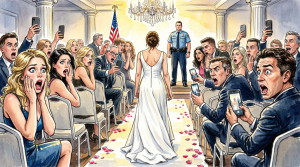
At 4:02, the doors opened and the string quartet began Canon in D. I stepped into the hallway with my bouquet held so tightly the stems pressed half-moons into my palm.
Then I saw it.
The left side of the aisle was a white-and-green graveyard of absence. Thirty-four untouched programs. Thirty-four little ivory ribbons tied to chair backs. Thirty-four clean empty seats catching afternoon light from the greenhouse glass.
The right side was full. Nathan’s family. His friends. People in navy dresses and good suits and one grandfather in suspenders. His mother with both hands over her mouth, already crying. His father sitting straight-backed, jaw tight, eyes wet. Warmth on one side. Vacancy on the other.
At the far end, Nathan stood waiting in a dark blue suit.
When he saw me, his face changed. Not the smile people put on for photos. Something rawer. His mouth moved around words I couldn’t hear, but I knew what he said.
I’m sorry.
I started walking.
The aisle looked longer than it had at the rehearsal. My heels clicked against the floor, each step small and unmistakable. I could smell lilies and candle wax. I could hear somebody crying softly in the second row on Nathan’s side. I could feel every empty chair like a pair of eyes.
And still I kept going.
At the altar, Nathan took my hands. They were shaking. Mine were worse.
The officiant smiled at us with wet lashes and began. We had written our own vows. Nathan went first.
“I don’t have much polished to offer,” he said, voice rough at the edges. “I don’t always have the right words, and I won’t always have easy hours. But what I have is yours. My time, my hands, my life. I see you, Melinda. I have always seen you.”
By then I was crying hard enough that the room had gone soft around the edges.
When it was my turn, I looked at him and forgot every smart sentence I had rehearsed.
“You are enough,” I said. “You have always been enough. And I choose you today and every day after, whether it’s easy or not.”
We kissed. Everyone on his side stood and applauded. No one stood on mine because no one was there.
For one perfect moment, it didn’t matter.
At the reception, it mattered again.
Table Three sat in the front left corner with eight untouched place settings and perfect little calligraphy name cards that no one would ever pick up. Catherine. Lawrence. Andrew. Aunt Patricia. Uncle Douglas. Helen. Professor Winters. Emily. The champagne glasses stayed full. The bread basket stayed full. Every time I tried not to look, I looked anyway.
At 7:23, during dessert, a man near the cake table collapsed.
It happened with the sick speed of real emergencies. One second he was laughing with a fork in his hand, the next there was the ugly sound of a body hitting the floor and a woman screaming his name. Chairs scraped. Someone dropped a glass. The quartet stopped in the middle of a note.
Nathan was moving before anybody else understood what they were seeing.
He crossed the room fast, dropped to his knees beside the man, and everything about him changed. His face. His posture. His voice. The warm, steady man who made eggs in our kitchen vanished, and someone sharper stepped into his place.
“Call 911 now,” he said. “Male, early sixties, likely cardiac. Tell them Horticulture Center, west entrance.”
A woman in heels from one of his tables ran forward. “Dr. Cross, I have an AED in my car.”
Dr. Cross.
I felt the room tilt again.
“Get it,” Nathan said without looking up.
Another man appeared beside him, older, calm, somehow already knowing where to stand. “You want me on compressions?”
“Yes. Two inches deep, fast. Rotate every two minutes.”
It was like watching a language I should have understood and didn’t.
When the EMTs arrived, one of them took one look at Nathan and said, “Dr. Cross, we’ve got it from here, sir.”
Sir.
Doctor.
My husband.
I stood beside the sweetheart table with my bouquet still in my hand from a photo somebody had interrupted, and for the first time since I met him, I realized I did not actually know who Nathan was. The man everyone else in the room seemed to recognize was kneeling on the floor in front of me, and all I had were questions.
Part 2
If you want to understand why that moment hit me like a betrayal and a miracle at the same time, you have to go back to a hospital waiting room fourteen months earlier.
It was 2:17 in the morning on February 19th, and Pennsylvania Hospital’s emergency room looked exactly like a place where time went to die. The lights were too bright. The green vinyl chairs were bolted together in rows. A toddler in dinosaur pajamas slept across three seats while his father snored upright with his mouth open. The coffee machine had an OUT OF ORDER sign taped across it with crooked blue painter’s tape. My roommate Jess was behind the double doors getting X-rays after a bike accident, and I had been sitting there so long my lower back had gone numb.
I was hungry, cold, and furious at everything.
Jess was going to be okay. They’d told me that twice already. Concussion, broken wrist, road rash, maybe a small fracture in one ankle. Nothing life-threatening. But hospitals flatten all scale. Nothing life-threatening still came with blood in her hair and her bike folded wrong under a streetlight and me riding in the ambulance with one hand sticky from holding hers.
I was staring at my phone without reading anything when a pair of worn black boots stopped in front of me.
“You’ve been here three hours,” a man said. “Have you eaten?”
I looked up.
Security uniform. Dark hair. Broad shoulders. Hospital badge clipped to his belt, turned backward so I could only see the bar code side. He looked like he’d been awake a long time, but not sloppy-long. Controlled-long. The kind of tired you get when you don’t have the luxury of falling apart.
“No,” I said. “The vending machines are broken.”
He glanced toward the dark snack machine like he personally disapproved of its laziness. “Stay there.”
I almost laughed. Stay there. As if I had anywhere to go.
He came back six minutes later with a wrapped turkey sandwich and a paper cup of coffee with one of those brown cardboard sleeves already on it.
“I raided the staff room,” he said.
The sandwich was cold in the center and the coffee tasted burnt enough to take paint off a wall. It was the best thing I had ever had at two in the morning.
“Thank you,” I said. “You didn’t have to do that.”
He shrugged and leaned one shoulder against the wall across from me. “You looked like you needed it.”
We talked for maybe seven minutes. Not movie-flirty. Not dramatic. Just a strange little island of calm in the fluorescent swamp.
He said his name was Nathan. He worked nights. Mostly operations and safety issues. He liked nights because “that’s when the work matters most.” I told him my roommate had the survival instincts of an overconfident raccoon and that I worked in academic publishing, which sounded glamorous if you’d never had to chase three late peer reviews and a missing permissions form through six time zones.
He smiled at that, finally, and the smile changed his whole face.
There was something precise about him. Not stiff. Just economical. He didn’t waste words. Didn’t fidget. Didn’t fill silence because silence scared him. He watched the room without making a show of watching it. A nurse came out pushing a cart, caught sight of him, and started to say, “Doctor—”
Nathan turned his head just enough to look at her.
She stopped. Not startled exactly. Corrected.
“Never mind,” she muttered, and kept walking.
I noticed it because it was odd. I filed it under hospital weirdness and let it sit there.
When they finally called me back to Jess, I stood and almost dropped the coffee because my legs had stiffened up. Nathan took the empty cup from my hand before it hit the floor.
“I’m Melinda,” I said.
“Nathan.”
The sliding ER doors opened with a sigh behind me. Harsh light spilled out. A monitor beeped somewhere inside like a car alarm with better funding.
“Take care of your friend,” he said.
I expected that to be the end of it.
Not in a sad way. In a life way. People pass through each other all the time, especially in places built for crisis. A kind security guard at two in the morning. A sandwich. A weird nurse slip. A thing you tell later as a story about how bad the coffee was and how nice one guy had been.
Three days later, he found me on Instagram.
I still don’t know how. Jess said I probably had my full name on some old publishing conference post or my account linked through mutual hospital friends I didn’t realize I had. At the time it felt impossible. I had not given him my last name. I was pretty sure I hadn’t even said where I worked.
His message was simple.
Hope your friend’s okay. If she is, want to get coffee sometime?
I sat on my bed staring at it with wet hair dripping down my back and felt something quick, clean, and reckless spark in my chest.
Jess, wearing a wrist brace and eating cereal straight out of the box, leaned in from the doorway.
“Who is that face for?”
I turned the phone toward her.
She squinted. “ER hot guy?”
“Apparently ER internet guy.”
She grinned. “Answer him.”
So I did.
Our first date was at Reading Terminal Market on a gray April afternoon that smelled like rain on brick and frying onions the second you stepped inside. He was there early. Of course he was. Jeans, gray jacket, hair still damp like he’d showered fast. He had the same steady look I remembered from the waiting room, like even standing in a loud crowded market he had already mapped the exits.
We got cheesesteaks and sat on a bench near the ice cream counter where kids kept begging exhausted parents for extra sprinkles.
His phone buzzed four times during lunch.
He looked at the screen once. His expression changed, not to panic, just sharper focus. He typed a reply so fast I barely saw it. It wasn’t regular texting. It was numbers and abbreviations, clipped and technical, like shorthand from another world. Then he put the phone away face down and gave me his full attention.
“Sorry,” he said. “Work.”
“Everything okay?”
“Yeah.”
He smiled then, small and real, and whatever question had started forming in me loosened its grip.
By the end of lunch I knew three things. He listened better than anyone I’d met in years. He didn’t talk much about himself. And I wanted to see him again badly enough that it actually annoyed me.
When we said goodbye outside under the train rumble and the cold spring wind, he tucked his hands into his jacket pockets and asked, “Can I take you out again?”
I said yes before dignity had time to intervene.
That night, I dug the crumpled brown napkin from the hospital sandwich out of my desk drawer where I’d somehow kept it, looked at it for a second, and laughed at myself.
Then I checked my phone again.
His message was already there.
Friday work for you?
I smiled so hard my cheeks hurt. But somewhere underneath that warmth, another feeling flickered—small, electric, hard to name.
Because I still did not know how a man I met at two in the morning in a hospital waiting room had found me at all. And because for the second time, I had the unmistakable sense that Nathan was standing in a life much bigger than the one he was showing me.
Part 3
We fell in love the way some people get caught in weather.
Not all at once. First you notice the air changing. Then you realize you’re already in it.
Nathan took me to places that made me feel like he actually lived in Philadelphia instead of merely sleeping there between shifts. A tiny noodle shop with fogged windows in Chinatown. A used bookstore in South Philly that smelled like dust and old paper and radiators. Walks by the river after rain when the air tasted metallic and the city lights looked rinsed clean. He always seemed slightly tired and slightly amused by everything. He paid in cash more often than cards. He never posted photos. He answered direct questions honestly and sidestepped personal ones so neatly that I didn’t always realize he’d done it until later.
He worked nights. That part was true.
He also disappeared in chunks of time that did not feel normal. Not cheating-disappeared. Not shady in the usual way. More like he was yanked by some invisible hook the rest of us couldn’t see.
Sometimes he would be halfway through dinner, glance at his phone, and go quiet for two seconds.
“I have to go.”
No drama. No elaborate lie. He’d kiss my forehead, pull on his jacket, and be gone.
By the third month, I had stopped asking what exactly “operations” meant in hospital security because every time I did, I got something technically correct and emotionally incomplete.
“Staffing issues.”
“Protocol review.”
“Bad night in the ER.”
“Overflow.”
Which, sure. Hospitals had bad nights. I knew that much. But hospital security also, in my limited understanding, did not keep annotated trauma journals by the bed.
The first time I slept over at his apartment in South Philly, I got up early looking for water and found a stack of medical textbooks on the floor beside the couch. Not one or two random paperbacks people bought in airports to look smarter. Actual textbooks. Trauma surgery. Emergency airway management. Advanced critical care. They were worn, flagged, and full of pencil notes in the margins.
When he came out of the shower toweling his hair, I held one up.
“You read this for fun?”
He glanced at the book, then at me. “I like understanding how things work.”
“That’s not a real answer.”
“It’s the answer you’re getting.”
He said it lightly enough that I laughed and let it go.
I let a lot go.
I let go of the fact that his ID badge was almost always flipped backward or tucked into a pocket. I let go of the pager that appeared one week in November and started beeping at random hours like a tiny vengeful robot. I let go of the fact that one nurse at a hospital fundraiser clasped his arm and said, “I heard about Tuesday. Nice save,” and he answered, “It was a team,” before steering me toward the buffet table.
By December, we had been together ten months.
The apartment I lived in was bigger than his place, brighter, less haunted by overwork, and one night while we were eating takeout Thai cross-legged on my rug, I said, “Move in with me.”
He looked up slowly from the carton in his hand.
“You sure?”
“Yes.”
“I’m not around much.”
“That’s not new.”
He held my gaze for a long second, like he was checking the walls for cracks I couldn’t see, then nodded. “Okay.”
He moved in with one duffel bag, a shoe box of cables and chargers, a stack of journals, two good knives, and almost nothing sentimental. It fascinated and unsettled me how lightly he lived. Like he had trained himself to leave fast if needed.
Still, he was easy to be with.
He fixed the cabinet hinge that had annoyed me for eight months. He made eggs in the cast-iron skillet every Sunday morning he was actually home. He folded towels exactly the same way every time. If I had a bad day at work, he listened without trying to turn it into a lesson. He was quiet in a way that made my nervous system unclench.
My family, of course, was going to care what he did.
That mattered more once things got serious enough to mention him. I put it off until March because I was enjoying the peace. Then my mother called while I was walking home from work through slushy late-winter puddles, and I told her.
“I’m seeing someone,” I said.
She lit up instantly. “Oh, wonderful. What does he do?”
There was the tiniest pause before I answered.
“He works in security at Pennsylvania Hospital.”
Silence.
Not long. Just long enough.
“Security operations?” she said finally, in the same tone she once used for a caterer who suggested buffet service. “Is that management?”
“He works nights. Operations and safety stuff.”
“Of course,” she said, too quickly. “I’m sure he’s very dedicated.”
I knew that tone. I had been raised by that tone. It sounded pleasant right up until it bit you.
“They’d like to meet you,” I told Nathan that night while he stood at the stove making eggs with one hand and reading something on his phone with the other.
He didn’t look up right away. “I heard enough of that call to know how this ends.”
“It might not be that bad.”
He plated the eggs, slid one plate toward me, and finally met my eyes.
“It won’t be fine, Melinda,” he said. “But we’ll do it anyway.”
He was right.
My parents’ house sat on a tree-lined street in a part of the Main Line where even the sidewalks looked expensive. Restored Victorian. Leaded-glass windows. A front hall that smelled like beeswax, fireplace ash, and old furniture polish. The kind of place where coats disappeared into a proper closet and nobody ever had mismatched hangers.
My mother opened the door wearing one of her soft cashmere sets and a smile that made me feel like a scholarship interview candidate.
Nathan had brought a bottle of wine. Not flashy. Good enough. I saw her eyes flick to the label and away. My father shook Nathan’s hand with the polite, over-firm grip of a man already measuring disappointment.
At dinner, they did what they always did when they wanted to remind someone of the family standard without naming it outright. They talked about sabbaticals in Provence. Faculty politics. Tenure committees. A friend’s daughter at Yale Law. My father asked Nathan about college. Nathan said he’d gone on scholarship to State. My mother asked whether hospital security offered “room for advancement.” Nathan said, “The work matters. That’s enough for now.”
Halfway through the meal, our neighbor Adelaide Winters mentioned her adult son had been dealing with dizziness and balance problems for weeks. Three doctors, no answers.
Nathan set down his fork.
“Has anyone checked for vestibular neuritis?”
The whole table went still.
Adelaide blinked. “How did you—”
“It sounds more like that than standard vertigo,” he said. “If he hasn’t seen ENT yet, I’d start there.”
My mother’s face changed. It happened fast, but I saw it. Curiosity first. Then calculation. Nathan had stepped outside the little box she had assigned him, and she didn’t like not knowing where the edges were.
“How would you know that?” she asked.
Nathan took a sip of water. “I work in a hospital.”
That was all he said.
On the drive home, the car was thick with silence. Streetlights flashed across his profile in gold bars. I could feel the questions gathering in me again, and I hated that my parents had sharpened them.
At 10:43, my phone lit up with a message from my mother.
We need to talk about your future. Call me when you have a moment. This is important.
Nathan saw the screen. He didn’t tell me it would be okay. He just reached across the console and took my hand.
Two weeks later, my father’s letter arrived on University of Pennsylvania economics department letterhead, four pages, single-spaced, the language polished enough to sound civilized while calling my relationship intellectually incompatible with our family values. He used the word desperate three times.
That same week, Nathan took a call at 2:14 in the morning in our dark kitchen, and I heard him say, in a voice so coldly focused it barely sounded like him, “How long? Fine. Intubate if sats go below eighty-eight. I’ll be there in twelve.”
He was dressed and out the door in under three minutes.
When he came back at dawn, there was a small brown-red stain on the cuff of his shirt.
I stared at it over my coffee.
He saw me looking, tugged his sleeve down, and said only, “Rough night.”
I nodded.
But while he showered, I stood in the kitchen holding my mug with both hands and staring at the closed bathroom door, my heart kicking a little harder than it should have.
Because security guards did not talk about intubation like that.
And for the first time, I couldn’t tell if the part that hurt was the fear that Nathan was lying to me—or the fear that I didn’t really want him to answer.
Part 4
I should have asked him that morning.
Not because I was owed every detail of his life on demand. Because by then the space between what I knew and what I was pretending not to know had gotten crowded enough to trip over.
Instead, I did what women raised in careful families get very good at. I absorbed discomfort and called it patience.
A month later, my mother invited me to coffee at Rittenhouse Square.
“Just the two of us,” she said on the phone, in a bright, syrupy voice that always meant there was a knife under the napkin.
It was raining that afternoon, the kind of thin Philly rain that makes the sidewalks shine but never fully commits. I got there three minutes late, shaking droplets off my umbrella. My mother was already seated at a little marble table by the window in a cream coat that cost more than my monthly grocery budget.
She was not alone.
The man across from her stood when I approached. He was handsome in a polished, irritatingly symmetrical way. Navy blazer. Good watch. Nice teeth. The kind of man who looked like his dry cleaning came back before he dropped it off.
“Melinda,” my mother said, beaming. “This is Dr. Trevor Ashford. His mother and I serve on the board together.”
Of course she did.
Trevor smiled and held out a hand. “So nice to finally meet you.”
A penlight peeked out of his jacket pocket like stage dressing.
I sat down because getting up immediately would have turned her ambush into the public spectacle she probably wanted. Also because I was briefly too stunned to trust my legs.
My mother launched right in.
“Trevor is pediatric surgery at CHOP,” she said, as if announcing a prize horse. “He and his family summer in Bar Harbor. You two have so much in common.”
“I’m engaged,” I said.
My mother took a delicate sip of tea. “You’re not married yet.”
Trevor at least had the decency to look embarrassed. “I think maybe there’s been—”
But I was already standing.
I left my untouched coffee on the table. My mother did not follow me.
That was when I knew this was no longer ordinary parental snobbery. This was a campaign.
The family group chat turned ugly next. Aunt Patricia asking whether anyone had “properly vetted” Nathan. Cousin Emily sending wide-eyed messages followed by the little zipped-mouth emoji. My uncle Douglas writing, Well, Melinda has always been strong-minded, which in our family meant possibly defective. Andrew, my brother, said nothing in the chat. He posted a sunset photo to Instagram instead with the caption, Sometimes you just have to let people make their own mistakes.
Three hundred likes.
Nathan came home that night at 2:14 a.m., hair damp with rain and fatigue sitting in his bones like extra weight. I showed him the post.
He read it once and handed the phone back.
“Block him if you want.”
“That’s it?”
“What do you want me to say?”
I wanted him to be angry. Defensive. Hurt enough that I didn’t feel like the only raw thing in the room. Instead he set his keys down, took off his jacket, and started rinsing blood from his knuckles under the kitchen faucet like this was a perfectly normal end to a Wednesday.
I stared.
He noticed, turned the water off, and flexed his hand once. “Bad restraining situation in the ER.”
“You were restraining someone?”
“In a manner of speaking.”
This was what he did. He answered in ways that were true if you didn’t lean on them too hard.
I took a breath. “Nathan.”
He looked at me, waiting.
I almost asked. Are you actually in security? Why do nurses keep almost calling you doctor? Why do you own more medical journals than some residents? Why do you talk like a man who runs a trauma bay instead of guarding a loading dock?
Instead I said, “My parents are going to keep doing this.”
“Yes.”
“They think you’re beneath me.”
A shadow passed over his face, not exactly pain, something older and more contained.
“I know.”
I hated how calmly he said it. Like class contempt was weather he’d learned to dress for.
A few weeks later, I picked him up from the hospital after work because his car was in the shop. It was 6:15 p.m., still humid out, the kind of sticky August heat that made your steering wheel feel damp.
He came out of the staff entrance in navy scrubs.
I had never seen him in scrubs before.
For half a second I told myself hospital security maybe wore scrubs in restricted zones. It made no sense, but denial is creative when it’s scared.
A nurse passing by stopped short. “Doctor, the family in Bay Three wants to thank you before they leave.”
Nathan didn’t break stride. “Tell them I’ll stop by later.”
She nodded and hurried off.
I rolled the passenger window down. “That nurse called you doctor.”
“She’s new.”
“And?”
“And hospitals are full of confused people.”
He got in the car, buckled his seat belt, and reached over to squeeze my knee, ending the conversation with the gentlest possible pressure. His ID badge was clipped to his waistband, turned backward again.
That night I sat cross-legged on our bed sealing wedding invitations by hand while he read beside me. Cream cardstock, calligraphy addresses, tiny stamps with pale blue flowers. Sixty-eight to my side. Eighty-two to his. I had been telling myself maybe blood would win over pride once paper made it real.
Nathan watched me press the final envelope shut.
“You don’t have to invite people who’ve already decided not to show up for you,” he said.
“They’re my family.”
He held my gaze for a second, then looked back down at his book. “Okay.”
My cousin Emily forwarded my mother’s group email two days later with just three words above it.
Is she serious?
I opened the attachment in the parking lot outside work. My car smelled like old coffee and hot vinyl. The email was clean and formal.
After much painful deliberation, we cannot in good conscience attend Melinda’s wedding…
There it was. My mother’s name. My father’s name. Their decision delivered to everybody before they bothered to say it clearly to me. “Departure from our family’s values.” “Respect our decision.” “With regret.”
I called the caterer ten minutes later.
“I need to cancel sixty-eight seats,” I said.
She went quiet. Then, softly, “Are you sure?”
I pressed my forehead against the steering wheel and watched a bead of sweat roll down the leather.
“Yes,” I said. “I’m sure.”
By the RSVP deadline, not a single person from my side had answered yes.
Most hadn’t answered at all.
When I met with Sarah, the venue coordinator, she pulled up the seating chart and looked at me with professional sympathy that almost undid me.
“We can rebalance the room,” she said. “Move people around so it doesn’t feel so stark.”
“No,” I said. “Leave the chairs.”
“Melinda—”
“I want to see it.”
Maybe I meant I wanted them to see it, even if they never came. Maybe I meant I wanted no one to help me hide what had happened.
The night before the wedding, I sat on the couch with my mother’s voicemail still glowing in the call log while Nathan stood in the kitchen doorway, exhausted and helpless in the face of something he couldn’t fix with his hands.
At 4:02 the next day, the quartet began to play and the doors opened.
I took one step forward, saw the entire left side of the aisle sitting empty and bright and brutally undeniable, and felt my throat close around a grief so sharp it almost stopped me cold.
Then I looked up and saw Nathan waiting for me at the altar.
And somehow, against all reason, I kept walking.
Part 5
The first ten feet of the aisle were the worst.
After that, your body gives up on hoping to be rescued and settles for movement.
I remember the smell of crushed greenery from the floral arrangements and the way my shoes pinched at the toes. I remember one of the empty programs on the left side had slipped halfway off a chair, crooked and stubborn, and I had the insane urge to stop and fix it. I remember Nathan’s mother dabbing her eyes with a tissue and Nathan’s father sitting so still he looked carved out of oak.
Mostly I remember Nathan’s face.
He looked devastated for me. Not embarrassed. Not flustered. Furious in the quiet, disciplined way he got when something precious had been mishandled.
By the time I reached him, I was shaking so badly he had to curl both hands around mine to steady them.
The officiant, Reverend Patricia Okoye, spoke in a voice warm enough to stand in. We had written our vows ourselves and then edited them down because Nathan said no one deserved to be held hostage by our feelings for twenty minutes.
He went first.
“I can’t promise you clean schedules or easy years,” he said, and his voice broke a little right there, which nearly finished me. “I can promise you truth. I can promise you I will come home to you whenever I can, and when I can’t, I will still find my way back. I can promise that on the ordinary days, the ugly days, and the days that ask too much, I will choose you on purpose.”
When it was my turn, I had to take a breath so deep it hurt.
“You make me feel safe,” I said. “Not the fake kind. Not the kind built on appearances or what other people call success. The real kind. The kind where I can be tired and angry and scared and still be loved correctly. You are enough. You have always been enough.”
I heard somebody sob softly from the second row on his side. It might have been me.
When Reverend Okoye told him he could kiss the bride, Nathan cupped my face with both hands and kissed me like the room had disappeared. For one tiny stretch of time, it had.
Then the reception started, and reality came back wearing place cards.
Table Three sat under a spray of white flowers and little candles that smelled faintly like vanilla when they warmed up. Eight untouched settings. Eight names in black ink. Eight absences turned into table decor.
Every hour, my eyes found that table on their own.
Nathan’s family did what they could. His mother hugged me hard enough to wrinkle the back of my dress and whispered, “You’re ours now, sweetheart.” His Aunt Denise pushed a plate of crab cakes into my hand because apparently all emotional events in that family were treated as an excuse to feed people. His cousins danced like they had been waiting all year for a reason. Warmth came at me from every direction.
And still that empty table sat there like a missing tooth I couldn’t stop tonguing.
At 6:33, we had our first dance.
The band played “Can’t Help Falling in Love,” and Nathan held me close enough that I could feel his heartbeat through his shirt. We swayed in a soft gold circle of candlelight and greenhouse glass while everybody watched. My cheek was against his chest.
“I thought they’d come,” I whispered.
“I know, baby.”
That was all he said. He didn’t insult them for me. Didn’t offer silver linings. Just held me and let the sadness exist without trying to tidy it up.
The song ended. We kept swaying for five more seconds because neither of us wanted to go back to the room.
At 7:23, dessert was being plated. I know the time because the cake knife had just gone missing and Sarah had asked if we had seen it, and I had laughed for the first time all day because apparently even at emotionally catastrophic weddings someone could still misplace a perfectly good knife.
Then I heard the scream.
A man maybe in his early sixties crumpled near the dessert station, hitting the floor hard enough that the cake stand rattled. His wife dropped beside him on her knees in one motion and started slapping his face, calling him Richard, her voice cracking into something animal.
Everybody froze for one stupid second.
Nathan didn’t.
He moved so fast my brain lagged behind my eyes. One second he was talking to his uncle near the bar, the next he was kneeling beside the man with both hands already checking airway, pulse, responsiveness.
“Call 911 now,” he snapped. “Male, sixty-ish, collapse, likely cardiac. Tell them we need ALS response.”
The whole room changed around his voice. Panic condensed into direction.
A woman from one of his tables—blonde, maybe early forties, in a dark green dress—ran forward already kicking off her heels. “Dr. Cross, I’ve got an AED in my trunk.”
Dr. Cross.
I turned so hard the edge of my veil brushed a candle flame and Sarah had to yank it away.
“Go,” Nathan said.
Another guest, older, calm, appeared at his shoulder. “Do you want me on compressions?”
“Yes. Start now. Hard and fast. Switch every two minutes.”
He sounded like a different person. Colder. Faster. Not cruel. Just utterly stripped of hesitation.
People moved toward him without question.
The blonde woman came back running with a red AED case. “Dr. Cross, here.”
Nathan took it, opened it, and said, “Charge to two hundred.”
I stood ten feet away with cake icing on my thumb from where I’d touched a plate and stared like I had stumbled into the wrong movie. The room smelled suddenly of sugar, spilled champagne, somebody’s floral perfume, and the dry hot tang that comes off an electrical device when it powers up.
The EMTs arrived in what felt like twenty seconds and six years.
One of them ducked through the doorway, took in the scene, and said, “Dr. Cross, we’ve got it, sir.”
Sir.
Doctor.
Cross.
Not Nathan from my kitchen. Not Nathan from my couch. Not Nathan from our bed reading trauma journals in sweatpants while pretending he just liked “understanding how things worked.”
He rode with the patient to the hospital because of course he did. The band packed up quietly. People whispered. Somebody offered me water. Somebody else asked if I needed to sit down. I nodded to everything and processed nothing.
He came back at 8:10 still wearing the same suit, jacket gone, sleeves rolled, tie loosened, hair flattened at one side where he must have scrubbed a hand through it.
“Is he okay?” I asked.
“He’s alive. They got him to cath lab. Good odds.”
I stared at him.
Then I asked the question that had been sitting in my mouth all year.
“Why was everyone calling you doctor?”
He looked at me for a long second.
Around us, the last of the guests were trying very hard not to watch us watch each other.
Then he said, quietly, “Because I am one.”
Everything inside me went still.
I heard the words. I understood every single one of them. And still they did not fit the life I thought I was in.
Before I could say anything else, my phone—forgotten in my clutch all evening—buzzed once, then again, then again, like something far away had started moving toward us fast.
Part 6
He told me the truth in pieces because if he’d given it to me all at once, I think I might have laughed in his face from pure overload.
We were standing in a side corridor near the catering kitchen while the reception wound down around us. Through the swinging doors I could hear dishes clattering, somebody crying-laughing too loud, Nathan’s cousin trying to start one last dance. The corridor itself smelled like coffee, buttercream, bleach, and wet flowers.
“I’m a trauma surgeon,” he said.
I just looked at him.
“At Penn?”
“Yes.”
“How much at Penn?”
He exhaled through his nose, then gave up on softening it. “I’m chief of trauma surgery. I also direct the trauma network.”
I actually leaned back against the wall because my knees had gone unreliable.
“Chief,” I repeated.
“Yes.”
“For how long?”
“Six years.”
The fluorescent light above us made everything too sharp. The pin in my hair hurt. My wedding ring felt suddenly heavy and strange, like it belonged to a version of me who had been briefed properly.
“You let me believe you were hospital security.”
“I do oversee hospital security systems and safety protocols. That part wasn’t false.”
“That is such an insane sentence.”
“I know.”
“Why?”
He looked wrecked. Not guilty in a slippery way. Guilty in the exhausted, stripped-down way of somebody who knows there is no elegant defense left.
“Because when I met you, you talked to me like I was just a man in a waiting room who brought you a sandwich,” he said. “No title. No reputation. No assumptions. I didn’t want to lose that.”
“You thought telling me the truth would make me stop loving you?”
“I thought it might change the shape of it.”
That hit harder than I expected.
There was a part of me still furious that he had let the lie sit there for so long. Another part, quieter and meaner, knew exactly what he meant. My parents would have treated Chief of Trauma Surgery like a crown. They would have invited him to dinner with good silver, laughed too hard at his jokes, dragged him across faculty parties by the elbow. They would have approved of him for reasons that had nothing to do with him at all.
I stared at the knot of his tie hanging loose at his throat and said the smallest, truest thing I had.
“I’m still angry.”
He nodded. “You should be.”
Somehow that helped more than any apology would have.
We finished the wedding because there was nothing else to do. We cut the cake again for photos we both knew we’d look dazed in. We thanked elderly relatives. We hugged people. We packed up centerpieces. Nathan’s mother kissed my temple and told me not to go to bed mad if I could help it. I almost laughed.
At home, after midnight, we were too tired to keep talking. My hair smelled like smoke from the catering candles and my feet had blistered at both heels. Nathan set my veil on the back of a chair as carefully as if it might bruise. We fell into bed without checking our phones.
While we slept, ten seconds of shaky vertical video started outrunning our marriage.
I woke at 6:42 to my phone vibrating itself across the nightstand.
It had that ugly, mechanical insistence of a device in crisis. Buzz. Pause. Buzz-buzz. Buzz.
Forty-seven missed calls.
Twelve texts.
Three voicemails.
Two messages from numbers I didn’t know.
I sat up so fast I made myself dizzy.
Nathan was already awake, propped on one elbow, hair sticking up at the crown. “What?”
“Something happened.”
That was the understatement of the year.
Amy Palmer—the daughter of the man who collapsed, though I didn’t know that yet—had posted a ten-second clip from the reception at 8:40 p.m. It showed Nathan dropping to his knees, the woman in green running in with the AED, the EMTs arriving and deferring to him.
Caption: The groom at my friend’s wedding just saved my dad’s life and everyone kept calling him Dr. Cross???
By midnight it had three hundred thousand views.
By six in the morning it had almost three million.
The reposts were worse.
Is that Dr. Nathan Cross from Penn?
Holy hell that IS him.
He saved my sister after a rollover on 76.
I was one of his residents. He’s terrifying and brilliant.
Cross protocol guy???
I sat on the edge of the bed with my bare feet on the hardwood and scrolled until my vision blurred. The apartment was still gray with early morning. Somewhere outside, a SEPTA bus hissed to a stop. Nathan took the phone gently out of my hand and opened his own.
His face went pale in a way I had never seen before.
“Damn it,” he said softly.
By 10:22, Penn Medicine released an official statement.
Dr. Nathan Cross has served as Chief of Trauma Surgery and Medical Director of the Philadelphia Trauma Network since 2019…
It only got worse from there. Better, if you were measuring public admiration. Worse, if you were me trying to understand how I had married a man who was apparently a medical legend and had somehow managed not to tell me.
Comments poured in by the thousands.
He saved my son after a four-story fall.
My husband coded twice. Dr. Cross brought him back both times.
I trained under him. Best surgeon I’ve ever seen.
He taught my entire class the multi-trauma sequence everyone uses now.
I clicked open one news story and saw his photo from some medical conference. Suit, podium, serious expression. I clicked another. There he was in scrubs outside a trauma unit. Another. There he was receiving an award with people in white coats smiling beside him.
My husband looked up from my couch in an old T-shirt and said, very dryly, “I hate the internet.”
I should have laughed. Instead I burst into tears.
Not because I was proud, though I was. Not because I was angry, though I was that too. I cried because every comment praising him felt like another person in on a fact I had somehow been last to receive. My love for him hadn’t changed. My footing had.
At one in the afternoon, my mother started calling.
At 2:47, my father emailed with the subject line: Urgent Family Matter.
At 3:15, Andrew sent me an Instagram DM.
Mel, I didn’t know. I swear. I’m sorry.
I read it. I didn’t answer.
The next day, somebody leaked my mother’s boycott email.
That did more damage than the clip.
Because one viral video had made Nathan famous for the people he saved. The leaked email made my parents famous for what they valued. Suddenly the internet had both sides of the story: the “security guard” they considered beneath the family, and the decorated trauma surgeon whose patients were filling the comment sections with gratitude and photos and stories of second chances.
By nightfall, strangers had found my mother’s LinkedIn. People were quoting her own words back at her. My father’s colleagues were being tagged. A BuzzFeed headline went up that made me physically ill.
I turned my phone face down on the kitchen table and stared at the wood grain while it kept lighting up like a trapped thing.
Nathan stood across from me in sweatpants, both hands flat on the counter, looking as tired as I had ever seen him.
“I’m sorry,” he said.
The apology landed in the middle of all that noise and somehow made more sense than anything else that day.
I looked up at him.
My husband. My liar. My impossible, absurdly capable husband.
Outside, the city moved on like cities do. Sirens. A garbage truck. Somebody shouting for a dog on the block.
Inside, my phone buzzed again. Then again. Then once more.
And I knew, with the kind of clarity that makes your stomach drop, that this was no longer just our private mess. The whole country had started looking at my family.
Part 7
By the third day, the internet had turned Nathan into folklore.
I don’t mean regular viral. I mean that weird, escalating kind of public fascination where people stop talking about a person and start talking around them, building a character out of clips and memory and reverence. There were TikToks with dramatic music. Threads from former patients. Long Facebook posts from nurses who had worked under him. Old residents calling him the best teacher they’d ever had and also the scariest person to disappoint in an operating room. A man in New Jersey uploaded a video saying Nathan had once repaired his daughter’s spleen after a car crash and then sat on the edge of her hospital bed explaining every drain and every machine until she stopped crying.
“The Cross protocol” started showing up in comments like it was common knowledge.
I had to Google my own husband.
There it was. Nathan Cross, MD. Publications. Conference talks. Medical panels. A headshot where he looked like somebody’s impossible standard. A grainy YouTube lecture from five years earlier. Hospital awards. Journal citations. A photo of him with a trauma team in scrubs and lead aprons, one hand lifted mid-explanation, eyes hard with concentration.
I sat at the kitchen table in our apartment and cried again, slower this time.
Not because I was ashamed. Not because I regretted marrying him. I cried because I had loved the man who made eggs in a T-shirt and fell asleep with one hand still on a book. The rest of the world seemed to love this other version of him—the doctor, the chief, the crisis legend—and I was suddenly trying to stitch the two together fast enough to keep up.
Nathan was home exactly one day out of four after that. The hospital needed him. The press wanted him. Penn wanted controlled statements and careful media language. He did as little as possible and returned to work like nothing had changed, which almost offended me on behalf of drama everywhere.
On the fourth day, we left.
No announcement. No post. No answering anyone. Nathan borrowed a friend’s cabin in the Adirondacks, someplace with bad roads, no cell service, and a wood stove that smoked a little when the wind shifted. The trees had just started to turn. The air smelled like pine needles, cold dirt, and wet leaves. The silence out there was so complete it rang in my ears.
For two days we barely talked about anything heavier than soup.
We hiked. We chopped wood badly. Nathan fixed a loose porch step because of course he did. At night we sat by the stove in socks and drank cheap red wine out of mismatched mugs because there were only two actual glasses in the cabin and one of them had a crack.
On the third day, with the world finally out of hearing range, I asked the question I had been circling.
“Why didn’t you trust me?”
Nathan sat in the porch chair with his elbows on his knees and a mug of coffee between his hands. The trees beyond him were all rust and gold. In the distance I could hear water moving over rocks.
“I did trust you,” he said.
“No, you trusted me with your feelings. You didn’t trust me with your facts.”
He nodded once, accepting the hit.
“When I was a resident,” he said, “everything in my life became about what I could do for people. Attendings. Patients. Donors. Administrators. Families. It was all title first. Need first. Capacity first. Which sounds noble until you realize people stop seeing the shape of your actual life.”
I leaned back against the porch railing and waited.
“When I met you, you didn’t know any of it,” he said. “You were tired and worried about your friend and mad at an out-of-order coffee machine. I brought you a sandwich and you smiled at me like I hadn’t walked in carrying a reputation. It felt…” He searched for the word. “Quiet.”
“That’s not a reason to let me believe you were a security guard for over a year.”
“No.” He looked down into his coffee. “It isn’t.”
The honesty of that steadied me more than a perfect explanation would have.
“I’m still angry,” I said.
“I know.”
“And I still love you.”
He looked up then, something fragile passing through his face before he hid it.
“I know that too,” he said.
We sat there a long time with the cold moving in around our ankles.
Back in Philadelphia, my parents’ life was apparently becoming a social crime scene. Colleagues were whispering. Board women were asking my mother careful, vicious questions over lunch. Somebody at my father’s department had apparently printed the leaked email and left it on the faculty lounge copier. Cousin Emily texted me a screenshot of a local article and then immediately texted, I’m sorry, I know this is awful, I just thought you should see how bad it got.
I didn’t answer that either.
The first day we turned our phones back on, I had three hundred and forty missed calls.
My mother alone accounted for nineteen of them.
I turned the ringer back off. Nathan looked over from the driver’s seat while we sat at a red light on Kelly Drive with the river throwing gray light back at the windshield.
“You don’t have to answer anybody,” he said.
“I know.”
My phone rang anyway.
Mom.
I almost let it go. I should have. There are calls that smell wrong the second they light up. This one did.
But something made me swipe answer.
Her voice hit me in fragments, breathless and broken.
“Melinda—your father—he collapsed at a faculty event. They’re taking him to Penn Presbyterian. Please. Please come.”
Everything in me went cold and sharp.
I turned to Nathan. He had already seen my face change. He was pulling to the curb before I could even speak.
“What happened?” he asked.
“My dad.”
He was out of the car on the next yellow light, already moving around to my side. “We’re going.”
The drive to Penn Presbyterian took twenty-three minutes and felt like being trapped inside a held breath. My mother kept calling and I stopped answering after the second update because her crying had become another sound I could not hold.
When we got there, she was in the emergency waiting room still wearing the coat from the event, a dark green cashmere thing with one sleeve smeared black where mascara and panic had met. The room smelled like vending-machine coffee, industrial floor cleaner, and stale fear. Two of my father’s colleagues stood near the wall pretending not to watch us.
My mother saw Nathan first.
For one awful second, I watched recognition, shame, relief, and horror all hit her face at once.
Then she looked at me and started crying harder.
At 9:15, a nurse pushed through the double doors and called my mother’s name.
“Your husband is in surgery,” she said. “Dr. Cross helped stabilize him in the ER and stayed with the cardiac team. He’s in the best hands.”
My mother sat down like someone had cut a string inside her.
Across the waiting room, Nathan was already stripping off his jacket and walking toward the secure doors.
He turned once, looked at me, and I saw it there—the same expression from our wedding aisle. I’m sorry. Not because he was leaving. Because once again he was walking into a fire I couldn’t follow.
At 11:47, the doors opened.
Nathan came out in hospital scrubs with a disposable cap hanging loose around his neck and exhaustion carved into the space beneath his eyes. He stopped in front of us.
“He’s stable,” he said. “He had a major coronary blockage. The cardiac team got him through bypass. He’s in ICU now.”
My mother stood too quickly and had to catch the arm of a chair.
“You saved him,” she whispered.
Nathan’s face went completely still.
“We did our job,” he said.
But I watched my mother look at the man she had considered beneath the family and understood, before she even said it, that something in her world had cracked all the way through.
Part 8
Hospitals strip people down fast.
Not physically, though they do that too. I mean all the polishing. The confidence. The social posture. The little curated stories people carry about themselves. Put them under fluorescent light with a loved one behind a locked door and suddenly all that expensive finishing work falls off.
My mother looked smaller in the ICU waiting area than I had ever seen her.
The room was painted that fake-comfort shade of beige hospitals seem to buy by the gallon. A television in the corner played a cooking competition with the sound off. The coffee in the machine tasted like damp cardboard and heat. Somebody across from us was opening a bag of peanut M&Ms one careful crackle at a time, and I could have screamed.
My mother sat beside me, hands clasped so tightly her knuckles had blanched. Every few minutes she would start to say something, then stop. I didn’t help her. I didn’t rescue the conversation. I stared at the vending machine reflection of both of us and let the silence do what silence does.
At 1:08 in the morning, a nurse came out and said my father was awake enough for a brief update.
My mother stood immediately. Then stopped.
“Can Nathan—” she started, and the sentence broke in half.
The request hung there like something filthy.
Nathan had not sat once since surgery. He was leaning against the wall near the nurses’ station in scrubs with dried fatigue all over him, talking quietly to another physician. When he heard his name, he turned.
My mother crossed three feet of linoleum like it was a mile.
“Nathan,” she said, voice shaking. “I know I have no right to ask you for anything. I know that. But he wants to see the doctor who… he wants to see you.”
Nathan’s face did not soften.
Not cruelly. Just firmly, professionally closed.
“I’ll stop in for two minutes,” he said. “Then he needs rest.”
My mother nodded like she’d been handed mercy she knew she hadn’t earned.
I watched Nathan disappear into ICU Room Four wearing the same hospital blues I had once seen him step out of at a staff entrance while telling me everyone got confused about badges. The memory stung and then passed. There was no room in that waiting area for old versions of him.
He came back out six minutes later.
My father had always looked most like himself in controlled settings. Lecture halls. Dining rooms. Panel discussions. Places where his voice could take up air and other people were expected to follow it. ICU took that away. By the time they let me in, he looked gray and reduced under the monitors, one arm webbed in lines and tape, the steady beep of the heart monitor somehow both comforting and obscene.
His first words when he saw me were, “I was wrong.”
Weak voice. Dry lips. No preamble.
I stood at the end of the bed with my coat still on.
“Yes,” I said.
He blinked at that, maybe expecting softness from proximity to mortality. He had never been very good at understanding that crisis doesn’t automatically earn access.
The nurse checked something at his IV pole and left us alone.
“I don’t know how to make this right,” he said.
There it was. The sentence people say when they finally realize there is no argument left. I had imagined hearing it for weeks. In every version in my head, it brought relief. In real life, it mostly made me tired.
“You can’t,” I said.
His eyes filled anyway.
“I called him nobody.”
“Yes.”
“I told people—”
“I know what you told people.”
He swallowed, wincing. Machines kept beeping around us in neat, pitiless rhythm.
“He saved my life.”
“He did his job.”
Something about that answer made him shut his eyes.
Maybe because it removed the romance of redemption. Nathan had not saved him because fate was poetic or because our family deserved a divine lesson. He saved him because that was the work in front of him and he was a man who did the work.
After that, the letters started.
They arrived in layers. First my mother’s email, long and shaking and stripped of polish. Then a handwritten card from my father in cramped, careful script because surgery had made his writing uncertain. Then Andrew’s texts, which somehow offended me most because they were so spare. I miss you. I was awful. I see that now. Please answer.
I answered none of them.
The apartment mailbox became a little brass mouth spitting out remorse three times a week.
Nathan never pushed. He would bring the mail upstairs, set the envelopes on the counter, and move on to chopping onions or answering a page or standing at the sink rinsing coffee grounds out of the French press. He understood, maybe better than I did, that pressure had been my family’s native language for years. He was never going to borrow it.
In late November, my mother sent a five-page letter on cream stationery that smelled faintly of her perfume. I sat at the kitchen table in socks with Chester, Nathan’s parents’ terrible little dog, snoring under the chair because we were dogsitting for Thanksgiving, and read every line.
No excuses. No talk of misunderstanding. No hiding behind “concern” or “wanting the best.” Just shame.
We judged a man by the title we believed he had and missed his character entirely.
We abandoned our daughter on the most important day of her life.
We have to live with that.
If you are ever willing, we will try to rebuild on your terms.
I read it twice, set it down, and stared out the window at the fire escape slick with rain.
Nathan came in from the bedroom toweling off after a shower and saw the pages on the table.
“Your mom?”
“Yes.”
“Anything different?”
I thought about it.
“She finally stopped defending herself.”
He nodded once. “That’s something.”
It was. Not enough. But something.
Five weeks later, I texted her.
Coffee Monday. Just you and me.
Her reply came in less than a minute.
Thank you.
The coffee shop we met in smelled like cinnamon, espresso, and wet wool from people coming in out of the cold. My mother was already at a corner table when I arrived, a teacup untouched in front of her and both hands wrapped around it like she needed the shape more than the heat. She had lost weight. Her face looked softer without certainty holding it up.
For thirty-two minutes, she apologized.
Really apologized. Not elegantly. Not in those polished, academic paragraphs my family liked to use when they wanted to sound self-aware while protecting the center of themselves. She cried once and then got embarrassed and blotted her eyes with a napkin. She said she had seen Nathan as a category before she saw him as a man. She said she had been more afraid of what people would think than of losing her daughter. She said both of those things were ugly and true.
I listened.
Then I gave her my terms.
“No pretending we’re normal,” I said. “No family holidays for now. No calling to tell me what I should be doing with my life. No revising the story so this sounds smaller than it was. And you will respect Nathan every time his name leaves your mouth.”
She nodded before I finished.
“I understand.”
“You don’t get to ask for forgiveness.”
She closed her eyes briefly. “I know.”
When I left, I felt lighter and sadder at the same time.
That night, my father left another voicemail. Weak voice, still recovering.
“I know I don’t deserve a response,” he said. “But if there is any chance you’ll let me say this to your face someday, I would be grateful.”
I deleted it without listening a second time.
Christmas invitation came next. Big family dinner. Everyone there. Come if you can.
I stared at it for a while, then closed the message.
We spent Christmas at Nathan’s parents’ row house in South Philly, where fourteen people fit into rooms meant for six and nobody seemed to find that stressful. His mother made three lasagnas because one would have been disrespectful to the concept of eating. His father argued with the Eagles game as if the television could be reasoned with. His aunt handed me a plate every seventeen minutes. Chester stole a meatball off the counter and had to be chased under a folding chair by two cousins and a shrieking child.
It was loud. Crowded. Warm. Somebody was always touching my arm or asking if I needed more bread or telling a story halfway over someone else’s story.
At 6:03 p.m., my phone buzzed.
Merry Christmas. We miss you. — Mom
I read it, locked the screen, and slid the phone back into my pocket.
Across the room, Nathan caught my eye over his cousin’s head and tilted his chin in a quiet question.
I smiled once and shook my head.
Not tonight.
He understood.
Still, later, when the house finally settled and we were lying in the guest room listening to pipes knock inside the walls, he turned on one elbow and said, “You know you never have to go back just because they’re sorry.”
I looked at the glow-in-the-dark stars still stuck to the ceiling from his niece’s old room and let that settle all the way in.
Outside, somebody was setting off illegal fireworks too early. Inside, the house smelled like laundry detergent, tomato sauce, and too many people breathing under one roof.
For the first time since the wedding, I realized I was not waiting to be claimed anymore.
But the next text came from Andrew, not my mother, and it dragged a whole new kind of anger up from the floorboards.
Because he wasn’t asking to apologize.
He was asking for a favor.
Part 9
Andrew’s message came at 9:14 the morning after Christmas while I was still in my pajamas eating leftover lasagna cold out of a bowl like an animal.
Hope you had a good holiday. I know I don’t deserve this, but would Nathan be willing to make an introduction for me? One of our clients is trying to partner with Penn on a med-tech initiative and his name would open the right door.
I read it twice because my brain needed the extra lap to accept the level of audacity.
Then I laughed. Not because it was funny. Because sometimes the only sound available is disbelief.
Nathan looked up from the coffee grinder. “What?”
I turned my phone around so he could read it.
He scanned the screen, expression unreadable, then handed it back. “That answers that.”
It did.
For weeks a part of me had been wondering whether Andrew’s silence at the wedding, the passive-aggressive post, the later apology—whether any of that had come from real shame. His text answered faster and more honestly than he ever had. My brother was sorry in the abstract. In the concrete, he was still looking at Nathan and seeing access.
I did not respond.
Instead I took a screenshot and sent it to my mother with one line.
This is exactly why I don’t trust any of you.
Her reply came ten minutes later.
I’m so sorry. I did not know he sent that. I’ll handle it.
I almost told her not to bother. Then I thought of all the years she hadn’t handled anything and let the sentence sit where it was. Let her do one small piece of cleanup inside the wreckage she helped make.
Two days later, Andrew called from a number I didn’t recognize.
I almost let it go to voicemail. Instead I answered and said nothing.
“Mel?”
I could hear traffic behind him, a horn, the hollow slap of city wind against a speaker. He sounded tired in a performative way, the way people do when they want credit for suffering.
“You asked Nathan for a favor,” I said.
Silence. Then, “I was trying to build a bridge.”
“No. You were trying to use my husband.”
“That’s not fair.”
I actually stopped stirring my coffee to appreciate the nerve.
“Not fair,” I repeated. “Andrew, you skipped my wedding, posted your little martyr sunset, let Mom and Dad humiliate me publicly, then waited until Nathan went viral to discover family loyalty. Don’t talk to me about fairness.”
He swore softly. “I said I was sorry.”
“Sorry is not a magic key.”
He exhaled hard. “You think I don’t know I screwed up?”
I went to the window while he talked. Outside, the street was wet from overnight rain, trash bags heaped at the curb, a delivery guy jogging across the crosswalk with two coffees in a cardboard tray. The ordinary city kept going like it had better things to do than host this call.
“I think you liked feeling superior until it became embarrassing,” I said.
“That’s not true.”
“It is.”
He was quiet long enough that I knew I had hit bone.
Then he said, smaller, “Dad wants to see you.”
There it was. The actual purpose.
I closed my eyes for one second.
“I’m not ready.”
“He’s trying, Mel.”
“He can try from a distance.”
“Are you really going to do this forever?”
The question had teeth, but not the way he meant. Forever. As if I were the one making some dramatic, unreasonable choice. As if estrangement dropped out of the sky instead of being built.
“I didn’t do this,” I said. “You all did.”
I hung up before he could answer.
January came in with that gray Philadelphia cold that feels damp even when it isn’t. Work resumed. Nathan disappeared into eighty-hour weeks and returned with new hollows under his eyes and stories he only told in fragments, never enough to betray a patient, always enough to remind me his life ran on emergencies and aftermath.
I learned his real rhythms slowly, which was its own strange intimacy. How he stood completely still for thirty seconds after a brutal shift before speaking to anybody. How he could eat a bowl of cereal at midnight over the sink with the concentration of a monk. How he never bragged, not once, not even when news articles called him groundbreaking or brilliant or indispensable. At home he was still just Nathan. He misplaced his keys. He forgot we were out of dish soap. He made coffee strong enough to violate treaties.
One rainy Tuesday in February, my mother called and asked if she could see me again.
“Just lunch,” she said. “No one else.”
I said yes because I was tired of fighting ghosts and because some part of me still wanted to know if change could exist outside crisis.
We met at a quiet café near the art museum. She looked better. Less wrecked. More deliberate.
“I cut back from the board,” she said after we ordered.
That surprised me. “Voluntarily?”
She gave a sad little smile. “I’m trying not to be the kind of person who treats other people like seating charts.”
That was the first thing she’d said in months that made me believe she might actually be learning instead of merely grieving the consequences.
We ate soup. We talked about neutral things. The weather. Work. Her new smaller condo with the basil plant that kept dying. It was almost peaceful.
Then she set down her spoon and said, “Your father wrote you a letter. A real one this time. He asked me not to pressure you, but he also knows I’m bad at staying out of things.”
I felt my shoulders go tight.
“I’m not promising to answer.”
“I know.”
She slid the envelope across the table.
My father’s handwriting on the front looked older than I remembered.
I didn’t open it until that night.
Nathan was on call. Rain ticked against the window. The apartment smelled like garlic because I had made pasta and barely eaten any of it.
The letter was shorter than his first one. No department letterhead. No rhetoric. Just paper.
He wrote that cardiac rehab had a way of humiliating a man into honesty. That he kept thinking about the empty chairs. That he had confused accomplishment with worth for so long he no longer knew where one ended and the other began. That he had looked at Nathan and seen the wrong thing because he had looked at me and seen the wrong thing first.
Then, three paragraphs in, came the sentence that made my stomach turn.
If you are ever willing, perhaps we could all have dinner together in a private setting, away from the gossip and public nonsense, and start repairing the family’s reputation honestly.
The family’s reputation.
I sat at the kitchen table holding that page and felt every soft maybe I had been entertaining inside myself turn to ash.
He still didn’t get it.
He still thought the tragedy was social. That if we just sat down in the correct arrangement, the story could be managed into something respectable. He had learned shame, maybe. He had not learned scale.
When Nathan came home after midnight, I handed him the letter without a word.
He read it in silence, then put it back on the table.
“That’s not an apology,” he said.
“No.”
“It’s branding with regret.”
I laughed so hard I scared myself.
Then I put the letter back in its envelope, slid it into the junk drawer with dead batteries and takeout menus, and realized something clean and hard had settled in me.
I wasn’t avoiding a decision anymore.
I had made one.
All that remained was saying it out loud.
Part 10
I met my father in March because I wanted an ending that belonged to me.
Not a family summit. Not a healing dinner. Not one of those sentimental scenes people imagine after public humiliation and private tears. I met him in broad daylight at a quiet conservatory café off the park where old women drank tea beside orchids and nobody important from his life was likely to wander through.
I picked the place because it smelled like dirt and green things and wet stone instead of polish and reputation.
He was already there when I arrived.
Cardiac rehab had taken some of him away. He looked thinner, shoulders slightly bowed, skin looser around the jaw. But the real difference wasn’t physical. It was the absence of his usual certainty. My father had always worn certainty the way other men wore expensive coats. That day he looked cold without it.
He stood when he saw me.
“Melinda.”
I sat. “Dad.”
The café was warm with humidifier mist and the faint sweet smell of orchids. A fountain somewhere in the next room kept up a quiet stone-and-water trickle that made everything feel too peaceful for the conversation we were about to have.
He wrapped both hands around a coffee cup he clearly wasn’t drinking.
“Thank you for coming,” he said.
“This is the only meeting.”
He absorbed that and nodded.
For a second neither of us spoke. I watched a drop of condensation slide down the outside of my water glass and pool on the table.
Then he said, “I read my first letter again.”
“The four-page masterpiece?”
His mouth twitched once. “Yes.”
“It was vicious.”
“I know.”
“No. I don’t think you do.”
He looked at me then, really looked, not with the old evaluating gaze but with something rawer.
“I thought I was being rational,” he said. “I thought I was protecting you from a mistake.”
“You thought you were protecting yourself from embarrassment.”
The sentence landed and stayed there.
He looked down.
“I did,” he said after a moment. “And worse than that, I convinced myself those were the same thing.”
That was the closest he had ever come to naming it cleanly.
I sat back and let him keep talking if he wanted to. This meeting was not for reconciliation. It was for witness.
“When your mother told me he worked hospital security,” he said, “I made a judgment in under a second. I’m ashamed of how fast it happened. Not just about him. About you. About what it said about your choices. About my failure, if I’m honest.”
There it was again. My choices as his failure. Everything bending back toward his reflection.
“You turned my wedding into a referendum on your ego,” I said.
He closed his eyes briefly.
“Yes.”
I almost smiled at how small the word sounded coming out of him.
“You know what the worst part was?” I asked. “It wasn’t the email. It wasn’t the empty chairs. It was that I kept hoping one of you would surprise me. That blood would mean somebody would choose me over appearances. No one did.”
He gripped the coffee cup harder. “I can’t defend that.”
“Good.”
His face tightened, but he didn’t argue. That was new too.
“I know your mother has met with you,” he said. “I know Andrew has made things worse.”
“That’s one way to phrase it.”
“He’s… immature.”
I laughed once. “He’s thirty-two.”
Silence again. Fountain. Silverware lightly tapping china at another table.
Finally he said, “I don’t expect forgiveness.”
“That’s wise.”
“But I hoped maybe in time—”
“No.”
The word came out so steady it surprised even me.
He stopped.
I leaned forward, elbows on the table, and spoke carefully because I wanted there to be no space left for reinterpretation later.
“You do not get late access because you finally understand what you did,” I said. “You do not get to call this a lesson and then walk out with a repaired daughter. You and Mom and Andrew showed me exactly how conditional your love could be when you thought I had chosen wrong. That knowledge doesn’t evaporate because Nathan turned out to be somebody you’d be proud to introduce at a donor dinner.”
Pain crossed his face then. Real pain. Not self-pity. Recognition.
“I would have been wrong either way,” he said quietly. “Even if he had only been security.”
“Yes,” I said. “That’s the point.”
He looked at his hands for a long time.
When he finally spoke again, his voice had gone rough around the edges.
“I missed you long before the wedding.”
I believed him. It changed nothing.
“I missed a version of you too,” I said. “Turns out she didn’t exist.”
He nodded once, accepting that more honestly than I expected.
We left twenty minutes later. No hug. No touch. No dramatic last look. Just two people standing from a small table beside a glass wall full of orchids and carrying different consequences out into the same gray afternoon.
Outside, the air had that late-March softness to it, cold but loosening. The parking lot smelled like wet pavement and thawing earth.
Nathan was waiting in the car because I had asked him to come but not to sit through it. He had the heat on and a paper cup of coffee in the console for me because he knew I’d come out wrung dry even if I pretended otherwise.
I got in, shut the door, and just sat there for a second.
He didn’t ask immediately. He let me hear the windshield wipers, the hum of the heater, the distant honk of somebody angry at nothing.
Finally he said, “How bad?”
I stared out at the conservatory glass reflecting the dull sky.
“Not bad,” I said. “Final.”
He nodded once like he understood the difference.
We drove home through slow city traffic. At a red light, he reached across and rested his hand on my knee. Warm. Steady. No performance to it.
That night we ate takeout dumplings at the kitchen counter because neither of us had energy for plates. Nathan had a trauma conference in Chicago the next week and was half-packing between bites, tossing socks and dress shirts into an overnight bag with the absentminded efficiency of someone who could prepare for travel while holding three separate thoughts at once.
I watched him move around our apartment—the apartment we had built in all the small domestic ways that actually matter—and felt something settle fully into place.
Not relief exactly.
More like alignment.
My mother texted the next morning.
How did it go?
I stared at the screen, then typed back.
I said what I needed to say. Nothing changes.
Three dots appeared. Disappeared. Appeared again.
I understand.
For once, I believed she meant it.
That spring, invitations started arriving again. Faculty events. Charity dinners. A hospital gala where Nathan was being honored. My parents were not invited to my life by default anymore, and that changed the shape of everything. My mother got occasional, careful lunches in public places. My father got distance. Andrew got nothing.
People kept asking if I was going to forgive them, usually in that hopeful, nosy tone people use when they want stories to end neatly so they can feel safe again. I stopped trying to explain the difference between forgiveness and peace.
Peace was sleeping through the night.
Peace was not jumping when my phone buzzed.
Peace was knowing exactly who was allowed through my front door and why.
By summer, our first anniversary was close enough to touch.
Nathan asked me what I wanted to do.
“Nothing fancy,” I said. “Just honest.”
He smiled at that in the quiet way he does when he thinks I’ve said something truer than I intended.
“Honest I can do,” he said.
I should have known then that he had already made a plan.
Part 11
For our first anniversary, Nathan took me back to Pennsylvania Hospital at 2:17 in the morning.
If that sounds deranged, you have not met my husband properly.
He told me to put on jeans and a sweater and not ask questions. We drove through sleeping streets with the windows cracked because the September air had finally turned cool again. The city smelled like damp brick, stale beer outside closed bars, and the sweet burnt note from a bakery starting early somewhere we couldn’t see.
Pennsylvania Hospital’s emergency waiting room looked almost exactly the same.
Same harsh lights. Same green vinyl chairs. Same vending machines, though the coffee machine had been replaced and now glowed with suspicious confidence. Different people slumped in the seats. Different crises. Same strange suspended-time feeling.
Nathan stood beside me with two paper cups in one hand and a sandwich from the staff room in the other.
“Behold,” he said. “My most romantic origin story.”
I laughed so hard a woman across the room gave me a tired, confused look.
We sat in the same row where I had been that first night, shoulder to shoulder, paper cups warming our hands. The coffee was still terrible.
“This is awful,” I said after one sip.
“I know. Tradition.”
There was no grand speech. No ring upgrade. No violin hidden in a corner. Just the two of us in a hospital waiting room in the middle of the night, the place where I had first met a man who looked like a tired security guard and had turned out to be a thousand other things besides.
“I was so suspicious of you,” I said.
“You should have been.”
“You were impossible.”
“I remain impossible.”
I turned toward him. “That part’s true.”
A patient transport aide pushed a wheelchair past us. Somewhere behind the ER doors, a monitor started alarming and then stopped. Overhead, the intercom crackled with a code I didn’t understand and no longer needed to.
Nathan took my free hand.
“I’m glad you didn’t walk away when you found out,” he said.
I thought about that.
“I almost did,” I admitted.
“I know.”
“You should know something, though.”
He waited.
“If my family had known who you were from the beginning, they would have loved you for all the wrong reasons. They would have paraded you around and acted like they were visionaries. And somehow that would have hurt worse.”
He was quiet for a second, then nodded.
“I know,” he said.
That was one of the things I loved most about him by then. Once the truth was on the table, he did not make me carry it alone.
After twenty minutes, he stood and tossed our cups. “Come on.”
“Where are we going?”
He smiled, that tired, warm smile that still felt private even now.
“To breakfast. Then home. Then sleep. Then I have surgery at noon because romance is dead.”
We ate pancakes at a twenty-four-hour diner where the coffee was actually worse than the hospital’s, which felt impressive. We sat in a cracked vinyl booth under a humming fluorescent sign while truckers and nurses and one very drunk college kid occupied the rest of the room. Nathan stole half my bacon. I stole half his toast. Outside, dawn started thinning the dark over the city.
When we got home, my phone buzzed with a text from my mother.
Thinking of you today. Happy anniversary.
I looked at it for a second.
Then, because a year had changed some things and not changed others, I typed back.
Thank you.
Nothing more.
That was all she got.
Later that afternoon, while Nathan slept for two hours before heading back to the hospital, I sat by the bedroom window with a cup of tea and watched light move across the buildings outside. Our apartment was full of ordinary proof of a shared life. His shoes by the door. My book turned facedown on the couch. A grocery list on the fridge in his blocky handwriting. The basil plant his mother had bullied me into taking home from Sunday dinner. The clean white envelope from my father still unopened in the junk drawer where I had left the last one.
I did not need to open it.
That had become one of the clearest gifts of the whole ugly year. I no longer confused obligation with love. I no longer believed blood gave people endless chances to wound you and still be called home. I no longer thought forgiveness was the price of being a decent daughter.
Some wounds heal crooked. Some never close right. Some stop aching only when you quit touching them to check.
My parents chose status over character. Appearances over loyalty. Pride over me.
I chose something else.
I chose the man who brought me a stale turkey sandwich at two in the morning because I looked hungry. The man who let me be angry at him and loved me cleanly through it. The man who could command a trauma room in ten seconds and still come home and argue with me about whether we were out of olive oil. The man my family dismissed as nobody because they had never learned how to measure worth without social proof.
They learned too late.
And too late is just another way of saying no.
People still ask sometimes, if they know the story, whether I ever forgave them.
I tell the truth.
No.
I built something better instead.
That evening, before Nathan left for the hospital, he kissed my forehead in the kitchen while the coffee maker hissed and the sky outside our window turned the color of pewter. He had one hand on his keys and the other still warm at the back of my neck.
“See you when I get home,” he said.
“Be careful.”
“Always.”
I watched him go the way I had watched him leave a hundred times by then—not afraid of the life he lived, not dazzled by the title he carried, just grateful for the ordinary fact of him.
Then I turned back into our apartment, into the quiet, into the life we had made without their blessing, and I felt something that had taken me a full year to name properly.
Not forgiveness.
Not victory.
Just peace.
THE END!

