The Illusion of the Empty Seats: A Chronicle of Chosen Family
Chapter 1: The Mathematics of Absence
My name is Laura Kennedy. I am twenty-eight years old, and on the sun-drenched afternoon of June 21st, 2025, my parents actively chose to attend a $22,000 luxury wellness retreat in the red rocks of Sedona rather than watch me walk down the aisle.
They didn’t skip my wedding because of a sudden financial collapse. They didn’t miss it because of a catastrophic medical emergency. They abandoned my wedding day because my autistic sister, Rachel, supposedly required esoteric “healing” far more than I required my parents’ presence.
“Perhaps stepping into a marriage will finally teach you that you are not the center of this family’s universe,” my father, Vincent, had told me weeks earlier.
I didn’t fall to my knees and beg. I didn’t shed a single tear at the altar. I walked down that aisle with my chin held high and my spine straight. But what my parents failed to realize was that the very daughter they had weaponized to justify their absence had already orchestrated a rebellion of her own. And when they finally saw my wedding photographs three days later, it wasn’t the sight of their empty chairs that shattered their world. It was the undeniable truth of who had filled them, and exactly who was standing by my side.
To comprehend the sheer gravity of that photograph, you must first understand the suffocating reality of being the “capable” child in a household that routinely mistakes a daughter’s resilience for a lack of needing love.
I work as a special education teacher in Austin, Texas, bringing home roughly $52,000 a year. My fiancé, Samuel, is a frontline paramedic. Together, we exist in the solid, unglamorous middle class. We budget meticulously, we work exhausting hours, and we never, ever ask for a financial handout. My parents are similarly middle-of-the-road earners. My father makes his living as an electrician, and my mother, Diane, handles medical billing. They had always preached financial conservatism—or so I naively believed.
The dynamic of our household shifted permanently when Rachel was diagnosed with Level One Autism Spectrum Disorder at the age of fifteen. She struggles with intense sensory sensitivities, processes environmental stimuli uniquely, and requires specific accommodations. But she is unequivocally not a helpless child. At twenty-four, she holds an associate degree in library sciences, works thirty hours a week at the local public library, and has maintained a pristine driving record for five years. She is vibrantly capable of navigating the world.
But in the Kennedy household, there was a twisted mathematical equation that governed our lives: Rachel’s diagnosis plus my perceived strength magically equaled my parents’ permission to completely check out of my life.
“Your sister requires a different caliber of support,” my mother would recite, a mantra she used to justify why I worked two jobs to fund my own university tuition while they casually dropped $8,000 annually on unverified “art therapy” for Rachel. Over nine years, they had hemorrhaged nearly $180,000 on alternative treatments. Sound baths, somatic release workshops, and outrageously priced supplements ordered from holistic websites that couldn’t even spell ‘science’ correctly.
I am not suggesting Rachel didn’t deserve accommodations. But there is a massive, dangerous canyon between genuine support and forced infantilization. My mother needed Rachel to be broken so she could play the savior.
This toxic pattern infected every milestone of my life. During my college graduation, they left twenty-three minutes into the ceremony because my mother had triggered Rachel’s sensory overload by blasting praise music all morning. When I won the Outstanding New Special Educator award, my mother purposefully scheduled a routine, non-urgent neurology appointment for Rachel at the exact hour of the ceremony. Which one matters more, Laura? my father had asked me then.
Samuel was the one who bought me grocery-store flowers. Samuel was the one who clapped. Samuel was the one who held my hand while my colleagues asked where my family was.
Then came December 2023. At the family Christmas dinner, Samuel and I joyfully announced our wedding date: June 21st, 2025. We had already placed a non-refundable $3,200 deposit on Barr Mansion, a stunning historical estate. My mother feigned absolute thrill, even discussing floral arrangements with Rachel. For a brief, foolish window of time, I believed we would have a normal family celebration.
But peace is merely a temporary ceasefire in my family. Exactly three months before the wedding, my phone vibrated late in the evening. It was my mother, her voice trembling with a manic, terrifying excitement.
“Laura, I finally found it. I found the place that will completely heal Rachel’s nervous system. It’s called the NeuroHarmony Wellness Intensive in Sedona.”
A cold dread coiled in my gut. “That’s interesting, Mom. When is it?”
A pause stretched over the line, just a fraction of a second too long. “Well, that’s the thing. The only available session is June 10th through the 24th. Do you think you could just push the wedding back a few weeks?”
Chapter 2: The Sedona Ultimatum
The sheer audacity of the request temporarily robbed me of oxygen.
“Mom,” I said, my voice dangerously low. “My wedding is June 21st. We booked the venue a year and a half ago. Flights are paid for. I cannot move my wedding.”
“You aren’t listening to me!” her voice sharpened into a defensive blade. “This is about trauma-informed integration. Dr. Sorenson is a visionary. Rachel might not get another chance. Can’t you just call the venue?”
I spent that evening doing a ten-minute internet search. NeuroHarmony was a luxury spa masquerading as a medical facility. It cost $22,000 for a fourteen-day stay. Furthermore, there were identical sessions available in May, July, and September. This wasn’t about a scheduling conflict; this was a calculated exercise in control.
I bypassed my mother and called Rachel directly. “Hey,” I asked gently. “Do you want to miss my wedding to go to Arizona?”
Silence hung on the line. Then, Rachel’s small, confused voice replied, “I didn’t know I had to pick. Mom said it was critical for my health. Can’t… can’t Mom just go without me?”
I closed my eyes, the heartbreak threatening to shatter my ribs. Rachel wasn’t driving this narrative. She was the hostage.
Days later, we were summoned to my parents’ house for a “family meeting.” My mother had printed out twelve pages of holistic propaganda, highlighted and color-coded. When I firmly reiterated that the wedding date was immovable, the atmosphere turned toxic.
“You’re choosing your own vanity over your sister’s medical needs,” my mother hissed, her face pale with fury.
That was when my father delivered his crushing blow about marriage teaching me I wasn’t the center of the universe. I looked at Rachel, who was sitting on the sofa, quietly weeping and twisting her bracelet.
“I am not choosing myself over Rachel,” I stated, standing up from the table, my hand gripping Samuel’s so tightly my knuckles ached. “I am choosing my boundary over your control. You are invited. But I will not shrink my life anymore.”
Four days later, an email went out to our entire extended family. My mother announced they would be missing the wedding to accompany Rachel to an “urgent medical intervention.” She painted herself as the ultimate martyr, sacrificing a joyful family milestone for her disabled daughter’s survival.
The betrayal stung, but the true horror was uncovered weeks later by my Aunt Cheryl. She called me, her voice hushed and frantic.
“Laura,” Cheryl whispered. “Your father refinanced the house. He pulled out twenty-eight thousand dollars in equity.”
My blood ran cold. My parents were three years away from paying off their mortgage. “Why twenty-eight? The retreat is twenty-two.”
“That’s the worst part,” Cheryl revealed. “I saw the credit card statements. Your mother told your father the retreat was only sixteen thousand. She charged the twenty-two, plus an extra six thousand on private spa treatments and luxury supplements. She lied to him to get the cash.”
My father had anchored himself to a massive mortgage payment until he was nearly seventy years old, all to fund a two-week vacation built on a staggering deception. And they had the nerve to call me selfish.
But as the wedding rapidly approached, a much darker, logistical reality set in. My wedding planner, Melissa, sat me down with the seating chart.
“Laura,” she said softly. “What do we do about the two front-row seats on the bride’s side?”
I swallowed hard. “Leave them empty. Everyone will stare, but I won’t pretend.”
Melissa hesitated. “What if they weren’t empty? What if I told you I know a couple who can fill them?”
Chapter 3: The Stand-Ins and the Secret
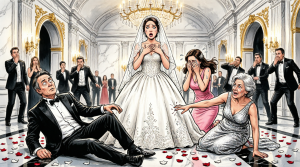
Melissa’s proposal sounded utterly unhinged at first. She suggested I hire James and Margaret Holloway, a retired couple who frequently acted as ‘stand-in’ parents for brides and grooms who were estranged, orphaned, or disowned. They charged an $800 honorarium to cover their time and formalwear.
Rent-a-parents. The concept made my stomach churn, but the thought of walking down the aisle past a physical monument to my own abandonment was far worse.
I met James and Margaret at a local coffee shop. They were elegant, softly spoken, and radiated a profound, non-judgmental warmth.
“We don’t try to play pretend, honey,” Margaret explained, reaching across the table to gently squeeze my trembling hand. “We are simply placeholders for love. When you look to your left during your vows, you will see two people smiling back at you. Everyone deserves someone in their corner.”
I paid them half the fee upfront. I didn’t tell a single soul besides Samuel.
What hurt the most, however, was the agonizing preparation I had already put in for Rachel. I had designed the entire wedding around her neurodivergent needs. I had paid extra to reserve a small, soundproof library adjacent to the gardens to serve as a quiet room. I stocked it with her favorite heavy-duty noise-canceling headphones, her preferred fidget spinners, and ice-cold bottles of Topo Chico.
I had even ordered her a sage-green bridesmaid dress made of soft, matte jersey—no scratchy tulle, no irritating tags. I had paid a seamstress to sew eight ounces of fishing weights into the hem so it would mimic the grounding pressure of her favorite weighted blanket.
It was all hanging in my closet, useless.
Until three days before the wedding.
Samuel’s sister, Julia, an occupational therapist, called me in a panic. “Laura. I just got a text from Rachel in Sedona.”
My heart hammered against my ribs. “Is she okay?”
“She’s miserable,” Julia said, her voice dropping. “She said she’s sitting in a yurt listening to singing bowls and she just misses you. But Laura… she asked me how to book a flight.”
I practically stopped breathing. “What?”
“She wants to come to the wedding. She told your mother she wanted to go, and your mother shut her down. I told her that if she was brave enough to get on a plane, I would personally pick her up from the Austin airport and smuggle her into the venue.”
“Will she actually do it?” I asked, tears springing to my eyes. Rachel had never flown completely alone in her life.
“I’ve coached her through the TSA neurodivergent traveler protocols,” Julia promised. “But she made me swear not to tell you she’s definitely coming until she’s physically on the tarmac. She doesn’t want to break your heart if she gets overwhelmed and backs out.”
The day before my wedding, I stood in the empty quiet room at the mansion, arranging the graphic novels on the side table. The space was perfectly calibrated, a tactile sanctuary of love.
Please, I prayed to whatever universe was listening. Please let her be brave.
Chapter 4: The Empty Room and the Arrival
June 21st, 2025.
The morning of my wedding was a blur of champagne, hairspray, and the fierce, protective laughter of my bridesmaids. No one dared utter the word ‘parents.’ I compulsively checked my phone every fifteen minutes, desperate for a text from Julia, but the screen remained agonizingly blank.
By 3:00 PM, Melissa ushered James and Margaret into the bridal suite. James looked incredibly distinguished in a tailored navy suit; Margaret wore a flowing lavender gown. She stepped forward and handed me a small, hand-tied cluster of wildflowers.
“From our personal garden,” Margaret whispered, her eyes shining with quiet empathy. “You don’t need to carry them. I just wanted you to have a piece of home.”
A ragged sob escaped my throat. Two complete strangers had just offered me more grace and maternal warmth in thirty seconds than my own mother had provided in an entire calendar year.
At 4:03 PM, the acoustic chords of Can’t Help Falling in Love drifted through the outdoor pavilion. Aunt Cheryl linked her arm firmly through mine.
“You’re not just doing this,” Cheryl whispered fiercely as we took our first step. “You are surviving this.”
I walked down the aisle. The late afternoon Texas sun filtered through the ancient oak trees in ribbons of liquid gold. I saw Samuel standing at the altar, his eyes bright with happy tears. And in the front row, sitting precisely where my abusers should have been, James and Margaret Holloway smiled at me with pure, unadulterated pride.
The ceremony was a brief, flawless eighteen minutes—shortened intentionally so Rachel wouldn’t feel trapped, even though she wasn’t there. We exchanged our vows. We kissed. The crowd erupted into joyous applause.
During the cocktail hour, Samuel and I slipped away to catch our breath. We walked past the library. The door to the quiet room was slightly ajar. I peered inside. The weighted blanket sat untouched on the armchair. The Topo Chico bottles were sweating in their ice bucket.
My chest caved in. She hadn’t made it. The Sedona brainwashing had won.
Samuel wrapped his arms tightly around my waist from behind. “You made the space for her, Laura. That proves everything about your character, and nothing about hers.”
I nodded, wiping a stray tear, and turned to head back to the reception tent.
“Laura,” Julia’s voice suddenly echoed from the end of the hallway. She was breathing heavily, as if she had just sprinted from the parking lot. “Don’t turn around yet. But someone wants to ask you a question.”
I froze. My pulse roared in my ears like a freight train.
I slowly turned around.
Standing nervously by the side entrance, clutching a small overnight duffel bag, was Rachel.
Chapter 5: The Viral Truth
She was wearing the sage-green bridesmaid dress. Her hair was pulled into a messy, beautiful bun. She was aggressively stimming with the satin ribbon of her bouquet, her fingers working the fabric, but her eyes were locked onto mine.
“Hi,” Rachel whispered, her voice trembling violently. “I… I took an Uber to the Phoenix airport. I flew by myself. Am I… am I too late?”
A profound, guttural sound tore from my throat—a mix of a sob and a laugh. I closed the distance between us in three massive strides and threw my arms around her. Rachel, who usually recoiled from deep physical pressure, melted into my embrace, gripping the back of my wedding dress with surprising strength.
“You came,” I wept into her shoulder. “You actually came.”
“Of course I did,” she sniffled, pulling back and wiping her eyes. “You made a dress with weights in it for me. You got my safe foods. Mom said I couldn’t handle the sensory overload, but I realized… I can handle it if I’m with you.”
Samuel rushed over, enveloping us both in a massive hug. “Let’s get you into a family photo before the sun goes down.”
When Rachel walked into the reception tent by my side, a shockwave rippled through the seventy-five guests. Whispers ignited like dry brush. Aunt Cheryl let out a shriek of absolute delight.
During dinner, Rachel utilized her quiet room twice, re-regulating her nervous system with the headphones. But when it was time for the toasts, she marched up to the microphone. The entire pavilion fell dead silent.
“I am not supposed to be here,” Rachel said, her voice echoing over the speakers. Her hands were shaking, but she stood tall. “My mother told me I was too fragile for this wedding. But Laura built this entire day so I could feel safe. That is what actual love is. It isn’t trapping someone. It’s making a safe room for them, even if you think they won’t show up.”
There wasn’t a dry eye in the venue. James and Margaret were openly weeping. I buried my face in Samuel’s shoulder.
As the sun began to dip below the horizon, our photographer, Natasha, called for the family portraits. We gathered against the beautiful, ivy-covered brick wall.
“Where are your parents?” Natasha asked politely.
“These are my parents,” I stated clearly, gesturing to James and Margaret, who flanked Samuel and me. Rachel stood tightly by my side, her hand gripping mine.
Natasha snapped twelve photos. The third one was an absolute masterpiece. It was a portrait of defiance, survival, and chosen family.
At 9:47 PM, while the reception raged on, I sat in the bridal suite, staring at the digital proof of that photograph. I opened Facebook. I typed out a caption, my thumbs flying across the screen fueled by years of repressed anger.
“June 21st, 2025. My parents skipped my wedding for a $22,000 ‘healing retreat’ to cure my sister, claiming I needed to learn I wasn’t the center of the universe. They were right. Love is the center. James and Margaret (left) are rent-a-parents who sat where my abusers chose not to. And Rachel (right)? She sneaked out of a yurt, navigated an airport alone, and flew 900 miles to choose me. This photo contains everyone who actually showed up. That is family.”
I hit post, turned my phone on airplane mode, and went back to my husband.
I had no idea I had just ignited a digital inferno.
By 8:00 AM the following morning, the post had 2,100 shares. By noon, it hit 5,000. It breached our social circle and was picked up by autism advocacy groups, special education networks, and survivor forums.
At 8:00 PM Texas time, my parents finally returned to their yurt in Sedona after a day-long hike. They found Rachel’s bed empty, save for a note: “I went to Laura’s wedding. I am an adult. This is my choice.”
Panicking, my mother forced my father to pack the rental car. They began the grueling drive back to Texas in the dead of night.
Somewhere on Interstate 10, around 1:00 AM, my mother finally secured a cellular signal. She opened her phone. The notification icon was glowing red with hundreds of tags.
She clicked on my Aunt Cheryl’s page and saw the photograph.
She saw the rent-a-parents sitting in her designated seats. She saw Rachel, glowing and happy, standing beside me. She saw the 8,000 shares, the thousands of comments from her church friends, her coworkers, and her neighbors, all bearing witness to her ultimate failure.
“Vincent,” my mother gasped, the color draining from her face in the passenger seat. “Pull the truck over. Now.”
Chapter 6: The True Inheritance
My father read the caption on the glowing screen, his face illuminated by the harsh dashboard lights of the truck. The illusion was dead. The martyrdom my mother had weaponized for decades was publicly, permanently shattered.
Between Sunday morning and Monday afternoon, my phone intercepted twenty-two frantic, threatening calls and eighteen unhinged text messages demanding I delete the post and stop “humiliating” the family. I read none of them.
When my parents finally arrived at their empty house in Austin on Monday evening, the ultimate consequence was waiting on the kitchen counter. My father opened the mail and found the updated mortgage statement. The payment had skyrocketed to $1,340 a month.
He sat in the dark kitchen, staring at the numbers. He was fifty-four. He would be paying off a luxury vacation for a daughter who didn’t want it, orchestrated by a wife who lied about the cost, until he was almost seventy years old. He realized, in that crushing silence, that he had mortgaged his entire future to protect an illusion that no longer existed.
The social fallout was biblical. My mother attempted to post a vague, victim-centric prayer request on her timeline to control the narrative. It received three likes and zero shares. At her medical billing office, coworkers stopped speaking to her. By November, she was forced to take an extended, unpaid leave of absence due to “severe psychological stress.”
As for Rachel? She never went back to that house.
She moved into our spare bedroom for two months while we finalized her paperwork. In October, using her own savings from the library, she moved into Mosaic Independent Living—a supported apartment complex designed for autistic adults. She manages her own schedule, works thirty hours a week, and sees a licensed, affirming therapist who treats her like a capable human being, not a broken toy.
I received a four-sentence email from my father in late July. “Laura. I was wrong. I chose wrong. I am sorry. I don’t expect forgiveness.”
I replied with two words: “Thank you.” I wasn’t ready to let him back in, but the door was no longer locked. My mother remains entirely blocked across all platforms.
Six months have passed since I walked down the aisle toward James and Margaret Holloway. The photograph still circulates online. I look at it often, reminding myself of the most vital lesson I learned that summer.
Family is not determined by biological default. It is not an obligation forged in shared DNA or geographic proximity. Family is an active, daily choice. It is the people who respect your boundaries, who celebrate your joy, and who show up to fill the empty seats when the people who were supposed to protect you decide to walk away.
Rachel was labeled too fragile to handle the world, yet she crossed state lines and defied a dictator to stand by my side. Sometimes, the people society underestimates the most are the exact warriors you want in your corner. I didn’t need my parents’ apology or their presence to validate my life. I simply needed to realize that my own strength was more than enough to build a new family from scratch.
If Laura and Rachel’s journey of surviving toxic family dynamics, setting ironclad boundaries, and discovering the true meaning of chosen family resonated with you, please like and share this post if you find it interesting! Let’s celebrate the courage it takes to walk away from those who dim your light.