At Dad’s Birthday, Sister Said, “We Didn’t Set Extra Seats For Your Annoying Kids.” And My Dad Added…
Part 1: The First Blow
It was supposed to be a simple birthday dinner, a small celebration for my dad’s 60th. I’d been planning it for weeks—coordinating with relatives flying in from three different states, booking the private room at Bellisimo, the upscale Italian place downtown. I even paid the $800 non-refundable deposit myself. It wasn’t much, but I wanted the night to be perfect for my dad, who deserved a night where he wasn’t the one organizing everything for everyone else.
But then came the moment that completely derailed it.
I arrived early with my seven-year-old twins, Lucas and Mia, and we walked into the restaurant, the smell of fresh bread and garlic in the air. Lucas was carrying a carefully wrapped birdhouse he’d painted for Grandpa—a gift from him and Mia that they’d worked on in the garage all week. They were proud of it.
I’d already explained to them that this was Grandpa’s special dinner, that we would be on our best behavior. They seemed excited. I thought we were just going to celebrate.
But when we stepped into the private room, everything shifted in an instant.
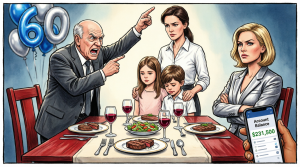
There was Diane, my sister, standing in the doorway with her arms crossed. She didn’t say hello. She didn’t wish my dad a happy birthday. Instead, she looked at my kids and said, “We didn’t set extra seats for your annoying kids.”
I froze. I felt my heart skip a beat.
Diane didn’t even acknowledge the twins as people—just as an inconvenience. Her words cut deep, deeper than I expected. I thought she’d at least greet them, pretend to be excited to see her niece and nephew. But no. It was clear from the start that their presence was unwelcome.
I stood there, holding Mia’s hand, while Lucas, clutching his little birdhouse, looked up at me, confused. He didn’t understand why his aunt was angry at him before even saying hello. I glanced at my dad, hoping he’d step in, but instead, he appeared behind Diane, looking at his shoes.
I kept waiting for him to say something, anything. But he didn’t.
“Kristen,” he said, clearing his throat like it was some mundane issue. “Maybe it’s better if you head out. You know how Diane gets when things aren’t organized her way.”
I didn’t argue. I didn’t scream. I didn’t make a scene. Instead, I nodded, took my kids’ hands, and walked back to the car.
Mia asked, “Why are we leaving?”
I lied through my teeth. “Grandpa’s party is for grown-ups only.”
I couldn’t believe the words as they left my mouth. The lie tasted bitter, but what else could I say? The truth would have been too painful for both of us. I wasn’t sure what hurt more—Diane’s blatant dismissal of my children or my dad’s passive acceptance of it.
But the damage was done.
The truth was, I hadn’t just been a guest at that party. I was the one who’d organized it. I had paid the deposit, made the arrangements, and even coordinated with the out-of-state relatives. And yet here I was, kicked out of my own family’s celebration because my kids were “annoying.”
As I drove to Chuck E. Cheese, the twins confused but distracted by the promise of pizza and games, I opened my phone. The first message was from Aunt Carol, who had texted at 7:30 PM: “Where did you go? Diane’s being awful as usual.”
Then came another one from my cousin Brett: “Your dad keeps asking about you.”
I didn’t respond to any of them. I just turned my phone off. Let them wonder.
The thing about Diane was that she’d always been like this. I remember back when I got into college and she didn’t. She told everyone I’d “probably slept with the admissions counselor” to get in. I remember when I got married and she wore white to my wedding, claiming it was “champagne.” When I had the twins, she asked if I was sure they were my husband’s. She’d always made me feel small, like I was in her way, like I was the one causing chaos in her perfect world.
And my dad? He’d never said anything. He’d never defended me. He just kept the peace, asking me to “be the bigger person.” Well, tonight, I was done being the bigger person.
I wasn’t going to keep swallowing her disrespect just to keep the family together.
Part 2: The Frozen Account
We drove to Chuck E. Cheese instead of staying at the party. The kids were confused at first, unsure why we weren’t at Grandpa’s birthday dinner. But once the games started, the confusion melted away. Lucas won enough tickets for a plastic ring, and Mia crushed the whack-a-mole game.
For the first time in weeks, I felt lighter. I watched my kids laugh, forgetting about the fancy dinner, forgetting about the tension that had suddenly appeared in my life. They were just kids, enjoying their time.
It was almost a relief to be away from the family drama. The phone buzzed around 7:30 PM, and I saw it was from my aunt Carol. She texted, “Where did you go? Diane’s being awful as usual.” Then came one from my cousin Brett, asking if I was okay, and finally from my dad, “We need to talk. Come to the house today.”
I silenced all of them.
Let them wonder. Let them figure it out.
The thing with Diane was that she’d never been fair to me. I spent years keeping my distance, never asking for anything from her. I gave $60,000 to her and Michael when they bought their house in Oakville—a house they now lived in without appreciating a single sacrifice I’d made for them.
But now, she wanted to make me feel like an outsider in my own family. She was pushing my children away like they were inconvenient, like they didn’t belong. Well, the truth was, I was done.
I didn’t know what I was going to do yet, but I wasn’t going to let her dictate the terms of my involvement with my own family.
At some point that night, after we got home, I pulled out my phone and looked at the family contract for the event—the $1,900 I was responsible for. I called the restaurant, spoke to Marcus, the manager I’d coordinated everything with. I told him there had been a change of plans. That I wouldn’t be attending the dinner after all, and that I was removing my authorization for any charges on my credit card. The $1,900 bill? Not on my watch.
Marcus was incredibly understanding. When I told him that my family had uninvited my children from my own father’s birthday party, he was quiet for a moment, then promised to ensure my credit card would not be charged. He mentioned that a new payment method would be required before the evening could continue, but assured me they would be more than happy to work out the details.
I hung up feeling oddly satisfied, but also exhausted. I couldn’t believe I was taking this step. But Diane had crossed a line. She thought she could treat my kids and me like we didn’t matter. Well, now she would face the consequences.
I texted back to Diane at 8:15 PM. The message was short and simple: “Seems you’ll need a backup plan.” Then I turned off my phone completely.
I didn’t know what would happen next, but I knew that whatever came, I wasn’t going to apologize for standing up for my children.
Part 3: The Party That Fell Apart
I didn’t find out about what happened at the restaurant until later that night.
Apparently, Diane’s card had been declined twice. Then she tried to get my dad to pay, but he’d maxed out his cards after buying a new fishing boat. My uncle Richard offered to split it with her, but even divided by two, it was still a hefty $900 each. And suddenly, everyone was very quiet. Phones were checked, apps were refreshed, and Diane started crying actual tears, saying I’d ruined my dad’s birthday and that I was cruel and vindictive.
My aunt Carol, bless her heart, had had enough. She stood up and said, “Maybe if you hadn’t kicked out the woman who planned this whole thing and insulted her children, we wouldn’t be in this mess.”
Then she walked out. Brett followed her. Uncle Richard and his wife followed too. The party disbanded.
Some people Venmo’d Diane what they could. My dad, to his credit, covered about $600 on a card that barely went through. Diane put the rest on her card, the one she usually reserved for emergencies, and spent the rest of the night glaring at anyone who made eye contact.
I didn’t know any of this while I was at Chuck E. Cheese. I didn’t hear about it until the next day when I woke up to 17 missed calls and 43 text messages. The majority were from Diane. The messages started off with her accusing me of ruining the party, but then, as the night wore on, her tone changed. By 2 AM, she had devolved into accusing me of being a selfish person, with 43 text messages full of venom.
My dad’s text came through around 6:30 AM. “We need to talk. Come to the house today.”
I dropped the twins off at my friend Rachel’s house and drove to my childhood home, unsure what I’d find waiting for me. My dad was on the porch when I pulled up, standing there like he was ready for a conversation he knew was coming.
He stood as I approached. “Diane’s moving in with me,” he said.
I laughed, genuinely shocked. “What?”
“She left her husband last night,” my dad continued, a bit too casually. “He served her with divorce papers this morning.”
I stood there, speechless, trying to process it. I didn’t know what to think.
“What does it have to do with me?” I finally asked.
“She needs someone to watch her daughter during the divorce,” my dad said. “Court dates, lawyer meetings, all of that. You’re good with kids. I thought you could help.”
I was stunned. “You want me to babysit Diane’s daughter after everything she did last night?”
My dad seemed uncomfortable. He rubbed the back of his neck, clearly realizing what he was asking. “I know you’re upset, but Diane’s going through a really hard time, and Stephanie is struggling.”
I crossed my arms and shook my head. “You want me to just take over, to be the one who fixes everything because Diane can’t manage her own life?”
He avoided my gaze. “Well, yeah. You’re good with kids. You always have been.”
I stood there for a long time, my thoughts racing. Finally, I just said, “I’m not babysitting Diane’s daughter after what she did. But I’ll talk to her.”
Dad opened the front door and Diane was sitting at the kitchen table, looking worn out, her face puffy from crying.
“What are you doing here?” Diane asked, clearly caught off guard.
“Dad asked me to come,” I said, keeping my tone neutral. “I’m not here to gloat. But here’s what’s going to happen.”
Diane stared at me with wide eyes. “What do you mean?”
“You’re going to apologize to my children,” I said firmly. “A real apology, not a fake one. Then, if you need help, I’ll consider it. But I’m not volunteering anymore. You want help, you ask. Not because it’s expected.”
Diane didn’t speak for a moment, then finally nodded. “Okay. I’ll do better.”
“Good,” I said. “Now go to your daughter and tell her you’re sorry for what you did. Then we’ll talk about Stephanie staying with me.”
Diane looked at me, her face conflicted, but she said, “I’ll do it. I’m sorry for everything, Kristen. I shouldn’t have treated you that way.”
I nodded. “You’re right. But it’s about time you figure out your priorities.”
Part 4: The Other Shoe Drops
It wasn’t over yet. Not by a long shot.
Two weeks later, Diane called me again. She asked if Stephanie could stay the night because she had a lawyer meeting the next morning. I agreed, but I wasn’t going to let it become a pattern.
The following week, I got another text from Diane: “Can Stephanie stay the night again? I have to meet with my lawyer.”
I agreed again, but something in me shifted. Diane had stopped even pretending to be responsible. It wasn’t just about being too busy—it was about relying on me to fix everything.
When I spoke to her the next morning, I said, “This is the last time. You need to get your act together.”
Diane didn’t respond immediately. She just looked at me with that same tired expression.
“Okay,” she said finally. “You’re right.”
I wasn’t sure she meant it, but I let it go. That afternoon, Diane came over to pick up Stephanie and apologized again. She promised it would never happen again.
“I’m trying, Kristen. I really am,” she said quietly.
I looked at her, and for the first time in years, I saw someone trying to be better, not just for me, but for herself and for her daughter.
“I believe you,” I said.
And in that moment, I realized that forgiveness doesn’t come in a straight line. It comes when you least expect it.
The next month, Diane took Stephanie to court for full custody. It was a long, painful process. But in the end, the judge sided with Diane. She was granted full custody of Stephanie.
But that didn’t mean everything was perfect. It meant Diane had started working on herself.
We were still figuring it out. But sometimes, that’s all you can do.
As for me, I had my family back.
Not perfect. But real. And that, for now, was enough.
Part 5: The Unexpected Call
The next few months were quiet, at least compared to the chaos of the past year. Diane had stopped leaning on me for help, and I had stopped expecting her to change overnight. She was still working on herself, still adjusting to the new reality of being a single mother with full custody of Stephanie. But she had taken steps—real steps—to improve her relationship with her daughter. She apologized, took responsibility for the mistakes she made, and started attending therapy regularly. For the first time, I felt like Diane was really trying.
As for me, I was starting to rebuild my own life. It wasn’t perfect, but it was mine. I had my children back in a way that felt healthier, more honest. Michael and I still had a strained relationship, but we were making progress. He was starting to realize that, like me, he needed to set boundaries, especially with Diane. We’d never be the family we once were, but we could find a new version of it—a version where honesty and mutual respect were at the core.
But then came the unexpected call.
It was a Tuesday morning. I was in the middle of getting the kids ready for school when my phone rang. I looked at the screen, expecting it to be my work or a family member. But when I saw the number, my stomach dropped.
It was from Diane.
I’d been avoiding her for the most part. I had no interest in rehashing old arguments or getting pulled into drama. I had no idea what she wanted now.
I answered the phone hesitantly. “Hello?”
“Kristen,” Diane’s voice was shakier than I’d ever heard it. “I need to talk to you. Can we meet?”
My heart skipped. “What is it, Diane? What’s going on?”
There was a long pause before she spoke again, her voice barely audible. “It’s about Stephanie.”
My mind raced. “What happened? Is she okay?”
Diane sighed deeply. “She’s fine, but I… I need to tell you something. Something I should have told you a long time ago.”
I stood there, my hand gripping the counter as I waited for her to continue. “What is it?”
“I’m moving out of Oakville,” Diane said, her words coming out fast. “I’ve been given a job offer in Vancouver, and I’ve decided to take it.”
The words hit me like a brick. “What? Vancouver? That’s so far away. You’re just going to leave?”
“I’m not leaving forever,” Diane explained quickly. “I’m just… I need to do this for me, Kristen. For Stephanie, too. We’ve been stuck in this same place for so long. I think this will be good for both of us.”
I tried to digest the news. Diane had always been a bit impulsive, but this? Moving across the country?
“Are you sure this is the right decision?” I asked, trying to keep my voice steady.
“I don’t know,” Diane admitted. “But I have to try.”
I thought about Stephanie. I thought about how much she had already been through. I thought about the trust issues she had with her mother, and how this move might shake things up even more.
“I don’t know how I feel about this,” I said honestly. “Stephanie has been through a lot already, and this—this is a big change.”
“I know,” Diane said softly. “That’s why I wanted to tell you first. I want you to know before it happens.”
I was silent for a moment, trying to find the right words. “When are you leaving?”
“Two weeks,” Diane replied. “I’ll have to start packing soon. I’m planning on taking Stephanie with me, of course. I just wanted to be upfront with you, Kristen. I know we’ve had our differences, but you’ve been there for her, and I appreciate that.”
The news felt like a slap, and I didn’t know how to respond. “I don’t know what to say,” I said, my voice trembling slightly. “I don’t know if I’m ready for this, Diane.”
“I know it’s a lot,” she said, her tone softer now. “But I’m hoping that when Stephanie and I are settled in Vancouver, we can work out something with visits. I want her to be close to you, but I need to figure this out.”
I closed my eyes, trying to calm myself down. “Okay,” I said after a long pause. “Let’s talk more about this later. I need to process it.”
Diane agreed, and we ended the call. I felt like I had just been blindsided. Vancouver. It was like she was pulling up roots and transplanting herself somewhere new without considering how it might affect everyone around her.
I sat down on the couch, feeling the weight of everything. The move was sudden, and I had no idea how Stephanie would react. She had already been struggling with her relationship with her mother. Would this be another huge setback? Would this put even more distance between her and the family?
I had so many questions and so few answers.
But one thing was clear: Diane was doing this for herself, and I wasn’t sure how to feel about that.
Part 6: The First Visit
Two weeks passed quickly, and before I knew it, Diane and Stephanie were preparing to leave for Vancouver. I wasn’t ready to say goodbye, but I knew this was happening whether I was ready or not.
The night before they were set to leave, Diane called me again. “Kristen,” she said, sounding a little unsure. “Can we meet? I think Stephanie needs to say goodbye.”
I agreed, and we met at a coffee shop near my place. When I walked in, I saw Diane and Stephanie sitting at a corner table. Diane was wearing the same expression she always wore when she was about to make a difficult decision—an expression of guilt mixed with resolve.
Stephanie, on the other hand, looked nervous but not sad. She wasn’t crying or visibly upset. She just looked… distant, like she was unsure how to process everything happening so quickly.
“Hey, you two,” I said, sitting down across from them.
Diane immediately jumped in. “We’re leaving tomorrow morning,” she said, her voice tight. “I wanted to give you a chance to say goodbye to Stephanie before we go.”
I looked at Stephanie, who was fiddling with her sleeve. “How are you feeling?” I asked gently.
She shrugged, not making eye contact. “I don’t know. I think I’ll miss you. But I’ll be fine.”
I smiled softly. “You’ll always have a place here, Stephanie. You know that, right?”
She nodded but didn’t say anything.
Diane looked at me, her eyes tired. “I know this is hard, Kristen. But I think it’s the best thing for us. I hope you’ll understand.”
I nodded, even though I wasn’t sure I fully did. “I’ll always be here for you both, Diane. Just… please make sure Stephanie is okay.”
“I will,” Diane said, her voice almost pleading. “I promise.”
I could see the sincerity in her eyes, and it made me think that maybe, just maybe, she was starting to get it. She was starting to realize that her decisions didn’t just affect her. They affected Stephanie. And they affected me.
When it was time to leave, Diane gave me a quick hug. “Thank you for understanding,” she said, her voice thick.
Stephanie stood up and gave me a quick hug as well. “I’ll miss you, Grandma,” she said quietly.
“I’ll miss you too,” I said, holding her a little longer than I expected. “You be good to yourself, okay?”
Stephanie smiled a little, nodded, and then walked out with Diane.
I watched them leave the coffee shop, a heavy weight in my chest. I didn’t know what would happen next. I didn’t know if this move would bring Diane closer to Stephanie or tear them further apart. But one thing was for sure—this was a moment that would change everything for all of us.
And all I could do was wait and hope that this was the beginning of a better chapter for Diane and Stephanie, even if it meant letting go of something I wasn’t ready to lose.
Part 7: The Unexpected Message
A month went by. Diane and Stephanie settled into their new life in Vancouver, and while I was still processing everything, life slowly moved forward.
Then, one Saturday afternoon, my phone buzzed. It was a message from Diane.
The message was simple: Stephanie misses you.
I stared at the message for a while, not sure how to respond. It had been a while since we’d talked. I hadn’t been sure how much I wanted to reach out after everything had happened. But now, seeing her message, I felt a pang of hope.
I typed back: I miss her too. Is she doing okay?
Diane’s response was quick: She’s been struggling a bit. It’s hard for her to adjust. I think she misses you more than I expected.
I didn’t know what to say. The guilt and hurt from the past few weeks weighed on me, but something in Diane’s message felt different—softer, more open.
Maybe we could talk more soon? I typed.
Diane’s reply came a few minutes later: I’d like that. I think it’s time we start rebuilding some bridges.
I set my phone down, heart pounding. Could this be the moment we started to heal? Could it be possible to rebuild the broken pieces of our relationship?
Maybe the road to healing wasn’t as clear as I’d hoped. But maybe it was worth trying again.
Part 8: The First Step Toward Healing
It had been a month since Diane and Stephanie moved to Vancouver, and I still didn’t know where I stood with them. I thought I’d given up on the idea of reconciliation, but seeing that text from Diane made me reconsider. For the first time in a long while, I felt like there might be a chance for us to rebuild what had been broken.
I took a deep breath and sent a response: How about we schedule a video call? It’d be nice to catch up.
It didn’t take long for Diane to reply: I think that sounds great. Let’s do it tomorrow at 3 p.m.
The next day, I set up the video call in the quiet of my living room. I didn’t want to make the same mistakes I had in the past—waiting for them to come to me or putting off a conversation that needed to happen. I needed to take the first step, even if it felt uncomfortable.
At 3 p.m., I clicked the “Start Video” button, and the screen flickered to life. Diane’s face appeared, a little older than I remembered but still familiar. She looked tired, and her smile was small, but it was genuine. She was sitting at a small table in a cozy room that looked nothing like her old house in Oakville. It looked like she was trying to settle into her new life, even though I knew it was a tough transition.
“Hey, Kristen,” Diane said, her voice soft, hesitant. “It’s good to see you.”
“Hi, Diane,” I replied, trying to sound more at ease than I felt. “I’m glad we could finally do this.”
“I know it’s been a while,” Diane said, looking down for a moment, her hands fidgeting with the edge of the table. “I didn’t know how to reach out to you after everything, but I think it’s time we talk.”
I nodded. “I agree. It’s been hard for me too, but I’ve been thinking a lot about how we can move forward.”
Diane’s eyes softened a little. “I know I messed up. And I can’t take back what I did. I hurt you, and I hurt Stephanie. I was selfish, and I didn’t realize how much I was pushing you away. I’m sorry for all of it.”
Her words hung in the air, and I could feel the weight of them. The apology wasn’t easy for her, and I knew it took a lot for her to admit she was wrong. But it was the first real step in healing.
“I don’t want you to just apologize,” I said softly. “I want you to understand why it hurt me. You took away my relationship with Noah, and for what? Because I didn’t follow your rules? I didn’t want to live in that toxic space, Diane. You never gave me the chance to just be his grandparent.”
Diane looked down again, and I could see the guilt washing over her. “I know. And I’ve realized that now. I let my fears control me. I didn’t want you to be involved because I thought you’d take him away from me. But I see now that I pushed you away in the process, and I lost my connection with you, and with Noah.”
I could tell she was struggling with the words, but she was being honest, and that mattered. “I just want to know that my role as his grandfather is respected, Diane. I want to be part of his life, but I need your trust.”
She nodded, her voice quiet but steady. “You have my trust, Kristen. And I want you to be involved in Noah’s life. I know that’s not enough to fix everything, but I’m willing to do the work to rebuild that relationship.”
I took a deep breath. “It’s going to take time. But I’m willing to try.”
Diane smiled faintly. “I am too.”
After a long pause, I added, “And I think we need to talk about the rules. The boundaries. I’m not going to sign a list or be controlled. I want a relationship, not a transaction.”
She nodded again, this time with more certainty. “I agree. I should have never treated you like that. I was trying to control things because I was scared of losing them. But I see now that I was pushing you away, and that’s not fair.”
I felt a small weight lift off my shoulders. This conversation wasn’t going to fix everything, but it was a step in the right direction.
“You know, Diane,” I said, “this is the first time in a long time I’ve felt like we’re not at odds.”
Her smile was faint but real. “Me too, Kristen. Me too.”
We ended the call with a mutual understanding that the road ahead would be slow. It wasn’t about making grand gestures or pretending like everything would go back to normal immediately. It was about starting with small, honest conversations and being patient with one another.
That night, I felt a glimmer of hope. Not for perfection, but for progress. I wasn’t sure what the future held, but for the first time in a while, I felt like it was worth trying.
Part 9: Rebuilding One Step at a Time
Over the next few weeks, Diane and I continued to talk. The calls were still awkward at times, but they were filled with genuine effort. Diane apologized more than once for the past, and I started to realize she wasn’t just apologizing to make herself feel better. She was trying to make things right.
There were still moments when I was frustrated, when I felt like Diane wasn’t fully seeing the damage she had caused. But I reminded myself that this wasn’t going to be fixed in a few days. Trust takes time to rebuild.
Noah and I had our usual Saturday visits, but this time there was a noticeable difference. He was happy to see me, and he didn’t have to ask if we were going to the “right” house anymore. He just knew that his grandpa’s house was a safe place, and that was enough.
One Saturday, as we were heading to the park, Noah looked up at me and said, “Grandpa, when can I see Mom again?”
I hesitated, not because I didn’t want him to see Diane, but because I wasn’t sure if it was the right time.
“I think it’s going to take some time, buddy,” I said gently. “But when it’s time, I’ll be there to help.”
Noah smiled, and I could see the relief in his eyes. “I’m glad you’re here, Grandpa.”
“I’m always going to be here, Noah,” I said, squeezing his hand.
The next weekend, Diane called me again, and this time, she had a different tone. “Kristen, I was wondering if I could bring Stephanie over for a visit. She’s been asking about you.”
I was surprised, but I agreed. It felt like a small step, but a step nonetheless.
When Diane and Stephanie arrived, Stephanie was shy at first, but I could see the change in her. She wasn’t the same guarded girl she had been when she first moved in with me. She was warmer, more open. Diane’s eyes were filled with gratitude as she stood in the doorway, watching her daughter reconnect with me.
“I’m really trying,” Diane said softly, watching us. “I know it’s not enough yet, but I’m working on it.”
“I see it,” I said, genuinely meaning it. “And I think that’s all any of us can do.”
The visit was simple. We spent the afternoon coloring and playing games, just like old times. Stephanie smiled more in those few hours than I had seen her smile in months.
As they left, Diane said quietly, “Thank you, Kristen. For giving me a chance. For giving Stephanie a chance.”
I didn’t say much. I didn’t need to. I just nodded and watched them walk away, feeling like I had made a real difference.
The road to rebuilding was long, but it was moving forward. I had no illusions that everything would be perfect. There would be setbacks, and there would be moments of doubt. But for the first time in years, I felt like I had control over something that mattered: the relationship with my family.
Part 10: A New Beginning
A few months later, Diane called me with unexpected news.
“I’m moving in with Stephanie,” she said, her voice bright. “I’ve found a small apartment closer to her school, and I think it’s time for us to start fresh. I know it’s been a tough journey, but I’m proud of how far we’ve come.”
I smiled, genuinely happy for her. “That’s great, Diane. I think it’s exactly what you need.”
“I think it is too,” she said. “And I want you to know that you’ll always be part of Stephanie’s life. And mine.”
I felt a lump in my throat. “You don’t have to say that. I’m just happy to be here when you need me.”
“I know,” she said softly. “And I’m thankful for that. I don’t think I could have gotten through this without you.”
The weight of the past few months hit me then, but instead of feeling exhausted, I felt a quiet peace. Diane had found her way back to herself, and in doing so, she had finally created space for all of us.
As I hung up the phone, I looked out the window at the setting sun, the trees swaying in the breeze. It felt like a new beginning.
Not just for Diane. Not just for Stephanie. But for me, too.
The past was always going to be there, a part of the story. But it didn’t have to define us.
And in that moment, I understood something my mother had always known: love doesn’t come with conditions. It comes with the willingness to show up, to try, and to keep trying, no matter how hard it gets.
I was ready for whatever came next. And for the first time in a long time, I wasn’t afraid.
Part 11: The Decision to Move Forward
As the months passed, things began to settle into a new rhythm. Diane’s decision to move in with Stephanie was one I never expected, but it seemed to be exactly what both of them needed. The fresh start allowed them to rebuild their relationship, free from the weight of old resentments. I could see the difference in Stephanie too—she was no longer the withdrawn girl who had spent too many days hiding from her mother’s mistakes. She was starting to bloom again, slowly, like a flower opening after a long winter.
For the first time in a long time, my phone calls with Diane weren’t awkward. They weren’t filled with defensiveness or tension. She’d call me occasionally just to check in, to ask how Noah was doing, or to share some small victory Stephanie had achieved. It was these small moments of connection that began to rebuild the bridge between us.
But it wasn’t just Diane and I who were healing. Noah, too, was growing more comfortable in his own skin. His Saturday visits to my house became less about me trying to prove that I was the “good grandparent” and more about him simply enjoying the time with me. He’d run through the door with a smile on his face, asking if we could play catch, or showing me a new drawing he’d made at school. It was in these small, everyday moments that I found myself feeling whole again.
And then, just as I was beginning to think that maybe, just maybe, we were on the path to normalcy, I received another call. This time, it was from Michael.
“Dad,” he said, his voice filled with a mix of hesitation and excitement. “I need to talk to you.”
I sat down, my stomach churning. After everything that had happened, after the distance between us and the strain from the past few years, I wasn’t sure what he was about to say.
“What’s going on, Michael?” I asked, trying to keep my voice steady.
He exhaled, clearly gathering his thoughts. “I’ve been thinking a lot about everything lately. About the past, about what’s happened with Diane and me, and about Noah.”
I could hear the struggle in his voice, the weight of his own self-reflection. Michael had always been the kind of person who avoided confrontation, who would rather sweep things under the rug than face them head-on. But now, something in his voice told me he was finally ready to confront the truth.
“Go on,” I said, my heart racing.
“I know I’ve messed up,” he continued. “I should have been more supportive of you, of the situation with Diane. I should have stood up for you when she treated you badly. I should have done more to protect Noah, and I should have been a better son.”
His words hit me like a wave, and I found myself sitting still, trying to process everything. It wasn’t the apology I had been expecting, but it was the one I needed. Michael wasn’t asking for forgiveness, but he was finally taking responsibility for his actions.
“I’m sorry, Dad,” he said, his voice softer now. “I’ve been trying to fix things with Diane, but I haven’t been able to fix myself. And I need to do that before I can do anything else.”
I was silent for a moment, letting the weight of his words settle in. It was hard to hear, hard to accept, but it was also what I had been waiting for. I had been waiting for Michael to see the truth of what had been happening, to see that his silence had been a form of complicity.
“I’m proud of you for saying that,” I finally said, my voice thick with emotion. “I think you’re on the right path, Michael. It’s not easy, but you’re starting to see what you need to do to heal.”
There was a pause on the other end of the line. “I want to make it right, Dad. I want to be a better father, a better son, a better person.”
“You’re already on that journey,” I said. “Just keep walking it. We’ll get there.”
I knew it wasn’t going to be easy. There would be bumps in the road, setbacks, and moments of doubt. But for the first time in years, I felt a flicker of hope.
The next weekend, I had Noah over for his usual Saturday visit. We spent the afternoon playing in the park, enjoying the sunshine, and just being together. As we sat on the grass, Noah looked up at me with those big gray-blue eyes that always seemed to hold so much more wisdom than a child his age should possess.
“Grandpa Walter,” he said, his voice soft. “Do you think people can change?”
I smiled and ruffled his hair. “I think they can, buddy. It’s not easy, but I think they can.”
Noah nodded thoughtfully, as if my answer had satisfied some part of him. He turned his attention back to the butterfly he was watching, his small hands reaching out to try and catch it.
That night, I sat at my kitchen table, the soft hum of the refrigerator the only sound in the house. I thought about Michael’s call earlier, about the changes we had made, and about the difficult road that lay ahead for all of us.
But I also thought about the way things had started to feel, just a little, like they used to. The laughter in my house. The warmth of being a grandfather again. The possibility of healing.
I wasn’t going to pretend it was easy. It wasn’t. But for the first time in a long time, I felt like I had a chance to start over, to rebuild what had been broken.
The next morning, I received a text from Diane.
“I just wanted to say thank you,” she wrote. “Thank you for giving me a chance. I’m doing the work I need to do, and I hope I can be the mother and sister you deserve.”
I read the text several times, not sure how to respond at first. But after a moment, I typed back: I’m glad to hear it. I’m proud of you, Diane. We’re all on our own journeys.
And for the first time in years, I truly meant it.
Part 12: A New Beginning
Summer came quickly. The sun was shining more often than not, and I found myself spending more time outside, working in the garden, enjoying the quiet life I’d built for myself. Things weren’t perfect, but they didn’t have to be. I had my health. I had my kids. I had my own space, and for the first time, I felt like I was truly in control of it.
Diane continued to do the work she’d promised to do, and while our relationship wasn’t perfect, it was improving. She visited on weekends with Stephanie, and I saw the gradual changes in her. She wasn’t perfect, but she was trying. And that was enough for me.
As for Michael, he started to spend more time with Noah. He took him to his first baseball game. They spent weekends fixing up the backyard together. Michael apologized more in those quiet moments, not with grand gestures, but with small acts of care. I could see that he was trying to be better, not just for me, but for himself.
Noah continued to thrive. His love for animals grew, and I started taking him to the local animal shelter to volunteer on Saturdays. We cleaned cages, fed the animals, and even helped with adoption events. It was something that brought us closer together, and it was something that brought him joy. He was learning that love wasn’t just about receiving; it was about giving, too.
By the time fall arrived, I felt like I had finally found some semblance of peace. The noise of the past few years had quieted, and the relationships I had worked so hard to repair were finally starting to heal. My heart still carried scars from the past, but those scars no longer felt like burdens. They felt like reminders of how far I had come.
One Saturday afternoon, as Noah and I sat in my garden, watching the birds come and go, he asked, “Grandpa Walter, do you think people can always fix things?”
I smiled and pulled him into my side. “No, buddy,” I said, “but I think if they try, they can make things better. And that’s what matters.”
Noah looked up at me, his face serious. “I think I want to try,” he said.
I ruffled his hair, feeling that familiar warmth flood through me. “I think you already are.”
And as I watched him run off to play with the dog, I realized that, for the first time in a long time, I had everything I needed.
The road to healing wasn’t perfect. It was messy, complicated, and full of setbacks. But it was ours to walk together. And that was enough.
Part 13: The Unwritten Chapter
Years passed. Not without bumps, not without struggles, but with a steady sense of progress. Michael remarried, and this time, he didn’t rush. He took his time, making sure the woman he chose was someone who understood what it meant to be part of a family, who didn’t treat relationships like business transactions. They had a daughter a few years after Noah, and Noah took his role as big brother seriously.
Diane and I still weren’t best friends, but we had learned to communicate. We didn’t need to love each other the way we once did, but we respected each other now. I saw how hard she worked to make up for the mistakes she had made, and for the first time, I realized that her journey was her own. She wasn’t doing it for me; she was doing it for herself and for her daughter.
As for Noah, he grew into a kind and thoughtful young man. He went to college and studied environmental science, with dreams of becoming a wildlife biologist. He continued to spend time with me in the summers, working at the animal shelter, and we stayed close. He never forgot the lessons about love and giving, and he passed them on to the next generation.
One evening, Noah called me, his voice a little shaky. “Grandpa Walter,” he said, “I want you to know something.”
“What’s that, kiddo?”
“I’m going to propose to someone. I think I’m ready.”
I smiled, a little surprised but proud. “That’s wonderful, Noah. I’m happy for you.”
“Thanks, Grandpa. I want you there when it happens. Will you come?”
“Of course,” I said, my heart full.
As I hung up the phone, I felt a wave of gratitude wash over me. Life had been hard. It had been messy, painful, and sometimes it had seemed like it would never get better. But here I was, standing in my garden, with my family—my children, my grandchildren—around me, all of us learning, growing, and healing together.
This was the story I had worked so hard to write. It wasn’t perfect, but it was real. And it was mine.
And for the first time in a long time, I knew that everything would be okay. Because I had learned that, in the end, family isn’t about perfection. It’s about love, respect, and the willingness to keep going, no matter what.
And that, I realized, was the greatest gift I could ever give.

