My parents tried to push me out of “their investment property” — so I put the bank on speaker in front of them
My Parents Tried Forcing Me Out Of “Their Investment Property” — So I Called The Bank
The smell of chlorine from my morning swim was still on my skin when I saw a stranger drilling into my front door lock.
My mother was inside taking photos while my father supervised from the porch. He told me they were renting the place out because the market was up. When he said the investors gave permission, not me, I did the only thing that would make them freeze.
I pulled out my phone and called the bank.
My name is Harper Thompson, and I’m thirty‑four years old. I’ve lived in Aurora, Colorado, for four years, building a life that felt solitary but secure.
Or at least I thought it was secure until I pulled into my driveway at ten in the morning on a Tuesday.
The sky was that piercing high‑altitude blue that makes everything look sharper than it really is, but the scene in front of my front door didn’t need any extra clarity to look like a nightmare.
I turned off the ignition of my SUV. The silence of the engine cutting out was instantly replaced by a high‑pitched mechanical whining sound. It was the sound of metal eating into metal.
I stepped out, my gym bag heavy on my shoulder, the smell of chlorine from my morning laps still clinging to my skin and hair. My muscles were tired in that good, heavy way you feel after swimming two miles, but the adrenaline spike that hit me the second my boots touched the pavement erased all of that fatigue.
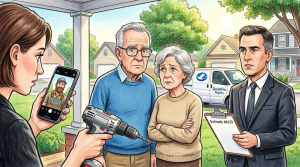
There was a man kneeling at my front door. He wore a utility vest and held a heavy‑duty power drill, and he was systematically destroying my deadbolt.
That was shocking enough. But it was the audience standing three feet behind him that made my stomach drop through the concrete.
My mother, Marjorie Whitman, was holding her phone up, panning it slowly across the front porch and the entryway as if she were filming a segment for a lifestyle channel. She was wearing her Sunday church blazer, the beige one with the gold buttons. On a Tuesday morning. Next to her stood my father, Dale. He had his arms crossed over his chest, his posture rigid and authoritative, nodding at the man with the drill like a foreman inspecting a construction site.
And there was a third person, a man I didn’t recognize. He looked slippery—the kind of man who wore a suit that was slightly too shiny and a smile that didn’t reach his eyes. He was holding a clipboard and tapping a pen against his chin, watching my mother film with an approving nod.
I slammed my car door. The sound cracked through the suburban quiet like a gunshot.
The drilling stopped. The man in the vest looked over his shoulder. My parents turned.
“Stop,” I said.
It wasn’t a scream. It was a command, low and vibrating in my chest.
“What do you think you are doing?”
My father didn’t look guilty. That was the first thing that chilled me. A normal person caught breaking into a house would look terrified.
Dale Whitman just looked annoyed, like I was a delivery driver interrupting an important meeting. He checked his watch—a gold timepiece he’d bought when he retired—and frowned at me.
“You’re early,” he said.
Not hello. Not surprise. Just a criticism of my timing.
“I live here,” I said, walking up the driveway, ignoring the stranger in the shiny suit to stare directly at my father. “I come and go as I please. Why is there a man drilling a hole in my front door?”
“Standard maintenance, Harper,” my father said, his voice smooth, carrying that paternal tone he used to use when I was twelve and asked why I couldn’t go to a sleepover. “We’re upgrading the security. The old locks were flimsy.”
“The old locks were fine,” I said. “And I have keys to them. I do not have a key to whatever this guy is installing.”
“We’ll give you a copy for the transition period,” my mother chimed in. She lowered her phone, but didn’t put it away. She offered me a bright, strained smile.
“Oh, Harper, look at you. Your hair is wet. You’ll catch a cold.”
“Mom, stop,” I snapped.
I looked at the man with the drill. He was standing up now, looking between me and my father, sensing the tension.
“Who hired you?” I asked.
“I did,” the man in the shiny suit said.
He stepped forward, extending a hand that I absolutely did not shake.
“Gavin Holt, property consultant. Your parents have retained my firm to maximize the potential of their asset. We’re just doing some prep work for the listing photos.”
I felt the blood drain from my face.
“Listing photos,” I repeated.
“For the rental market,” Gavin said, his voice oily and confident. “The Aurora market is hot right now. Vacancy rates are under three percent. We need to get this unit on the market by the first of the month to capture the incoming transfer season.”
I looked at my father.
“You’re renting my house out?”
“We are renting the investment property out,” my father corrected.
He uncrossed his arms and placed his hands on his hips, full manager mode.
“Market conditions are optimal. Harper, we’ve been discussing this with Gavin for weeks. It makes no sense to have a three‑bedroom asset generating zero yield just because you want to rattle around in it alone.”
“I am not rattling around,” I said, my voice rising. “I live here. I bought this house. It is my home.”
“It is a family investment,” my father said, waving his hand dismissively. “We helped you with the down payment. We co‑signed. That makes it a partnership. And in this partnership, the majority vote says it’s time to liquidate the residency and pivot to income generation.”
I stared at him. The sheer audacity was so massive it was hard to comprehend. It wasn’t just greed. It was a complete rewriting of reality.
He wasn’t asking. He wasn’t suggesting. He was standing on my porch destroying my locks and telling me I was being pushed out of my own life because the market was good.
“No,” I said.
My father blinked.
“Excuse me?”
“No,” I repeated. “Get off my porch. Send the locksmith away. Tell this consultant to get in his car and drive until he hits Kansas.”
My father’s face darkened. The benevolent patriarch mask slipped, revealing the anger underneath.
“You do not give orders here,” he snapped. “Harper, you’re the occupant. We are the owners. Gavin explained the structure to us. Equitable interest means we control the disposition of the asset.”
“I don’t care what Gavin explained,” I said, shooting a glare at the consultant, who was now smirking slightly as he scribbled something on his clipboard. “I care about whose name is on the deed.”
The locksmith cleared his throat. He was a big guy holding the heavy drill like a shield. He looked uncomfortable.
“Look, folks,” he said, his voice gravelly. “I charge by the hour, but I don’t do domestic disputes. Who is the homeowner here? I need the owner to authorize the new key code.”
“I am,” my father and I said at the exact same time.
The air on the porch seemed to crackle.
“I am the senior investor,” my father said, stepping forward, using his physical size to try and dominate the space. He reached into the leather satchel my mother was holding and pulled out a thick sheaf of papers. “I have the documentation right here.”
He thrust a stack of paper toward the locksmith.
I glanced at it. It was a photocopy of a photocopy. It looked like the original closing documents from four years ago, but highlighted in yellow marker with sticky notes plastered all over the margins.
“See here,” my father said, pointing a thick finger at a line on the bottom of a page. “Dale Whitman, co‑signer. That is my signature. And here—” he flipped to another page “—financial guarantor. That gives me executive rights over the property management.”
The locksmith squinted at the paper. It was a mess of legalese, and to a layman, it probably looked impressive. He looked at my father, then at the suit‑wearing consultant, who was nodding vigorously.
“Mr. Whitman is the primary financial backer,” Gavin added smoothly. “Under Colorado equitable statutes, he has full right of access and modification.”
The locksmith looked convinced. He hefted his drill again.
“All right, as long as you got the paperwork. Look, miss,” he said, turning to me, his expression softening with pity. “Maybe you guys should sort this out inside. I just need twenty minutes to finish the deadbolt.”
My mother touched my arm.
“Come inside, Harper. We can pack your things. Gavin found a lovely efficiency apartment near the airport. It’s much more suitable for a single woman.”
Pack my things. An efficiency apartment. They hadn’t just planned to change the locks. They had planned to erase me.
I pulled my arm away from my mother like she’d burned me.
I didn’t scream. I didn’t cry. A cold calm washed over me—the kind of calm I used in my job as a compliance officer when I caught someone trying to bypass federal regulations.
“Wait,” I said to the locksmith.
“Miss, please,” he sighed.
“You want to see who owns this house?” I asked. “You want to know who actually pays for the roof you’re standing under?”
“I just need to know who signs the check,” the locksmith said.
“Fine,” I said. “Let’s follow the money.”
I pulled my phone out of my pocket. My hands were shaking, not from fear but from rage. But I forced my fingers to be steady as I unlocked the screen.
I opened my banking app. Face ID flashed and the numbers populated. I tapped on the transaction history. I filtered for “mortgage.”
I walked right up to the locksmith, ignoring my father, who was trying to block me, and shoved the screen in front of the locksmith’s face.
“Read that,” I said.
The locksmith squinted at the bright screen.
“Transfer… two thousand four hundred fifty dollars,” he read.
“And the date?” I asked.
“First of the month,” he said.
“And who is the sender?” I pressed.
“Harper Thompson,” he read aloud.
“Scroll down,” I commanded. “Read the one before that and the one before that.”
He scrolled.
“Harper Thompson. Harper Thompson. Harper Thompson.”
I took a step back.
“That is four years of mortgage payments. Every single cent paid by me, from my account, solely. I turned to my father. “Show him your receipt, Dad. Show him the transaction where you paid the mortgage this month or last month or any month in the last four years.”
My father’s face went red.
“That is irrelevant. The down payment is a gift letter—”
“I cut him off. “Remember? You signed a gift letter to the bank saying it was not a loan so I could qualify. You want me to pull that up too? Because it’s in my cloud storage.”
I turned back to the locksmith.
“These people are co‑signers. That means if I get hit by a bus and stop paying, the bank comes after them. It does not mean they own my house. It does not mean they can drill my locks, and it certainly does not mean they can push me out.”
The locksmith looked at the digital proof on my phone—crisp, undeniable, up‑to‑date banking records. Then he looked at the messy highlighter‑stained photocopies in my father’s hand. He looked at Gavin, who was suddenly very interested in the texture of the stucco wall and refusing to make eye contact.
The locksmith chuckled. It was a dry, humorless sound.
He reached down and unplugged his drill from the extension cord.
“Whoa,” the locksmith said. He began winding the cord around his arm. “I am out.”
“Wait,” my father barked. “We have a contract with you.”
“You misrepresented the job,” the locksmith said, tossing the drill into his tool bag with a heavy clank. “You said you were the owners and the tenant was vacating. You didn’t say the owner was standing right here showing me her mortgage receipts.”
“She is not the owner,” my mother shrilled, her voice cracking. “She is our daughter.”
“Lady, I don’t care if she’s your daughter or the President,” the locksmith said, hoisting his bag onto his shoulder. “I do not touch disputed property. Liability 101. If you want this lock changed, you bring me a court order. Until then, I am gone.”
He walked past me, and as he did, he tipped his chin at me.
“Sorry about the door, miss. The mechanism is damaged, but it’ll still lock from the inside with the deadbolt thumb turn. Just don’t lose your key.”
“Thank you,” I said.
We watched him walk to his white van, throw his gear in the back, and drive away.
The silence that followed was heavy and suffocating.
My father turned on me. The vein in his forehead was throbbing.
“What is wrong with you?” he hissed. “Do you have any idea how embarrassing that was? You treated us like criminals in front of a tradesman.”
“You were acting like criminals,” I said. “You were breaking and entering.”
“We are your parents,” my mother cried, clutching her phone like a talisman. “We are trying to secure your future. Gavin has a plan to generate three thousand a month in passive income. That money could go into a trust. It could help us retire. We are a family, Harper. Why are you so selfish?”
“Selfish?” I laughed, but there was no humor in it. “I’m selfish for living in the house I pay for?”
“You don’t understand finance,” Gavin interjected. He had recovered his composure now that the locksmith was gone. He stepped forward, flashing that used‑car‑salesman smile again.
“Harper—can I call you Harper? Look, emotion clouds judgment. Your parents are looking at the bigger picture. This property has appreciated forty percent. To let it sit as a single‑occupancy residence is financially irresponsible. We can leverage the equity—”
“Get off my driveway,” I said.
Gavin blinked.
“I’m just trying to mediate.”
“I’m not mediating with a trespasser,” I said. “If you’re not in your car in ten seconds, I’m calling the police. And unlike the bank, the police do not care about equitable interest. They care about who’s on the deed.”
Gavin looked at my father.
“Dale, perhaps we should regroup at the office. The environment here is hostile.”
“Go,” my father said to him, but his eyes were locked on mine, full of disappointment and rage. “We’ll handle her.”
Gavin nodded and scurried toward his car, a silver sedan parked at the curb.
“You have made a mistake, Harper,” my father said, his voice dropping to a menacing whisper. “You think that little banking app makes you big? You think you can cut us out? We built you.”
“You co‑signed a loan, Dad,” I said. “You didn’t build me, and you definitely do not own me.”
“We’ll see,” he said. “The bank listens to the people with the leverage, and we have more leverage than you think.”
He grabbed my mother’s arm.
“Come on, Marjorie. Let her cool off. She’ll realize how unreasonable she’s being when she sees the numbers.”
They marched down the driveway, creating a united front of indignation. My mother looked back once, her face twisted in a mix of sorrow and anger, as if I were the one who had betrayed them.
I stood on my porch, trembling slightly now that the adrenaline was fading. The morning sun felt too hot. The hole where the locksmith had started drilling was a jagged silver scar in the dark wood of my door.
I watched them get into their SUV. I watched Gavin get into his silver sedan, and that was when I saw it.
Gavin’s car was parked directly in front of my mailbox. The back seat was full of cardboard signs. Through the rear window, I could clearly read the top one.
It was professional, printed in bold red and white letters.
PRE‑LEASE TODAY. THREE BED, TWO BATH. AVAILABLE IMMEDIATELY. CONTACT GAVIN HOLT CONSULTING.
I felt a cold shiver go down my spine that had nothing to do with the chlorine from the pool.
Available immediately.
They hadn’t come here to ask. They hadn’t come here to discuss. They hadn’t even come here to warn me. They had come here to execute a plan that was already in motion.
They weren’t preparing to list it. They had already started marketing it. Somewhere out there, people were probably already looking at photos of my living room, thinking it was available.
My father’s words echoed in my head.
“The bank listens to the people with the leverage.”
I realized then that this wasn’t just a domestic dispute. They weren’t just overstepping boundaries. They were playing a game with rules I didn’t know, using paperwork I hadn’t seen.
I looked down at my phone. The banking app was still open.
“I made a mistake,” I whispered to the empty driveway. “No, Dad. You made the mistake.”
I didn’t go inside to pack. I didn’t go inside to cry.
I tapped the “Contact Us” button on the banking app. I pressed the icon for a phone call.
I wasn’t going to argue with my parents anymore. I wasn’t going to debate ethics with a consultant like Gavin Holt.
I was going to do the one thing that cuts through every lie, every delusion, and every family “understanding.”
I was going straight to the institution that actually held the deed.
I held the phone to my ear, listening to the ring, watching the dust settle on my driveway. My parents thought they were investors.
They were about to find out they were just liabilities.
I walked inside and locked the deadbolt. It was a futile gesture considering the lock was half destroyed, but the mechanical click gave me a sliver of psychological safety.
The house was silent. It was the kind of silence I used to crave—the silence I had fought tooth and nail to afford. But now it felt heavy. It felt like the air inside a courtroom before the judge walks in.
I went to the kitchen island and set my phone down on the granite countertop. I stared at the banking app, the screen dimming and then going black.
To understand why I did what I did next, you have to understand that this house was not just a collection of wood and drywall to me. It was the wreckage I had clung to after my life fell apart.
I was thirty years old when I signed the divorce papers. My ex‑husband had been charming, ambitious, and fundamentally incapable of telling the truth about our finances. By the time I extricated myself from that marriage, my credit score was a smoking crater, and my self‑esteem wasn’t much better.
I spent two years rebuilding. I lived in a studio apartment that smelled like boiled cabbage and listened to my neighbors argue through paper‑thin walls. I worked sixty‑hour weeks at North Bay Compliance Group, climbing from a junior auditor to a compliance manager. I saved every dollar that didn’t go to rent or basic sustenance. I stopped eating out. I stopped buying clothes. I became obsessed with stability.
Then came the year 2020.
The world went mad. Interest rates hit the floor, and I saw a chance to reclaim my dignity.
I found this house in Aurora. It was a three‑bedroom ranch‑style build from the eighties. Outdated but solid. The price was three hundred fifty thousand dollars. It was a stretch, but I could make the monthly payments.
The problem was the bank. Because my credit history still had bruises from my divorce and because the lending market was jittery during the pandemic, the underwriter balked. They wanted more assurance.
That was when my parents stepped in.
I remember the conversation vividly. We were sitting on their back patio in the United States, the late‑afternoon Colorado sun slanting across the yard. My father, Dale, had poured himself a scotch and looked at me with what I thought was pride. He said that family helps family. He said they had some liquidity from selling a rental property in Florida. They offered to give me twenty thousand dollars for the closing costs to lower the loan‑to‑value ratio. And more importantly, they offered to co‑sign the mortgage to get the approval across the finish line.
I hesitated. I remember asking my mother, Marjorie, if this would put any strain on them. She had squeezed my hand and told me that my happiness was their only investment.
We signed a gift letter. That’s a crucial piece of paper in American real estate. It is a legal affidavit stating that the money provided is a gift, not a loan, and that there is no expectation of repayment.
My father signed it. My mother signed it. We sent it to the lender.
For four years, I honored that trust. I paid every single mortgage payment. I paid the property taxes. I paid the insurance. I paid for the new roof when a hailstorm shredded the shingles last summer. I paid for the water heater when it flooded the basement. My parents never put another dime into the property after that initial closing day.
But people change. Or maybe circumstances just strip away the polite veneer and reveal who people really are.
My parents retired eighteen months ago. The market downturn hit their portfolio harder than they expected. Inflation ate into their fixed income. The comfortable American retirement they’d bragged about started to look a little thin around the edges.
I noticed the change in our Sunday dinners. The conversations shifted from golf and gardening to complaints about gas prices and the cost of healthcare.
Then came the comments about my house.
It started innocently.
“It’s so much space for just one person, Harper,” my mother would say when she visited.
Or my father would ask, “Do you really need a home office and a guest room? You’re hardly ever here.”
He was right about one thing. My job at North Bay Compliance Group requires travel. I spend about ten days a month on the road auditing satellite offices across the United States and ensuring corporate adherence to federal regulations. My house sits empty for a third of the month.
To me, that empty house was a sanctuary waiting for my return. To my parents, apparently, it was a wasted resource. It was a factory with the machines turned off.
I walked over to the fridge and pulled out a bottle of water. My hands were steady now. The shock of seeing the locksmith had burned off, replaced by the cold, hard clarity of my profession.
I deal with rules. I deal with contracts. I deal with people who think they can bend the line between “theirs” and “ours” without consequences.
At North Bay, when a manager tries to expense a personal vacation as a business trip, they always have a justification. They always say they earned it or that it doesn’t hurt anyone.
My parents were doing the same thing.
They had convinced themselves that because they helped me start, they owned the finish line.
They had mentioned Gavin Holt about two months ago. My father met him at a seminar titled “Wealth Preservation for the Modern Retiree.”
I had looked him up on LinkedIn back then. His profile was a buzzword salad of “asset optimization” and “legacy building.” He wasn’t a real estate agent. He was a consultant. That meant he charged fees for advice that didn’t have to adhere to the strict ethical codes of a licensed realtor.
Gavin had obviously looked at my parents—anxious, aging, and asset‑rich on paper but cash‑flow poor—and seen a feast.
He had planted the seed.
Why let a three‑bedroom house in a prime Aurora ZIP code sit empty when it could be generating three thousand a month? Why let a daughter live for “free” in a family asset when that asset could pay for cruises and medical bills?
They had dehumanized me in their eyes and certainly in Gavin’s spreadsheets. I was no longer Harper Thompson, their daughter who had survived a divorce and built a career. I was just a non‑paying tenant. I was an inefficiency in their portfolio.
I thought about the scene on the driveway, the way my father had said, “Market is good.” He wasn’t speaking to me. He was quoting Gavin. The way my mother had photographed my living room—she wasn’t capturing memories. She was creating marketing content.
And that sign in the back of Gavin’s car—PRE‑LEASE TODAY—that was the detail that turned my stomach.
Pre‑lease means you secure a tenant before the unit is even available. It means they had probably already promised this house to someone. They might have taken a deposit. They were likely planning to present me with a done deal, a signed lease and a move‑out date, expecting me to fold because “family helps family.”
They thought they could pressure me. They thought that because I was their daughter, I would bow to their authority. They thought that because they were co‑signers, they were co‑owners.
But they forgot what I do for a living.
I walked back to the island and picked up my phone. I unlocked it and looked at the banking app again.
I could have called my parents. I could have cried and begged them to respect my boundaries. I could have tried to appeal to their love for me.
But I knew that would fail.
You cannot use logic to fight greed, and you cannot use emotion to fight entitlement.
My parents had already justified this moral breach to themselves. They had rewritten the narrative so that they were the victims—the “poor retirees” with a supposedly selfish daughter “hogging a gold mine.”
If I argued with them, it would just be a family squabble. It would be he said, she said.
I needed a higher power.
I needed an authority that didn’t care about family dynamics, retirement anxiety, or equitable feelings.
I needed an entity that cared about one thing, and one thing only: the black‑and‑white reality of a contract.
I tapped the screen. The number for the customer service line of Harborstone Bank appeared.
I didn’t press the button immediately. I hesitated for exactly three seconds.
I knew that once I made this call, I was crossing a line. I was taking a private family betrayal and making it a matter of institutional record. I was potentially triggering a fraud investigation. I was likely destroying my relationship with my parents forever.
But then I looked at the front door. I looked at the wood shavings on the floor where the drill had bitten into the frame.
They had brought a drill to my home.
They were ready to physically breach my security to monetize my life.
They had declared war on my autonomy.
I pressed the call button.
The phone rang. It was that generic electronic trill that connects you to a call center somewhere in America.
“Thank you for calling Harborstone Bank,” a recorded voice said. “For English, press one.”
I pressed one.
“Please enter your sixteen‑digit account number or Social Security number,” the voice requested.
I entered my Social Security number, the one that was the primary identifier on the mortgage.
“Thank you, Harper,” the automated system said. “I see you are calling about your mortgage ending in 429. Is that correct?”
“Yes,” I said to the empty room.“Please describe the reason for your call,” the voice asked.
I took a deep breath.
“I need to speak to the fraud department regarding unauthorized access and potential title fraud.”
The robot paused. It didn’t understand the nuance, but it understood the keywords.
“I am connecting you to a specialist. Please hold.”
Smooth jazz music began to play.
I walked over to the window and looked out at the street. The locksmith was gone. My parents were gone. Gavin was gone. The street looked peaceful—just a row of suburban houses under the Colorado sun.
But my world had shifted on its axis.
I was not just a daughter anymore.
I was the primary borrower, and I was about to defend my territory.
A human voice cut through the music.
“This is Sarah with the Harborstone security team. Can I have your full name for verification?”
“Harper Thompson,” I said, my voice steady, cold, and professional.
“Thank you, Ms. Thompson. I see you are the primary on the account. How can I help you today?”
“I need to verify the current status of my title and my authorized users,” I said. “And I need to know if anyone other than myself has attempted to make changes to the mortgage terms or access the equity in the last thirty days.”
There was the sound of typing on the other end.
“Okay, let me pull that up,” Sarah said. “It might take just a moment.”
I waited. The silence on the line was thick.
“That is interesting,” Sarah said after a moment. Her tone had shifted from polite to alert.
“What’s interesting?” I asked.
“Ms. Thompson, did you authorize a third‑party inquiry regarding a refinance application last week?”
My hand tightened around the phone.
“No,” I said. “I did not.”
“And did you authorize a request to change the mailing address for official correspondence to a P.O. Box in downtown Denver?”
“No,” I said. “I absolutely did not.”
“Okay,” Sarah said. “We have a problem.”
“Yes, Sarah,” I said, looking at the scar on my door. “We definitely do.”