I CAME HOME FROM A SIX-MONTH DEPLOYMENT IN MY DRESS BLUES TO FIND A SOLD SIGN ON MY LAWN
When the taxi pulled away, the first thing I saw wasn’t home.
It was the SOLD sign stabbed into the middle of my front lawn like a flag planted by an invading army.
For one second my brain refused to process it. I just stood there at the curb in my dress blues with my duffel over one shoulder, medals glinting against my chest in the weak October sunlight, and stared at the red block letters. SOLD. The grass around the sign was still perfectly cut, the edges of the walkway still trimmed the way I had trimmed them myself before I deployed, and the house beyond it still looked, at first glance, like mine.
Then I saw the men in coveralls.
They were coming out through the front door two at a time, carrying the contents of my life in careless armfuls and pitching them into a construction dumpster parked at the curb. Books. Storage bins. Framed commendations. A lamp from the living room. The cedar chest that had belonged to my mother. One of them swung a garbage bag full of my winter clothes and let it slam against the rusted steel side of the dumpster before heaving it in like he was clearing out a dead relative’s junk.
And there, standing on my porch with beers in their hands as if this were some kind of tailgate, were my father Richard and my younger brother Caleb.
Neither of them looked surprised to see me.
That was the first clue this had been planned down to the minute.
Richard didn’t smile. He didn’t wave. He didn’t call me honey or kiddo or any of the names he used in public when he wanted people to think he was the kind of father whose love came naturally and without condition. He just lifted his beer, pointed lazily toward the dumpster with two fingers, and said, “You don’t live here anymore. We cashed out.”
My bag slid an inch down my shoulder.
That was the only outward sign that anything in me moved.
Inside, something did move—fast and sharp and lethal—but I had spent too many months in too many places where emotional control wasn’t a virtue, it was survival, to give them what they wanted. Panic is a luxury for people who have never learned that the first person to lose composure usually loses everything that matters next.
So I adjusted the strap on my bag, lifted my chin, and started walking up the driveway.
My boots crunched over the gravel in a steady, even rhythm. It was the same rhythm I’d used crossing tarmacs, compounds, perimeter roads, embassy corridors, and one airstrip in a country I’m still not allowed to name in writing. Ten years in military logistics and intelligence had taught me one lesson more clearly than any other: the loudest person in the room is usually the most fragile.
My father expected noise from me.
He expected disbelief, screaming, maybe tears.
He expected the version of me he had spent my whole life trying to keep alive—the emotional daughter, the one who could be manipulated if you turned guilt and volume up high enough.
Instead, what he got was a woman who looked at the scene the way she might look at an ambush site. Not shocked. Just assessing.
I was twenty-nine years old. I had just come home after six months in a high-security zone where sleep came in fragments and trust was rationed like ammunition. The idea of home had been the one soft thing I allowed myself out there. I’d pictured this exact driveway more times than I could count. The maple near the garage already turning gold. The pale gray siding I had repainted myself. The brass porch light I’d replaced one summer afternoon after sweating through two T-shirts and cursing at ancient wiring. The front window where I had once sat through a thunderstorm with a book and felt, for the first time in my life, absolutely safe.
I had bought the house at twenty-two.
Fresh off my first deployment, still carrying half my weight in adrenaline and most of my savings in hazard pay. It wasn’t a big house, but it was mine—a three-bedroom Cape Cod on a quiet street with a postage-stamp front porch, oak floors that needed refinishing, and a backyard just large enough for a future I wasn’t yet ready to name. I had sanded those floors myself until my palms blistered. Painted the walls soft gray because white felt too temporary and dark colors made the rooms close in around me. Replaced the kitchen sink, fixed the fence, learned the difference between a mortgage rate and a predatory loan, all while doing reserve training, working rotations, and trying not to become the kind of soldier who couldn’t remember how to be a person at home.
The house wasn’t just property.
It was the first thing in my life no one could take credit for giving me.
Or at least that was what I had believed.
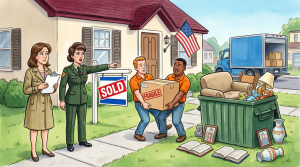
By the time I reached the foot of the porch steps, Caleb was smirking.
He had always been handsome in the smooth, infuriating way of men who never had to develop depth because beauty and charm bought them too much time. He was thirty-two, broad-shouldered, blond, still carrying enough of his old athletic build that strangers probably still assumed competence when they looked at him. If you didn’t know him, you might see a guy who had once been destined for something big. If you did know him, you saw the rot beneath the polish.
He had been the star in our family from birth, though no one would ever admit it that plainly.
The boy.
The athlete.
The one who mattered in that special, unspoken way sons matter to men like my father.
My mother died when I was seventeen, and after that the family gravity shifted completely around Richard and Caleb. My father had always liked me best when I was useful and quiet. Caleb, on the other hand, he loved actively. Fiercely. Destructively. Every mistake Caleb made became a problem to solve, never a lesson to absorb. Every broken promise got a fresh excuse. Every debt a new bailout. Every drunken fight, reckless girlfriend, missed opportunity, bad investment, or half-finished dream got wrapped in the same language: he just needs support, he’s going through something, he’s got too much potential to waste.
Potential, in my family, was another word for expensive male failure.
Caleb had once been a sports star.
In high school, he was the quarterback everybody in town came to watch on Friday nights. In college, for one shining year, he was the kind of athlete local papers wrote sentimental pieces about. Then came the blown shoulder, the transfer, the sports betting, the painkillers, the failed attempt at real estate, the online poker, the short-lived gym partnership, the crypto obsession, the inevitable slide from adored prospect to charming parasite. Every time he crashed, my father cushioned the fall with someone else’s money, someone else’s time, someone else’s sacrifice.
Usually mine.
Now he lifted his wrist and checked the time, and the sunlight caught the face of a brand-new Rolex.
It was gold and vulgar and expensive enough that I knew immediately where the down payment had gone.
“Thought you’d be later,” he said, like I had interrupted brunch.
I let my eyes rest on the watch for exactly one beat too long.
Then I looked at my father.
Richard was sixty-two and built like a man who had always expected rooms to part for him. He still had most of his dark hair, though now it was silver at the temples in a way women at church probably found distinguished. He wore pressed jeans, a quarter-zip sweater, and the kind of expression he usually reserved for waiters, junior associates, and people he was preparing to talk over.
“Caleb got into some trouble,” he said, taking another sip of beer as if we were discussing weather damage. “He owed the wrong people money. One hundred and twenty thousand, to be exact. We had to move fast.”
“We?” I asked.
My voice came out low, flat, almost curious.
It irritated him immediately.
He took the beer bottle away from his mouth and narrowed his eyes. “Family sacrifices for family.”
That sentence had been the backbone of my childhood.
It meant I gave up debate camp because Caleb needed private coaching.
It meant my college fund vanished into his rehab, then into a legal retainer, then into “business capital.”
It meant when I enlisted, my father told people proudly that I was serving my country while privately informing me I was abandoning my family. It meant every achievement of mine arrived to him already pre-converted into something Caleb deserved more.
I looked past him toward the open front door.
A man in coveralls came out carrying one of my framed commendations—the one for meritorious service during a classified supply recovery operation overseas. He didn’t even hold it upright. It hung crooked in his arm beside a box of books. Then he tossed both into the dumpster.
The glass cracked with a sound so precise it made my jaw clench.
“You sold my house,” I said.
“You don’t need a whole house,” Richard replied. “You’re never here. You’re deployed half the time, in barracks the rest. This was the practical choice.”
Practical.
I almost laughed.
There are words selfish people use when they want theft to sound mature.
Caleb tipped his beer at me. “It’s not like you had a family in there, sis.”
I turned back to him fully then, and for the first time since I stepped out of the taxi, my anger showed—not in movement, not in volume, but in the fact that he stopped smiling.
“You used the power of attorney,” I said.
It wasn’t a question.
Richard’s mouth twitched. “You signed it.”
I had.
Eighteen months earlier, right before my previous rotation, I had signed a military deployment power of attorney naming Richard as a limited emergency agent for certain personal matters if I became unreachable, medically incapacitated, or killed. I’d done it because one of the women in my unit had come home from a bad situation to find her accounts frozen and her landlord filing notices because no one had legal authority to act while she was in intensive care overseas. I had told myself I was being practical. I had told myself that if the worst happened, at least there would be a clean line of authority for insurance, medical decisions, temporary bill management.
What I had not told myself—because I did not want to see it—was that my father treated authority the way Caleb treated credit cards: as permission to take what was easiest.
“I signed a contingency POA for emergencies,” I said. “Not a blank check to loot my life.”
“It was legal,” Caleb said, spreading his hands.
“Then why did you wait until I was overseas?”
He didn’t answer.
Richard did. “Because if we had asked, you would have said no.”
Honesty, for him, usually arrived only after the damage was irreversible.
“And that bothered you?”
He stepped forward on the porch, using the height to make himself larger. It had worked on me once. It no longer did.
“You want to make this about you because you don’t understand scale,” he said. “This wasn’t a joyride. Caleb was in danger.”
“With loan sharks?”
“With consequences,” he snapped. “And I wasn’t going to let my son get buried because you insist on hoarding assets you don’t even use.”
There it was.
Not just justification. Resentment.
The house had offended him for years.
I remembered the day I bought it. The closing papers. The smell of the title office. The trembling in my hand when I signed because I had spent most of my life assuming stability was something other people inherited, not something I could build myself. I remembered inviting Richard over that first week because some stupid part of me had still wanted his approval. He stood in the living room, looked around at the stripped floors, the bare walls, the boxes, and said, “It’s a lot of house for one person. Caleb’s still sharing an apartment with two idiots while you play homeowner.”
Play homeowner.
That was how he had always treated my competence. As performance. As some temporary thing I put on like a costume while waiting to become useful to someone else again.
I looked back at the dumpster.
Near the top, half-hidden under a winter coat and a stack of old throw pillows, I saw a black fireproof document pouch with a zipper and a brass tag. Mine.
My pulse changed rhythm.
That pouch had lived in the bottom drawer of my home office desk.
Inside it—unless Richard had gone through it and discarded the contents separately—should have been the only paper in the house that mattered more than any weapon I had ever carried.
Forty-eight hours before my most recent deployment, on the advice of a JAG officer and a private estate attorney I trusted far more than my family, I had transferred the title of the house into the Jordan Revocable Living Trust. The move had been boring, unromantic, and absolutely essential. It insulated the property from personal liability, simplified certain future planning decisions, and—most important now—removed the house from the reach of any power of attorney that did not explicitly govern trust assets.
Richard knew nothing about it.
I had never told him.
I had never told anyone in the family.
Not because I expected this exact scenario. Because my work had taught me that if you have something worth protecting, you don’t advertise the route around your perimeter.
Apparently he had emptied my office, seen a boring black pouch, and decided it was junk.
That was the first real mistake they had made.
I stepped sideways toward the dumpster.
Richard misread the movement as defeat. “You can take what clothing you need,” he said. “There’s a motel off Route 40 where—”
I ignored him, reached into the dumpster, and pulled the document pouch free.
A cascade of loose papers slid toward the bottom. A notebook. An old tax file. My homeowners insurance binder. But the pouch itself felt weighted.
Still full.
Richard frowned. “What is that?”
I brushed drywall dust off the front and tucked it under my arm. “Maybe the most expensive thing you threw out.”
Caleb rolled his eyes. “God, you always do this dramatic pause thing.”
I unzipped the pouch just enough to confirm what I already suspected.
There it was.
The certified trust deed, thick cream paper, county seal, date stamp.
Still intact.
Still loaded.
A cold, clear calm settled over me then. The kind that arrives not when danger disappears, but when its shape finally becomes useful.
“Is the buyer here?” I asked.
Richard blinked. “What?”
“The buyer. Is she here?”
He straightened, sensing something changing but not yet understanding it. “She’s inside doing a final walkthrough. Don’t you dare make a scene, Jordan. She paid cash. We need this to close.”
Need.
Another revealing word.
I almost smiled.
“I wouldn’t dream of making a scene,” I said. “I’d just like to meet the woman who thinks she bought my house.”
And because fate occasionally has a sense of theater, the front door opened before he could stop me.
A woman in a beige pantsuit stepped onto the porch holding a leather portfolio under one arm and a sheaf of papers in her hand.
One look told me everything.
She was in her mid-forties, maybe, with perfectly styled hair that had not moved in the wind, nude heels that had never touched untreated soil, a square-cut diamond ring, and the restless eyes of someone who scans a room for leverage before warmth. She looked at me the way investors look at old flooring: in terms of how inconvenient it will be to remove.
“Is there a problem?” she asked.
Richard spoke first. “No problem. This is my daughter Jordan. She’s just upset about the transition.”
Transition.
I stared at him.
The woman shifted the deed packet higher in her hand. “Your father mentioned you might show up,” she said to me. “Look, honey, it’s done. Papers are signed. Funds are transferred. I need you off the property before I have to involve law enforcement.”
Honey.
I glanced past her into the foyer.
My shoes were gone from the mat.
The painting above the console table—mine, bought from a local artist with my first stateside bonus—was gone too. So were the books from the shelves in the den. The house already had that hollowed-out look evacuated spaces get, as if even the walls are startled by the speed of betrayal.
Then I saw Richard through the doorway by the kitchen island, waving a printed bank receipt like a campaign banner.
“It’s over, Jordan!” he called. His face was flushed with triumph. “One hundred twenty thousand wired straight to the lenders. Caleb is clear. The rest is in a secure account. You can’t touch it.”
He was proud.
That was the part that burned the deepest.
Not ashamed. Not desperate. Proud.
He thought he had orchestrated something clever. He thought this was the move of a patriarch making hard choices for the greater good. He genuinely believed the only injustice here was that I might object.
I turned back to the woman.
“You wired the full amount?” I asked.
She checked her watch, impatient. “Six hundred fifty thousand. Cash. Cleared ten minutes ago.”
“Without title insurance?”
That got her attention.
She narrowed her eyes. “I buy distressed properties all the time. I don’t need a lecture from a girl in a uniform.”
Behind her, Richard’s grin faltered very slightly.
He knew that tone.
It was the tone people used right before I dismantled something.
I took the document pouch from under my arm and slid out the top sheet.
“You really should have waited for the title search,” I said.
She scoffed. “I skipped the red tape to beat the market.”
“Did you?”
I unfolded the deed and held it where she could see the seal.
“This property is not owned by Jordan Merrick the individual,” I said. “It has been titled for six months in the Jordan Revocable Living Trust. I am the grantor and sole trustee. Richard Merrick is not a trustee, not a successor trustee, and not an authorized agent of the trust.”
She stared at the paper.
Richard took one step toward the doorway. “That’s not relevant. I have power of attorney.”
“You had a limited deployment power of attorney,” I corrected without looking at him. “It gave you authority over designated personal matters in case of emergency. It does not grant you the right to transfer or encumber trust-owned real estate. Not legally. Not remotely.”
I could actually see the sentence reach the investor in stages.
First confusion.
Then denial.
Then the first flicker of actual fear.
She snatched the deed copy from my hand and scanned the first page. Then the signature page. Then the trust notary seal.
“What is this?” she demanded.
“That,” I said, “is a certified copy of the recorded title transfer filed forty-eight hours before I deployed.”
Behind her, Richard stopped moving.
Caleb looked from his face to mine and back again, his own smugness beginning to slip.
“Dad?” he said.
Richard ignored him.
“You told me,” the woman said slowly, turning toward my father now, “that the property was in your daughter’s personal name and you held full authority to sell.”
Richard tried for indignation. “I do hold authority.”
“Over me as a person in a limited emergency capacity,” I said. “Not over trust assets. Which means the sale documents you signed are void. Which means the deed in her hand”—I nodded toward the investor—“is worthless. And because you induced a wire transfer across state lines based on misrepresented authority and a fraudulent conveyance, this isn’t just civil. It’s potentially federal.”
The word federal had a visible effect on everybody.
Sarah—that was the name printed on the top of her purchase packet, Sarah Delaney Capital Acquisitions—went pale with incredible speed.
“No,” she said, though she was reading the date stamp right there. “No. No, if that were true, it would have shown up in the—”
“In the title search you didn’t run?” I asked.
That landed.
Her gaze snapped to Richard.
“You said you had clean authority.”
“I do,” he said, but it had gone thin now. “I have the POA.”
“Show her the fine print, Dad,” I said.
He took the folded copy from his pocket with shaking hands.
Sarah grabbed it, skimmed the first paragraph, then flipped to the signature and limitations page.
The color left her face completely.
The document did what I knew it would do: it referenced emergency financial decisions regarding listed accounts, bill payment, limited personal transactions, and medical authority if I were incapacitated. It said absolutely nothing about any trust, any real estate transfer, any sale of titled assets not personally held.
“It’s gone,” Caleb whispered, not to anyone in particular.
Sarah turned on him first. “What?”
“The money,” he said. “It’s gone.”
Richard snapped, “Shut up.”
But it was too late.
Sarah took two fast steps into the kitchen, heels clicking like hammer blows against my refinished hardwood. “Reverse the wire,” she said.
Richard backed up. “I can’t.”
“What do you mean you can’t?”
He hit the refrigerator with his shoulders and looked suddenly older than he had five minutes earlier. Sweat gathered at his temples.
“I already sent it,” he said. “The one-twenty to Caleb’s lenders. The rest moved this morning. It’s in another account. I just need—”
“How much of my money is left?”
Silence.
Caleb, idiot that he was, looked at his watch.
Sarah followed his glance.
Her eyes fixed on the Rolex.
That was the second real mistake they had made.
Not the fraud. Not the forged confidence. Flaunting the spending before the body was even cold. Predators respect greed in theory. They despise being forced to look at the proof of it in gold.
Sarah’s entire demeanor changed.
The investor vanished. In her place stood a woman who had just realized she had been conned so badly it would echo through every room she did business in.
“You wired six hundred fifty thousand dollars,” she said, each word carved out separately, “for a deed your seller had no authority to execute, and then distributed the proceeds before the transfer legally closed.”
Richard swallowed. “We can work this out.”
She laughed once, and the sound had no humor in it. “You don’t get to say ‘we’ anymore.”
Then she took out her phone and dialed 911.
Richard lunged forward. “Don’t.”
She pivoted away from him and said, very clearly, “I need to report a real-estate fraud in progress. Significant financial theft. The seller is on-site. So are witnesses.”
Caleb cursed under his breath and sat down hard on one of the kitchen stools as if his legs had given up.
I stayed where I was in the doorway, one shoulder against the frame, the trust deed folded once more in my hand.
The scene had tipped exactly the way I had hoped it would.
Richard knew it.
He looked at Sarah making the call, at Caleb staring down at the floor, at the workers outside pausing now and pretending not to listen, and then his eyes came back to me.
The panic in them hardened into something uglier.
Not guilt.
Never guilt.
Rage.
“You did this,” he said.
There it was. The only conclusion narcissists ever reach when their own actions trap them. Someone else made it happen.
I held his gaze.
“I signed the papers you put in front of that woman?” I asked.
“You stood there and let me.”
“No,” I said. “I gave you a chance to tell the truth.”
“You set me up!”
The workers had stopped hauling now. One of them was leaning on the dumpster door. Across the street, old Mr. Halpern had come out onto his porch. His wife stood just behind him in a cardigan, both hands over her mouth. Down the block, another neighbor was pretending to walk her dog but had not actually moved more than three feet in the last minute.
That, more than the legal danger, was what Richard couldn’t tolerate.
Witnesses.
He had built his life on appearing like the benevolent patriarch: booster-club donor, Rotary treasurer, deacon, youth coach, family man. The idea that neighbors would see him as a thief in his own daughter’s doorway was intolerable to him in a way prison might not have been.
“You wanted them to see this,” he said, voice rising. “You wanted to humiliate me.”
I laughed quietly.
“No, Richard. You humiliated yourself. I just turned on the lights.”
He actually flinched at Richard.
I had not called him Dad in years when we were alone. But saying his name in front of others, stripped of title, did something to him. It made the hierarchy visible in a way he couldn’t control.
“I raised you,” he shouted. “I gave you everything.”
That was the script. The one men like him always returned to when power wobbled.
I thought of the house I’d bought with my own hazard pay.
Of the scholarships I’d earned.
Of the part-time jobs.
Of the deployments.
Of the nights I came home and fixed my own plumbing because asking him for help would have cost me three years of future leverage.
“You didn’t give me this house,” I said. “You tried to steal it.”
He was pacing the kitchen now, trapped between the island and the fridge, fury making him clumsy. “Your brother could have been killed over this debt!”
“Then he should have thought about that before taking it.”
“Family protects family!”
“Family doesn’t liquidate their daughter’s home while she’s deployed.”
Sarah ended her call and turned back toward us, every line of her body tight with controlled violence. “Police are on the way,” she said. “And unless you want fraud charges multiplied by assault, you will not touch me, you will not touch my phone, and you will not leave this house.”
Richard pointed at me instead. “She manipulated this. She knew.”
“Yes,” I said. “I knew how to protect myself. That’s what bothers you.”
Sirens sounded in the distance.
Not close yet.
But coming.
Caleb stood up so fast the stool tipped over behind him.
His face had gone gray under the tan. The Rolex looked ridiculous now, obscene and juvenile on a wrist that had started to shake.
He looked from Richard to Sarah to me, doing frantic math.
Then he bolted.
Not out the front door.
Toward me.
For one split second I thought he was going to shove past and run. Instead he stopped so close I could smell his cologne and the stale trace of nicotine in his clothes. He held up his phone, screen already lit.
“You think you won?” he whispered.
On the screen was an email draft.
Addressed to my division’s Inspector General office.
The subject line: Urgent Report of Classified Asset Diversion.
Below it were attached PDFs. Screenshots. Fake invoices. What looked, at first glance, like military procurement forms with my name and signature block copied across them. Some idiot version of a trail suggesting I had diverted equipment or sold materiel off-books.
He must have gotten the templates from files on my old home office laptop before they tossed it.
For a lesser civilian target, it might have worked.
For me, it was pathetic.
But he didn’t know that.
“One anonymous report like this,” he said softly, and there it was again, that same family instinct to weaponize systems against me, “and your clearance freezes. Your career stops cold. Investigations. Seizures. You know the drill. So here’s the deal: you tell them it was all a misunderstanding, you sign the house over clean, and this never gets sent.”
I looked at the phone.
Then at him.
Then I laughed.
Not loudly. Just enough.
It hit him harder than a scream would have.
“Go ahead,” I said.
He blinked. “What?”
“Send it.”
For the first time since I’d stepped out of the taxi, uncertainty crossed his face.
I leaned in slightly.
“My equipment trails are audited monthly. Every serialized item. Every movement request. Every procurement request. Every transfer. Every discrepancy triggers internal review before it ever becomes an IG issue.” I tapped one of his fake attachments with one finger. “You used the wrong form template. That one was discontinued last year.”
His eyes widened.
“And those invoice numbers?” I added. “You copied civilian contractor formatting onto a military asset record. If you send this, you’re not exposing me. You’re handing federal investigators a packet of fabricated documents tied to your IP history and your phone.”
Sarah, who had stepped close enough to hear, made a short sound of disbelief.
Caleb’s confidence broke all at once.
His thumb hovered over the send button, then jerked away as if the screen had burned him.
“That’s not—”
“It’s extortion,” I said. “In front of witnesses.”
The sirens stopped outside.
Blue and red light rolled across the kitchen walls.
Caleb looked toward the window.
Panic, real panic, finally took him. He started to back away. Then, in one graceless movement, he shoved the phone toward his pocket.
I reached out and caught his wrist.
Not hard.
Just enough.
The years of training made it effortless.
He gasped more from surprise than pain.
When the officers entered through the still-open front door a second later, the picture they got was simple: one man sweating by the fridge, one investor holding a fraudulent deed packet, one son trying to pocket a phone while I held his wrist and said, very clearly, “He’s attempting to extort me with falsified federal documents. I want that device seized.”
Everything after that moved quickly.
Too quickly for Richard to regain control.
Too quickly for Caleb to invent a new script.
Too quickly for Sarah to cool down into strategy.
The first officer separated us immediately and asked for names. The second took Sarah aside. The third, older and harder around the eyes, recognized me from somewhere—not personally, but from the uniform, I think, and the way I was standing. He looked at the trust deed in my hand, then at the papers on the island, then at Richard.
“Who signed the sale documents?” he asked.
Richard tried one last pivot.
“It’s a family misunderstanding.”
Sarah laughed in his face.
“No,” she said. “It’s felony fraud.”
The officers were professionals, but even professionals have expressions when the facts line up too neatly for comfort. Within minutes, Richard was in handcuffs in the kitchen he had just tried to sell out from under me. Caleb too, after they took the phone and scrolled just far enough to see the drafted accusation and attached forged files.
“It was a joke,” Caleb said.
No one answered him.
Jokes are rarely composed as extortion leverage in the middle of a fraud investigation.
Richard was louder.
He cycled through the whole script in under two minutes. It’s a misunderstanding. She’s unstable. The buyer is overreacting. This is a civil issue. I have authority. She knew. She let it happen. He landed, inevitably, on fatherhood as entitlement.
“I’m her father,” he told the officer, like biology was a notarized defense.
The officer replied, “That doesn’t help your case, sir.”
Neighbors watched openly by then.
Mr. Halpern had crossed the street. Mrs. Alvarez from two houses down stood in her robe on her own lawn with one hand over her eyes because she couldn’t quite believe the theater of it. The workers in coveralls had stepped so far back they were practically in the gutter, suddenly very eager to be nobody’s accomplices.
When Richard was led through the front door in cuffs, he turned once toward me.
Not to apologize.
To accuse.
“This is on you,” he said.
Maybe he believed it.
Maybe men like him always do, right to the end.
I looked at him standing on my porch in handcuffs, his reputation draining out onto the gravel for the whole street to see, and I felt something in me finally unclench.
“No,” I said. “This is on paper.”
The officer took him down the steps.
Caleb followed a minute later, smaller somehow, stripped of the athlete’s shine and the parasite’s swagger. He glanced once at me with something like hate, then once at the phone in the evidence bag, and I knew exactly what he was thinking.
Not I shouldn’t have done it.
I shouldn’t have been caught.
That, too, was ordinary in our family.
Sarah stayed long enough to give a statement and three versions of the same threat regarding lawsuits, criminal referrals, and her investors. I did not feel sorry for her, not entirely. She had come in predatory and impatient, willing to skip due diligence for the promise of a faster flip. But there are different kinds of predators, and some of them still dislike being eaten by someone dumber than they are.
At one point, after the officers had taken both men out and the house had fallen into the strange echoing quiet of emptied conflict, she looked at me across the kitchen island and said, “You knew.”
“Yes.”
“You let me wire the money.”
I considered that.
“I gave you three opportunities to ask the right questions,” I said. “You chose speed.”
She stared at me for a long moment, then gave a short, humorless nod.
Fair enough.
When she left, she did not say goodbye.
The police took statements in my living room while the workers, under supervision, began hauling my things back out of the dumpster and carrying them inside. One of them handled my commendation frame with an embarrassed sort of care now, as if retroactive gentleness could erase the fact that he had treated it like scrap. The glass was cracked but the certificate inside was intact. The cedar chest had a gouge in the lid. My winter coats smelled faintly of drywall dust. The document pouch sat on the coffee table beside me like a loaded weapon that had finally discharged.
An hour later, the cruisers were gone.
The neighbors drifted back to their houses in clusters of murmured disbelief.
The workers finished re-stacking what they could salvage in the foyer and took off without collecting the rest of their payment from a man who was no longer available to write checks.
Then it was just me.
Me and the house.
Or rather, me and the emptiness left behind by the attempt.
There are silences that feel like peace and silences that feel like a blast wave after the noise. This was the second kind. The rooms were half-stripped. The walls looked oddly bare where frames had been taken down. The living room rug was rolled up and leaning against the far wall. Every closet door in the upstairs hall stood open. The place looked like a family had been in the middle of moving out when the world split.
I walked through it slowly.
Not checking for damage.
Memorizing survival.
In the guest room, two drawers had been pulled from the dresser and left on the floor. In my office, filing boxes had been dumped out and kicked half open. In the kitchen, there was still a ring from Richard’s beer bottle on the island. I stared at it for a long time before wiping it away with the edge of my sleeve.
By the time I reached the primary bedroom, the sun had shifted. Late light poured in across the floorboards, catching dust in the air. My deployment bag sat in the doorway where I’d dropped it when I arrived. My bed was stripped bare, mattress naked, sheets gone.
I sat down on the edge of the frame and let myself feel it then.
Not grief exactly.
Not rage either.
Something like the hard, delayed tremor after a firefight when the body realizes it’s still alive and no longer has an immediate task to justify its tension.
They had not just tried to sell my house.
They had tried to erase the version of me that existed without their permission.
That mattered more than the fraud, somehow.
My house had always offended them because it was proof that I could build a life that did not center their needs. Caleb saw it as unfair inventory. Richard saw it as withheld tribute. Neither of them could tolerate the fact that I had taken military discipline, hazard pay, sleepless nights, and every lesson this world had carved into me and converted them into stability.
So they had tried to take that stability and call it family.
They had failed.
I stood, went downstairs, and closed the front door.
Then I changed the security codes.
The panel beeped once, politely.
New master code accepted.
It was a small sound.
But it landed in the house like a verdict.
I stood there with one hand resting on the wall by the keypad and listened to the clean silence afterward.
For the first time in years, there was no one in the rooms expecting something from me. No one needing cover. No one drafting me into a crisis they had built with their own appetites and carelessness. No one calling it loyalty because they wanted access to my labor.
Outside, the SOLD sign still leaned crookedly in the lawn where the workers had planted it.
I walked out, pulled it from the ground, and threw it into the dumpster.
Then I came back in, locked the door, and stood in the middle of my living room while the last of the evening light faded around me.
I wasn’t happy.
Not yet.
There would be statements, lawsuits, title corrections, maybe press because of my work, definitely gossip because of the neighborhood, and years, probably, of fallout from the kind of family fracture that doesn’t mend just because the law gets involved. There would be paperwork. Attorney calls. Motions. Evidence chains. Insurance claims. There would be quiet nights when I’d wake up hearing Richard say we cashed out and have to remind myself that he had not, in fact, won.
But in that moment, standing in the stripped-down shell of the only place on earth I had ever truly made for myself, I had something more important than happiness.
I had my perimeter back.
And after six months in a high-security zone, after a lifetime in a family that treated me like backup funding with a pulse, that was enough.
It had to be.
Because safety comes first.
Everything else gets rebuilt after.