MY DRUNK GOLDEN-BOY BROTHER CRASHED MY CAR THROUGH A DESIGNER BOUTIQUE, RAN OFF INTO THE NIGHT
The first thing I heard after the crash was steam.
It hissed out of the crushed radiator of my Toyota Camry in one long furious stream, like the car itself was trying to curse us with its last breath. Glass glittered across the alley in wet shards. The front half of my hood had disappeared through the shattered display window of Luso, the most expensive boutique in town, and one of the mannequins from the front display had pitched forward onto the windshield in a frozen, elegant death pose. It wore a silver gown that probably cost more than the Camry had when I bought it.
And then, through the steam and the smell of burnt rubber and coolant and broken plaster, I heard the second sound.
Running.
Hudson didn’t say my name. He didn’t ask if I was okay. He didn’t even look back.
He just shoved open the driver’s side door, stumbled once on the curb, then ran hard down the alley in his designer sneakers and his navy-and-gold varsity jacket, the back of it flashing GOLDEN BEARS under the streetlight before he vanished around the corner.
I stayed where I was in the passenger seat for a second too long, gripping the edge of the crushed dashboard and trying to remember how to breathe.
My chest hurt where the seat belt had locked across it. My right knee had slammed into the glove compartment. Something warm trickled down the side of my neck—not blood, just sweat and the fine shaking aftermath of adrenaline—but in that moment I couldn’t tell. The world was all noise and light and pain and disbelief.
Hudson had done this.
Hudson had been drunk, laughing, swerving with one hand on the wheel like he was filming himself for some private highlight reel, and now my car—my car, the one I had bought with years of scraped-together paychecks—was buried in Italian silk and broken glass while he ran like the consequences belonged to someone else.
Which, I realized a moment later, they probably did.
Because in our family, they always did.
I fumbled for my phone to call 911, but before I could unlock the screen, a black SUV swung into the alley so fast its tires screamed against the wet pavement.
My parents.
Of course.
For a stupid half second, the sight of the car made something inside me unclench. The old reflex. The child part of me that still believed parents arrived to help. Then my mother was out of the passenger side before the SUV had fully stopped, and I saw her face.
Not fear.
Not concern.
Calculation.
She didn’t come to my door. She didn’t ask if I was hurt. She went straight to the open driver’s side, leaned in, and scanned the seat, the wheel, the center console.
“No airbag,” she muttered, sharp and almost relieved. “Good.”
I stared at her. “Mom—”
“No blood on the wheel,” she said next, as if she were taking inventory in a store. “Good. Very good.”
My father came around the front of the SUV with that same look he wore in boardrooms, charity galas, and parent-coach meetings when he had already decided what the outcome of the conversation would be. He was tall, broad-shouldered, immaculate even at midnight, in a camel overcoat over a dark suit that smelled faintly of Scotch, cedar, and money. He glanced once at the storefront, once at me, then lifted his eyes toward the alley corner where Hudson had vanished.
“He ran?” he asked.
“Yes,” I said. My voice came out cracked and too thin. “He ran. He drove through a building and then he ran.”
My father’s jaw flexed once.
My mother straightened and finally looked at me. “Were you seen?”
“What?”
“By anyone,” she snapped. “Did anyone see him get out?”
I stared at her, trying to understand how we had moved so quickly from disaster to damage control, how the entire universe had apparently skipped right past the part where a mother checked whether her daughter was alive.
“I don’t know,” I said. “I wasn’t exactly taking notes.”
My father stepped in closer. “Listen to me carefully, Blair.”
The use of my full name in that tone was never a good sign. It meant he was no longer speaking as a father. He was speaking as an executive closing a deal.
“Hudson has the draft combine next month,” he said. “There are scouts watching him now. Interviews. Background checks. Media interest. If this becomes a DUI, if it becomes a hit-and-run, if it becomes public at all, it’s over.”
I laughed once because I genuinely thought I had misheard him.
“It should be over,” I said. “He could have killed someone.”
“No one was killed,” my mother said briskly. “And if you had let him drive somewhere other than this stupid alley, he wouldn’t have overcorrected.”
I looked at her.
I think that was the exact second the last decent illusion I had about my family burned away. Not exploded. Burned. Slow and final.
“You made me get in the car,” I said. “Both of you did. You said I was being dramatic because he was ‘just blowing off steam.’”
My mother made a dismissive sound. “This is not the time for one of your emotional recaps.”
My father moved close enough that the headlights from the SUV cut one half of his face into shadow. “Here is what is going to happen,” he said. “You were driving. You swerved to avoid a dog or a deer or whatever else makes you sound panicked and incompetent instead of criminal. You were upset. You left the scene briefly. Now you’re in shock. That is the story.”
I felt the cold air hit the sweat at the back of my neck.
“No.”
“Blair—”
“No,” I said louder. “Absolutely not. He did this. He was drunk. He needs to face it.”
My mother turned fully toward me then. Her expression had gone from sharp to something flatter and meaner.
“And you?” she said. “What exactly do you need to face, Blair? Another extension on your thesis? Another semester of pretending your English degree is a career plan?”
I just stared at her.
Hudson was the athlete. Hudson was the investment. Hudson was the future wrapped in a six-foot-two body and a slapshot that made grown men in team jackets follow him around with clipboards. I had been hearing versions of this hierarchy my entire life, but usually it came dressed in softer language. Hudson needs more structure. Hudson’s opportunities are time-sensitive. Hudson has talent that must be protected.
This was the naked version.
My father folded his arms. “You are one semester from graduation in a field that does not generate income. Hudson is a top prospect. We have spent years and millions putting him where he is. We are not sacrificing his future over a night of bad judgment.”
“A night of bad judgment?” I said. “He drove my car through a storefront.”
“And if he gets charged, his career is over,” my father said. “Do you understand how much is riding on this?”
I did understand.
That was the problem.
I understood exactly how my family worked. I understood that Hudson’s future had been converted into currency years ago, that his talent no longer belonged to him entirely, if it ever had. My parents had built their identities around him: the gifted son, the future pro, the one who justified their private coaches, travel teams, camps, equipment, club memberships, donations, and social climbing. Hudson wasn’t just their child. He was their most profitable project.
And me?
I was the person they expected to absorb the collateral damage.
Sirens sounded in the distance then, thin at first, then louder.
My mother’s head snapped toward the mouth of the alley.
My father stepped even closer, lowering his voice to a hiss. “If you refuse, we cut off your tuition tomorrow. Your apartment lease? Gone. Your health insurance? Gone. Your phone, your car insurance, your access to the emergency fund—gone. You’ll be out on the street before the week is over.”
I felt something inside me go very still.
They knew exactly where to put the knife.
I was twenty-one and one semester away from finishing college. I had no safety net besides them because they had carefully designed my life that way. I worked three part-time jobs, yes, but every spare dollar I had spent over the last two years had gone into buying that Camry outright because I’d wanted one thing in my life that belonged entirely to me. My tuition was still theirs. My apartment was in my father’s name. My insurance came through my mother’s company. My phone bill auto-paid through a family plan I was “not mature enough” to separate from. Even my tiny emergency savings account existed under a trust sub-account my parents monitored in the name of “financial guidance.”
Be a sister or be a stranger, my mother’s expression said before her mouth did.
“Make the choice,” she whispered.
The sirens were close now. Red and blue light began to strobe faintly off the wet brick walls of the alley.
My hands were shaking so hard I could barely feel my phone anymore.
I looked at my ruined car.
At the mannequin slumped across the hood like some warning from a very expensive ghost.
At my parents, standing there in their perfect coats, looking at me not with love or fear or even desperation, but with expectation.
Like I was an employee being told to take a hit for the company.
“Fine,” I whispered.
My father’s shoulders loosened.
“Good girl,” he said.
And then he did the thing that broke something in me so thoroughly I don’t think it will ever mend in the same shape again.
He reached into the inner pocket of his coat and pulled out his silver flask.
At first I thought he was going to drink from it. Some stupid, disconnected part of my brain actually believed that. Instead he uncapped it, stepped forward, and before I could move, he splashed the whiskey all over the front of my hoodie, my throat, my hair.
I gasped. It was ice-cold and nauseatingly strong, the smell rising off me instantly.
“There,” he said calmly, capping the flask. “Now you smell right.”
My mother nodded once in approval.
He leaned into the passenger side of the car, wiped the neck of the flask with his handkerchief, then tossed it onto the floorboard by my feet.
“You were driving,” he said. “You were drinking. You panicked. You are sorry.”
My mother was already backing toward the SUV. “Don’t ruin this,” she said.
Then they got into the car and left me there.
Left me alone in the alley, soaked in whiskey, shaking from shock and pain, while the police arrived to process the version of the truth they had prepared for me.
The holding cell smelled like old bleach, wet concrete, and the kind of hopelessness that lingers even after the people who made it leave.
I sat on a narrow metal bench with my knees pulled to my chest and my forehead resting against them, staring at the floor until the gray paint blurred. The whiskey on my sweatshirt had dried stiff and sour. The booking officer had taken my belt, my shoelaces, my phone, my wallet, my dignity, and half the skin off my fingertips with fingerprint ink.
I had been photographed under fluorescent lights that made me look exactly like what my parents wanted me to become: unstable, reckless, ruined.
The interrogation itself had been a fog of repetition.
Why did you leave the scene?
I didn’t leave. I was right there.
Why is there alcohol on your clothing?
I was drinking earlier.
How much?
I don’t know.
Why didn’t you call 911 immediately?
I panicked.
Why is there no measurable alcohol in your system?
I don’t know.
Do you want a lawyer?
No.
That last answer had come from reflex, not strategy. It hadn’t occurred to me yet that my parents had already arranged the entire thing.
The officers didn’t believe my story about swerving to avoid a dog, not really, but they had my confession, my car, the whiskey smell, the property damage, and the fact that I had stood there like an idiot waiting to be collected by the consequences. By the time the breathalyzer read 0.00, they were already irritated enough to interpret the result however they liked. One officer wrote something about delayed alcohol dissipation and emotional impairment. Another said maybe I’d switched to pills. It didn’t matter. Once a narrative forms around you, people stop looking for facts and start looking for supporting details.
I spent the night in custody.
My parents bailed me out at six in the morning.
The ride home felt longer than the arrest. No one spoke. Not because there was nothing to say, but because they had already said the only thing that mattered: this is yours now.
I sat in the back seat because my father had instructed me to, as if even sharing the front with them might contaminate the image they intended to present later. Dawn spread slowly across the sky in thin, gray strips. I watched familiar streets pass by and tried to imagine what version of myself I was supposed to become now.
By the time we pulled into the driveway, the house looked exactly the same as it always had. White stone, black shutters, the front oak still dripping from the night rain. You could have photographed it for a holiday card. You could have sold it as the home of a respectable family with values and ambition and a son destined for glory.
Inside, the kitchen smelled like bacon.
Hudson was sitting at the island in gray sweats and a compression shirt, his blond hair damp from the shower, his phone in his hand, laughing at something on the screen. He looked clean. Rested. Amused.
He didn’t even glance up when we came in until I dropped my booking packet on the counter hard enough to make the silverware rattle.
Then he lifted his eyes to me.
A slow smirk spread across his face.
“Rough night, sis?” he said. “You should really learn to handle your liquor.”
I stopped so fast my knee hit the island.
My mother moved around me to refill his orange juice.
“Eat your breakfast, sweetheart,” she said softly, as if he were the one recovering from a trauma.
I turned toward her. “Are you hearing him?”
She set the juice pitcher down and finally looked at me. Whatever softness she reserved for Hudson vanished instantly.
“Go upstairs,” she said. “Your father and I will decide how to proceed.”
“I’m not a child.”
“You are living under our roof,” my father said, unfolding the morning paper at the table as if he were preparing for a normal day. “On our money. Given the legal costs we’re about to absorb cleaning up your mess, you will do exactly as you’re told.”
“My mess?” My voice cracked. “He crashed my car.”
Hudson bit into a strip of bacon and said through the mouthful, “Allegedly.”
I lunged before I fully understood that I was moving. Not to hit him, not really. More to tear the smugness off his face with my bare hands. My father was faster. He caught my forearm in a grip so hard it sent pain shooting up my shoulder.
“Enough,” he said, low and lethal. “The narrative is set.”
I stared at him.
“If you deviate now,” he continued, “you compound the charges. False statement to police. Filing a fraudulent report. Obstruction. Perjury if it reaches court. You are too far in to turn back, Blair. Do not make this worse.”
Worse.
There is a point in every betrayal when language becomes obscene. Worse. As if the crime were my resistance to being used.
Hudson lifted his juice in a mock toast.
I think I hated him most in that moment not because he was cruel, but because he was comfortable. He was not wrestling with guilt. He was not afraid. He had spent his whole life being taught that trouble arrived for other people, never for him. He’d broken curfew, rules, bones, promises, and every time my parents had rearranged reality to absorb the damage. Coaches got persuaded. Teachers got donated to. Girlfriends got bought off with flowers or slander. Hudson did not survive consequences. He had never met them.
“Go to your room,” my mother said.
I laughed in disbelief. “I’m twenty-one.”
“And I can still have your phone deactivated before you reach the stairs,” she replied.
I looked at the counter automatically.
My phone was gone.
So were my laptop bag and keys.
They had already searched my things while I was in custody.
I went upstairs because rage is useless when your enemy controls the plumbing.
The next three days blurred into one long punishment dressed up as care.
My parents brought in a lawyer named Sterling—Martin Sterling, Esquire, gold cufflinks, sulfur breath under layers of peppermint, the kind of man who carried a hundred and fifty dollars’ worth of pen and somehow still wrote like a bureaucrat. He didn’t ask me what happened. He didn’t say, Tell me your version. He didn’t even pretend.
He handed me a legal pad with bullet points.
“You were under emotional stress from school,” he said. “You had been drinking alone earlier in the evening. You were embarrassed, so you delayed calling authorities. We are going to pursue a no-contest plea with a request for probation, community service, and court-ordered counseling. If you cooperate fully, jail is unlikely.”
“I wasn’t drinking.”
He gave me the kind of patient smile men reserve for the supposedly unstable. “I’m not interested in metaphysical truth, Blair. I’m interested in the version that will survive contact with a prosecutor.”
“I don’t need counseling.”
My mother, sitting in the corner like a queen overseeing a beheading, said, “You do if you want to stay in this family.”
That sentence should have sounded dramatic. In that room it just sounded administrative.
Sterling rehearsed me the way you rehearse a witness or a child in a pageant.
Yes, Your Honor.
I was overwhelmed.
No, this is not a pattern.
Yes, I’m willing to accept help.
No, I do not wish to contest the officer’s report.
He wanted me small, contrite, blurred. My parents wanted me unstable enough to be disbelieved, but not so unstable that I became inconvenient. It was a very fine line, and they walked it with practiced ease.
Worse than the legal coaching was the social poisoning.
I overheard my mother on the phone with my aunt telling a story about how “Blair has been struggling for months, and we had no idea how bad it was.” She spoke in a trembling voice full of pained dignity. She mentioned pressure, mental health, maybe alcohol misuse. By dinner, my cousin texted Hudson to ask if I was okay. By the next morning, a woman from church had sent my mother a message about a wonderful residential recovery retreat in Nevada.
They were making the lie bigger than the crime.
Because once you decide a person is unstable, the truth becomes something you can gently place out of reach.
I was not allowed my phone. Not allowed my laptop. Not allowed to leave the house. My father took my wallet “for safekeeping.” The door to my room did not lock from the inside, but it didn’t matter; they checked on me every few hours under the guise of concern and in practice of surveillance. Hudson passed the doorway sometimes and grinned like he was walking by a zoo enclosure.
By the fourth night I had stopped crying.
That scared me more than the crying had.
I was lying on the floor beside my bed, staring at the underside of my desk, listening to the hum of the vent and the distant thud of Hudson’s music in the basement. I was thinking, with terrible clarity, that my life had been professionally dismantled in less than a week. I would carry a record. I would lose my apartment. My degree would come attached to a story about collapse and rehab and poor judgment. Hudson would go on being Hudson, except now he would have a cautionary tale for interviews. My struggling sister. My family went through a hard time. I learned a lot about gratitude.
The thought made bile rise in my throat.
I rolled onto my side and looked at the pile of belongings my father had dumped on my dresser after the tow yard released the personal items from my car.
Wallet.
Lip balm.
A cracked sunglasses case.
A paperback copy of Middlemarch I’d been annotating for class.
And my car keys.
I stared at the key fob for a long time.
Then I sat up so quickly I nearly blacked out.
Two weeks before the crash, after three break-ins near campus, I had installed a dash cam.
Not a cheap one either. I had saved for months and bought the kind of unit every true-crime subreddit swore by because it had front and rear coverage, interior audio, collision detection, parking mode, and cloud backup when paired correctly.
I had installed it myself in the Camry with a YouTube tutorial, swearing for an hour about trim clips and cable routing while my roommate Elena laughed and handed me screwdrivers. I remembered the exact brand because I had obsessed over reviews.
Vantrue N4 Pro.
At the time it had felt like a paranoid purchase.
Now it felt like oxygen.
My heart started pounding so hard it made my fingertips buzz.
If the camera had survived the crash—and even if it hadn’t, if the data card had uploaded before the power died—then there might be footage. Audio. Proof of Hudson driving. Proof of him running. Proof of my parents arriving after and coaching the whole thing.
But I had no phone. No computer.
I looked toward the hallway.
Listened.
The house was quiet in the particular way of 2 a.m. when wealth and exhaustion make everyone sleep deeply because they assume the locks are for other people.
I waited another fifteen minutes just to be certain. Then I opened my bedroom door and stepped into the hall.
There was one squeaky board near the landing. I avoided it by muscle memory. I padded down the stairs, keeping close to the wall. The kitchen was dark, the refrigerator humming softly, the digital oven clock glowing 2:17. The basement door stood half open, blue light leaking out from underneath.
Hudson’s gaming room.
Of course he had the best equipment in the house. Triple monitors. Fiber internet. A custom tower that glowed like a radioactive aquarium. He liked calling it his command center, which would have been embarrassing enough without the LED strip lights and a mini-fridge full of performance drinks.
I slid into the chair and touched the mouse.
The monitors woke at once.
Password.
For one horrifying second my mind blanked.
Then I typed: puck999.
Hudson had never met a password he couldn’t make dumber.
I opened an incognito browser, then navigated to the Vantrue cloud portal. My hands were shaking so badly I mistyped my own password twice. On the third try, it opened.
The dashboard loaded.
Three event files.
One of them timestamped 11:42 p.m., the exact minute my life cracked in half.
I clicked it.
The video opened with Hudson’s hand slapping the steering wheel in rhythm to whatever song had been blasting through my speakers. The camera angle showed more of his torso than his face, but it was unmistakably him: the Golden Bears jacket, the thick silver watch my parents had bought him after last season, the way he drove with his knees too wide and one shoulder tilted arrogantly back.
“You’re too drunk,” my own voice said from the passenger side.
“I’m elite, Blair,” Hudson laughed. “My reaction time is statistically superior.”
Then headlights, a turn too sharp, my hand bracing against the dash, Hudson swearing, the violent lurch of impact, glass exploding inward, the world shuddering to a stop.
For a second the footage blurred.
Then it steadied.
The audio kept going.
Hudson cursing.
My breathing.
His door opening.
The slap of his shoes as he ran.
Then, blessedly, the next part.
The SUV arriving.
My mother’s voice: “Did the airbags deploy?”
My father: “No. Good.”
Me saying, “Hudson could have killed someone.”
My mother, flat as a blade: “You are replaceable, Blair.”
My father giving the order.
The whole thing.
Every word.
And then the image that made my vision sharpen like a knife: my father uncapping the flask and splashing whiskey over me while I stood there crying.
It was all there.
I had them.
I dragged the file into a download folder, but the progress bar moved sluggishly, stalling every few seconds. Too much data. Too much video. I swore under my breath. A direct email would be faster if I sent the cloud link instead of the file itself.
Not the police.
Not the chief, who played golf with my father and called him “Frank” at charity events.
Not Sterling.
I needed someone outside their orbit and mean enough to fight.
I thought of Nana.
My grandmother on my mother’s side had died two years earlier, leaving a trust so large no one in the family ever referred to it directly. They called it “the estate” or “the arrangement” or “Mother’s planning.” But I knew there was one man who actually controlled the mechanics: Edward Henderson, the estate attorney and co-trustee, a severe widower with wire-frame glasses and a private contempt for my father so longstanding it had become almost elegant.
Henderson didn’t like Michael Montgomery because he thought him vulgar.
I needed vulgarity to meet law.
I opened a draft email.
To: e.henderson@…
Cc: countyDA-tipline@…
Subject: Evidence of fraud, coercion, and witness tampering
I attached the cloud share link. I began typing, as quickly and clearly as I could.
My name is Blair Montgomery. I am being forced to plead guilty tomorrow for an accident caused by my brother, Hudson Montgomery…
The cursor blinked.
I heard a sound behind me.
Not loud.
Just a shift of air, the old wood stair settling under weight.
“What,” my father said softly from the doorway, “do you think you’re doing?”
The keyboard clattered to the floor because I knocked it with my knee trying to spin around.
He stood at the bottom of the stairs in slacks and a dress shirt, as perfectly composed as if he had been expecting this moment. In one hand he held the old autographed Little League bat from Hudson’s childhood—the one that had sat over the basement fireplace for years like a relic of greatness in progress.
For one insane second I thought he might actually hit me.
Instead, he looked past me at the screen.
Saw the paused frame of himself with the flask.
And something changed in his eyes.
Not guilt.
Recognition.
He stepped forward without hurrying and pressed the power button on the tower, holding it down until all three monitors went black.
“No,” I said, half-rising. “No, no—”
He turned to the modem shelf, yanked the ethernet cable free, then looked back at me.
“I saw the network activity spike on the house app,” he said. “You were online for exactly four minutes.”
My stomach dropped.
I looked at the dead monitors, then at the draft email that had vanished with them, and for a moment I felt the whole room tilt.
“I had it,” I whispered.
He came closer, still holding the bat loosely at his side. “If you’re asking whether I understand what that footage means, yes. If you’re asking whether you’re clever, no.”
I glanced down. In my panic I had shoved the partial file onto the only thing available: a spare USB drive from Hudson’s desk, sticking out of the tower port.
My father noticed my eyes move.
“Give me the drive.”
I covered it with my hand. “No.”
He lifted the bat just slightly. Not toward me. Toward the monitors.
I understood immediately. He wasn’t threatening my body. He was threatening every machine in the room. Every route out.
“I will break every electronic device in this house before I let you destroy this family,” he said. “Give it to me.”
My fingers would not unclench.
“Blair.”
There is a point at which terror becomes math. Three monitors. One tower. My evidence half-downloaded, maybe corrupted. No phone. No allies in the house. A bat. A man who had already decided the ends justified anything.
My hand opened.
He took the drive, set the bat against the desk, dropped the little stick to the floor, and crushed it under the heel of his shoe.
Plastic snapped.
He looked down at the broken pieces as if finishing a thought.
“You have no proof,” he said.
Then he turned, took the bat, and motioned with it toward the stairs.
“Upstairs.”
He marched me to my room like a prisoner, opened the door, shoved me in, and before I could turn back, I heard the deadbolt click from the outside.
Not the lock. A deadbolt.
They had installed one on my bedroom door years earlier after Hudson started sneaking out in high school. It had never once been used on him.
I sat on the floor for a long time after that, my back against the bed, staring at the door and trying not to scream.
I had had the truth in front of me. I had watched it. Heard it. Touched it. And then my father had stepped out of the dark like a correction to hope.
By sunrise I had convinced myself it was over.
That was the strange mercy of despair. It simplified things.
When they drove me to court the next morning, I felt almost calm.
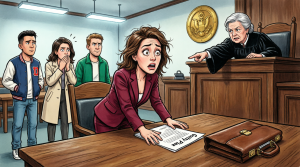
The courtroom smelled like old paper, floor wax, stale coffee, and the faint human anxiety that seems to live permanently in legal buildings. Mr. Sterling sat beside me at counsel table with his leather folder and his false concern. Behind me in the gallery, my parents wore expensive grief. My mother had chosen navy, which she wore whenever she wanted to seem wronged and dignified at the same time. My father looked as he always looked: expensive, rested, certain.
Hudson wasn’t there.
He had hockey practice.
That detail should not have surprised me, but it did. Even now. Even after the alley, the whiskey, the deadbolt, some part of me kept waiting for him to demonstrate an ordinary human threshold of shame.
He never did.
“All rise,” the bailiff called.
Judge Keller entered and took the bench. He was known in town for being sharp, impatient, and particularly hard on drunk driving cases because his sister had been hit by one years earlier. I had read that the night before on the yellowing local-news tablet in my room while my father thought I was asleep.
“Case 4920,” the clerk read. “State versus Blair Montgomery.”
My name sounded unreal in that room. Like it belonged to the version of me my family had manufactured.
Judge Keller looked over the file. “Counsel?”
Sterling stood smoothly. “Your Honor, after consultation with my client, we are prepared to enter a plea—”
I looked up.
At the evidence screen on the wall.
At the court reporter’s laptop.
At the prosecutor’s open tablet.
At the technology in the room.
And then, like a match striking in a dark theater, the actual tiny detail came back to me.
The dash cam.
Not the cloud app. Not the house internet. Not Hudson’s PC.
The camera itself.
When I bought it, I had splurged on the LTE module because I was paranoid about theft. The salesman had told me, very proudly, that even if someone stole the camera, smashed my phone, or killed the local Wi-Fi, any collision file would still sync through the prepaid data SIM to the manufacturer’s cloud. Independent. Redundant. Untouchable from the car side.
That was why I’d wanted it.
Because I was tired of living in a house where everything depended on someone else’s permission.
My father had shut down the computer.
He had killed the local download.
But he had not killed the cloud.
And in those few frantic minutes before he reached the basement—before he killed the monitors, before he crushed the USB—I had not only opened the footage. I had clicked share. I had entered Henderson’s email. I had entered the DA tipline. I had hit send on the cloud link form before the screen went black.
At the time, when the monitors died and my father sneered about the internet, I had assumed the transmission failed with it.
But the dash-cam portal didn’t work like ordinary email. The share request happened server-side once the file link was generated. If it had gone through at all, it had gone through completely.
And if Henderson had seen it…
If the DA tipline had seen it…
Then my father hadn’t just failed.
He had failed hours ago.
Sterling was still speaking. “…prepared to plead—”
“I plead not guilty,” I said.
My own voice startled me.
Sterling froze.
The courtroom did too.
He turned toward me, smile vanishing. “Blair.”
“I plead not guilty,” I said again, louder this time, standing up. “And I would like the court to review newly submitted evidence of witness tampering, insurance fraud, coercion, and obstruction.”
Sterling grabbed my sleeve. “Sit down.”
I shook him off so hard his folder slid off the table.
My mother made a strangled sound behind me.
Judge Keller leaned forward. “Ms. Montgomery, what evidence?”
“The prosecutor has it,” I said. My heart was trying to break through my ribs, but my voice held. “Or her office does. It was sent early this morning. There should also be a copy with Edward Henderson, executor of the Margaret Collins Trust.”
The prosecutor, Assistant DA Vance, frowned and opened her laptop. She was young, sharp-cheeked, and had so far worn the politely bored look of someone expecting a routine plea from a reckless rich girl.
That expression disappeared as she clicked.
Her eyes widened.
She looked at me first.
Then at my parents.
Then at Judge Keller.
“Your Honor,” she said slowly, “I need a recess.”
My father stood up in the gallery. “This is outrageous.”
“What is it, Ms. Vance?” the judge asked.
She swallowed once, then turned her screen slightly so he could see the subject line.
TRUTH – COLLISION FOOTAGE / MONTGOMERY
The courtroom air changed.
My father said sharply, “This is privileged family material. We do not consent—”
“Sit down, sir,” Judge Keller snapped, sudden steel in his voice, “or I will have you removed.”
“I object,” Sterling said, but his tone had lost its polish. Panic was showing through.
“To what?” the judge asked, not even looking at him.
Sterling opened his mouth.
Nothing came out.
Judge Keller turned back to the prosecutor. “Play it.”
My mother made a choking sound.
The screen on the wall flickered, then filled.
The first image was Hudson’s hand on my steering wheel.
Then his voice.
Then mine.
Then the crash.
No one in the courtroom moved.
Not the bailiff. Not the clerk. Not Sterling.
Every eye was fixed on the screen as my brother stumbled out of the driver’s seat and ran.
And then came the part that mattered most.
The SUV arriving.
My mother’s voice, clear as cut glass: “Did the airbags deploy?”
My father: “No. Good.”
Me: “Hudson could have killed someone.”
My mother: “You are replaceable, Blair.”
My father explaining the story.
My voice breaking.
Then, in sharp, undeniable audio and video, my father uncapping his silver flask and dumping whiskey over me while I cried.
It is hard to describe the silence that followed.
Not ordinary silence.
Not polite silence.
The kind of silence that feels like pressure changing in a room, like everyone inhaled at once and forgot how to reverse it.
I turned around slowly.
My mother’s face had gone the color of printer paper. One hand was clamped over her mouth. The other crushed the pearl necklace at her throat hard enough that I thought the string might snap.
My father looked as though someone had struck him across the face with something invisible and final. Not because he had just been exposed. Because for the first time in his life, exposure was happening in a room he did not control.
Judge Keller’s gaze moved from the frozen frame on the screen to my parents, then to Sterling, whose expression had become a study in rapid professional self-preservation.
“Bailiff,” the judge said.
His voice was soft now. Ice-soft.
“Take Mr. and Mrs. Montgomery into custody pending referral for charges of witness tampering, conspiracy, and obstruction. Issue an immediate warrant request for Hudson Montgomery. I want this referred to the financial crimes unit as well.”
My mother gasped, “This is insane.”
The bailiff was already moving.
My father tried the old trick then, the one that had probably worked on assistant coaches, school administrators, board members, and people who enjoyed keeping their jobs. He straightened, drew himself taller, and said, “Judge, I think you are making a very serious mistake.”
Judge Keller did not blink. “No, Mr. Montgomery. I think you did.”
The officers closed in.
My mother began to cry—not for me, not from remorse, but from humiliation, which to her had always been the greater tragedy. My father jerked once when the cuffs touched his wrists, as if the metal itself were an insult to his species.
I should tell you that watching your parents be arrested is not satisfying in the simple way revenge fantasies promise. It is stranger than that. Heavier. There is triumph in it, yes, if they deserve it. Relief too. But woven through both is grief for the fact that the moment was necessary at all.
My body felt weightless and sick.
Sterling was talking quickly to someone now—maybe the prosecutor, maybe himself—but I barely heard him. My pulse roared in my ears.
Then I felt a vibration in the pocket of the borrowed blazer my mother had insisted I wear to court so I would “look remorseful and presentable.”
My hand closed around it automatically.
Hudson’s burner phone.
I had taken it from his desk drawer weeks ago to use the flashlight at night after they seized my phone. In the terror of the last twelve hours, I had forgotten it was still in my pocket.
The screen lit up with an email notification.
From: Edward Henderson.
Subject: Received.
My throat tightened as I opened it.
Blair,
I have received the file you transmitted. I have also reviewed the court recording now entered into the public record.
Under the moral turpitude, coercion, and fiduciary breach provisions of your grandmother Margaret Collins’s trust, Michael and Diane Montgomery are hereby removed as acting trustees, effective immediately, pending final judicial confirmation.
As the only remaining beneficiary in good standing, control of the trust principal and all discretionary distributions transfers to you upon execution of the enclosed emergency order.
Estimated current principal value: $5,012,443.16.
Please do not leave the courthouse without speaking to me. I am in the hall.
I read the number twice.
Five million dollars.
My grandmother’s money.
The fund my parents had treated like a lever, a leash, a private kingdom they ruled through my dependence.
Gone from them.
Mine.
My father was already at the double doors, twisting to say something to me over his shoulder as the officers led him out. I couldn’t make out the words. Maybe rights. Maybe lawyers. Maybe my name.
I didn’t care.
When the doors swung shut behind my parents, the room felt bigger.
Not safer yet.
Just bigger.
Judge Keller looked down at me, and the sternness in his face eased by a degree.
“Ms. Montgomery,” he said, “the charges presently before this court are dismissed without prejudice pending review of the new evidence.”
Dismissed.
A word so formal for the sensation of a trapdoor opening beneath a lie.
I nodded because I couldn’t speak.
“You may step outside with counsel if you need a moment,” he added.
I almost laughed at the word counsel.
Sterling had vanished to the far side of the courtroom and was suddenly very interested in not making eye contact with me.
I stood.
My legs worked strangely at first, as though they belonged to someone recovering from anesthesia. The courtroom blurred at the edges. Reporters hadn’t arrived yet—small mercy—but the clerk was staring, the bailiff was staring, even the court reporter was staring at me with a kind of stunned sympathy.
I walked out into the hallway.
Edward Henderson was waiting exactly where his email said he would be, in a charcoal suit with a navy tie and the same severe expression I’d seen at my grandmother’s funeral. He held a leather briefcase under one arm and two printed packets in his hand as though he had been anticipating this emergency for the pleasure of being right.
“Blair,” he said.
That was all it took.
The composure I had borrowed from fury cracked. Not into sobbing. Into shaking. Sharp, full-body shaking that started in my jaw and ran down to my wrists.
Henderson guided me to a bench outside the courtroom with surprising gentleness.
“You are safe for the moment,” he said. “Your parents are not. Focus on that first.”
I sat down.
The hallway smelled like copier toner and old stone.
A man in handcuffs was being walked past the far end by two deputies. Somewhere a printer jammed. Life, somehow, had resumed around the crater of mine.
Henderson sat beside me and opened the top packet.
“Your grandmother was many things,” he said. “Sentimental was not one of them. She anticipated character as a legal problem.”
I almost smiled.
He handed me the first page. Emergency trustee transfer order. Then a summary of the trust. Then my grandmother’s own clause language, typed in brutal clarity:
In the event of fiduciary misconduct, coercive financial control, or conduct of moral turpitude by any acting trustee, said trustee shall be removed and all authority shall vest in the nearest beneficiary not implicated in said misconduct.
My grandmother had built a trapdoor of her own.
“Did she know they were like this?” I asked.
Henderson’s mouth thinned. “Margaret knew your father better than your mother did. And she understood your mother’s weakness for power once she married it.”
I leaned back against the bench.
For the first time in days, maybe years, there was no demand on me in that moment. No script. No one asking me to keep a lie alive. The sheer absence of pressure felt almost frightening. Like stepping off a boat and realizing the land beneath you is steady.
“What happens now?” I asked.
Henderson looked toward the courtroom doors where voices were rising again. “Now,” he said, “you decide what part of your life you would like returned to you first.”
That question nearly undid me more than the video had.
Returned.
As if my life had been an object misplaced by thieves and not something I had been taught from childhood to surrender in pieces.
We spent the next two hours in a conference room off the clerk’s office while Henderson made calls with the efficiency of a man who had waited years for permission to stop being polite. My university bursar was contacted. My apartment lease was transferred. A new account was opened. My phone service was restored under my sole name before lunch. Henderson’s assistant began arranging for a temporary civil no-contact order the moment he heard that my father had locked me in my room.
Hudson’s agent, it turned out, had already been contacted by someone from the district attorney’s office. I learned that from Henderson too. He didn’t say it with satisfaction exactly, but he did allow himself the slightest dryness when he remarked, “The National Hockey League, in my experience, dislikes obstruction less than it dislikes public scandal about obstruction.”
By three that afternoon, my brother’s name was already on two local news sites.
By five, every person who had texted me pity in the last week had switched to outrage.
That part was almost funny.
People are moral weather vanes. They swing toward whichever direction the proof points loudest.
The reporters found me by early evening.
Henderson fended off most of them, but one young woman with kind eyes caught me as we stepped through the side entrance.
“Ms. Montgomery,” she called. “Do you want to comment on the allegations?”
I stopped.
The courthouse doors loomed behind me. The sky was painfully blue, one of those crisp autumn afternoons that seems designed for beginnings or endings, maybe both. The courthouse steps were warm from the sun. Cars passed. Somewhere across town, I imagined Hudson finally checking his phone and watching his own myth catch fire.
I turned back to the reporter.
“Yes,” I said.
Henderson glanced at me but didn’t interrupt.
I looked directly into the camera she lifted.
“My brother made a choice,” I said. “My parents made another. I was expected to destroy myself to protect all three of them. I’m done doing that.”
The reporter’s eyes widened just slightly.
That was the only statement I gave.
And it was enough.
By the next morning, the story was everywhere in the state. By the end of the week it had gone national in the strange, hungry way stories about rich families and sports prospects always do. Hudson’s draft profile was pulled pending investigation. My father’s firm put him on leave. My mother resigned from the charity board she had spent fifteen years using as a social mirror. Sterling issued a statement claiming he had been “materially misled by the family regarding the facts of the incident,” which was probably the closest he had ever come to sincerity.
Everyone wanted to tell me I was brave.
I wasn’t.
Not in the clean, cinematic way people mean when they say that.
I was cornered and then lucky and then furious enough not to sit down when the moment arrived. That’s not the same thing as bravery. Or maybe it is, after the fact. I still don’t know.
What I do know is that when I walked back into my apartment three days later—with a locksmith beside me because my father had tried to have the locks changed before Henderson’s office froze his authority—I stood in the tiny kitchen, set my bag on the floor, and cried for the first time since the crash.
Not because I was sad.
Because there was no one there to watch me do it.
No audience. No manipulation. No correction.
Just me and my breath and the silence of a life that might finally belong to me.
I finished my degree that winter.
I kept the Camry’s key fob for months even after the insurance settlement came through and Henderson insisted I buy something safer. I couldn’t quite explain why. Maybe because it was proof that what had been destroyed had once been mine. Maybe because I needed to remember the cost of independence in one small plastic shape.
Hudson was indicted before spring.
My father took a plea deal.
My mother wrote me two letters from her attorney first and then one of her own, long and handwritten and full of the sort of sorrow that still managed to cast itself as victimhood. I read it once. Then I put it in a drawer and never answered.
As for the trust money, the five million made more people nervous than grateful. Henderson helped me set up protections before I could make a single impulsive mistake with it. He insisted on advisors I trusted instead of family friends I didn’t. He explained taxes to me with the patience of a man teaching a language to someone who had only heard it used as a threat. He told me, the first time I apologized for asking too many questions, “Blair, your survival up to now has depended on not knowing things. Your freedom will depend on the opposite.”
I wrote that down.
Then I started living by it.
People like to imagine that sudden money transforms your life in obvious ways first—cars, clothes, penthouses, revenge. For me, the first transformation was smaller.
I bought my own phone plan.
Then I paid my tuition without permission.
Then I changed every password I had ever used.
Then I sat in a café near campus and ordered lunch without checking my bank app first.
Freedom, in the beginning, was embarrassingly practical.
Months later, once the headlines cooled and the legal process moved into the long dull machinery of consequence, I booked a flight.
Not because I was running.
Because for the first time in my life, I could go somewhere without asking anyone whether I was allowed to want it.
Europe sounded like a cliché when I first said it aloud. My roommate Elena laughed and said, “Good. Then go be a cliché in expensive boots.”
So I did.
I landed first in Lisbon because I liked the way the city looked in photographs—washed stone, hills, old light, the Atlantic nearby. I rented a small apartment with blue shutters and a balcony barely big enough for a chair. I walked until my legs ached. I drank coffee stronger than anything from home. I bought books in English and one in Portuguese I could barely read and carried them around like evidence of a new self.
Sometimes, in the first weeks, I would catch my reflection in a shop window and still expect to see the girl from the courtroom—the one with her shoulders up around her ears, waiting to be contradicted.
Instead I saw someone stranger.
Someone quieter.
Someone who no longer looked over her shoulder every time she made a decision.
I don’t believe in neat endings. Families like mine don’t produce neat endings. They produce fallout and silence and fragments of memory that remain tender long after justice has done its job.
There are still nights when I dream of the alley. Of steam. Of Hudson running. Of my father’s hand uncapping the flask.
There are also mornings when I wake in a city no one in my family chose for me, make coffee in a kitchen paid for by a fortune they thought they controlled, and feel something close to joy settle in my chest like it has finally found the right address.
That is the detail no one in my family understood.
Not the dash cam.
Not the LTE backup.
Not the trust clause.
The real tiny detail was me.
I was never the disposable one.
I was simply the only one they never bothered to know well enough to fear.
And that turned out to be their mistake.