I Bought My 9-Year-Old Daughter a Bicycle With My First Hard-Earned Bonus—My Father Slapped Her, Called Her Trash, and Handed It to My Nephew… They Thought I’d Stay Quiet Like Always. They Were Wrong…
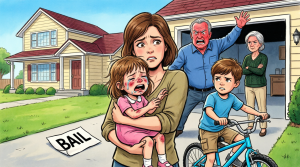
The first time Emma saw the bicycle, she pressed both palms against the shop window like she was touching something sacred, her breath fogging the glass in small, trembling clouds as if even her lungs were afraid to disturb the moment.
She was nine years old, all soft hazel eyes and quiet hope, the kind of child who still believed adults meant what they said and love was something steady that never disappeared without warning.
“Mom,” she whispered, her voice almost reverent, “the blue one… it looks like freedom.”
Freedom.
That word did something violent inside my chest because I had spent most of my life chasing that exact feeling in a house where it was rationed out like punishment, where approval was currency and I never seemed to earn enough to deserve it.
I had just received my first real bonus from the job I fought tooth and nail to keep, a job that required long nights, swallowed pride, and a spine I had slowly been rebuilding after years of being told I was too sensitive, too ambitious, too much.
That bonus wasn’t enormous, but it was mine, and for the first time in my life I could buy something beautiful without asking permission from anyone who believed I didn’t deserve it.
The salesman wheeled the bike out from the back, its blue frame gleaming under fluorescent lights, white decals curving along the metal like delicate brushstrokes, and Emma’s hands started shaking before she even touched it.
“Is it really mine?” she asked, her fingers hovering over the handlebars as though it might disappear if she claimed it too quickly.
“Every single piece of it,” I told her, and when I said it, I realized I wasn’t just giving her a bicycle, I was trying to rewrite a childhood neither of us had asked for but only one of us had survived.
On the drive home, she kept turning around in her seat to look at it in the back of the car, her grin stretching wide enough to split the day open, and then she said something that should have warned me.
“Can we show Grandpa?” she asked, clutching her stuffed bunny in one hand and already planning the moment in her head. “Maybe he’ll say he’s proud of you.”
I swallowed hard because my father had never once said those words to me, not when I graduated, not when I bought my first car, not even when I moved out and stopped being a financial inconvenience to him.
But I nodded anyway because children deserve to believe in softness until someone rips it away.
My parents’ house looked exactly the same as it had when I was growing up, the same cracked driveway, the same porch that had heard more criticism than comfort, and my father was outside wiping grease off his hands while my mother barked instructions at him from her throne near the door.
My sister Carara was there too, leaning against the railing with her husband Nate, and their twelve-year-old son Mason was pacing the yard like he owned the air everyone else breathed.
Emma carefully wheeled the bike up the driveway, her excitement bubbling over in every step.
“Grandpa,” she called out, her voice bright and proud, “Mom bought this for me with her bonus. Look!”
My father’s eyes moved from the bike to me, and I watched the warmth drain from his expression as though someone had flipped a switch.
“A bonus?” he grunted, the word sounding offensive in his mouth. “For what, exactly?”
“For working,” I replied evenly, though my pulse had already started pounding.
He lifted his hand sharply. “Don’t talk back.”
Before I could step between them, before I could calculate the distance, he moved forward and struck Emma across the face with a force that snapped her head sideways and silenced the entire driveway.
The sound didn’t echo loudly, but it echoed inside me, ricocheting through every memory of raised voices and withheld affection and hands that were supposed to protect but instead corrected.
Emma pressed her palm to her cheek, her confusion far worse than tears.
“Grandpa,” she whispered, her breath hitching, “I didn’t do anything.”
My father grabbed the bicycle from her hands as if she had stolen it, his grip tight and unapologetic.
“Kids like you don’t deserve things this nice,” he growled, and then he turned to Mason. “Take it. You’ll use it better.”
Mason didn’t hesitate, hopping onto the seat with a grin that looked practiced, pedaling tight circles around us like this was entertainment instead of humiliation.
Emma tried to step forward, but my father pressed two fingers against her forehead and shoved her back with casual cruelty.
“Trash doesn’t get shiny toys,” he said flatly. “Your mother never learned that either.”
My mother crossed her arms from the porch, a small smile curling at the corner of her mouth like she was watching a show she’d seen before and approved of.
“You shouldn’t teach her to want things above her level,” she added coolly. “She’s already too sensitive, just like you.”
Carara laughed under her breath, and Nate didn’t say a word, which somehow made it worse.
“Good thing Mason got it,” my sister chimed in. “At least someone in this family isn’t pathetic.”
Emma’s tears fell then, large and silent, sliding down her cheeks as if they were too heavy to stay inside.
“Mom,” she whispered, tugging at my sleeve, “can we go?”
She wasn’t asking for the bike back.
She wasn’t asking for an apology.
She was asking to escape.
My father shouted after us as I took her hand and turned away.
“Don’t walk off like you’re somebody,” he called out. “You could barely afford gas last month. Don’t pretend you’re better than us.”
Emma squeezed my fingers, her voice breaking in a way I will never forget.
“Mom… is Grandpa right? Am I trash?”
I knelt in the driveway, ignoring the laughter behind us, and wiped her tears with hands that were shaking from restraint, not weakness.
“No,” I said, my voice calmer than I felt. “But he’s about to learn he can’t treat us like that.”
Because something had shifted inside me, something cold and deliberate that no longer cared about keeping the peace or earning approval from people who fed on humiliation.
That night I didn’t sleep.
Every time I closed my eyes I saw her tiny hand flying to her cheek, the disbelief in her face when someone she had hoped would be proud instead decided to punish her for daring to receive something good.
Rage burned, but I refused to let it explode recklessly because my father thrived on chaos and emotional reactions.
If I stormed back there screaming, he would label me dramatic, unstable, ungrateful.
He would win.
So I didn’t plan noise.
I planned consequence.
The next morning I woke Emma gently and told her we were going out, and when she asked if we were seeing Grandpa again, I told her no in a tone that closed doors permanently.
I dropped her at my friend Jenna’s house, one of the few people who knew the full history of my parents’ cruelty, and she hugged Emma tightly before looking at me with quiet understanding.
“Do what you need to do,” she said.
When I pulled into my parents’ driveway again, my father was washing his truck like nothing had happened, Mason’s laughter echoing faintly from the backyard, and I stepped out of the car with a steadiness that surprised even me.
“You put your hands on my daughter,” I said, standing close enough that he couldn’t pretend he hadn’t heard.
He smirked without looking away from the water running over his tires.
“You always were dramatic,” he replied. “Maybe if you raised her right, she’d learn respect.”
“You slapped her,” I repeated, because sometimes repetition is the only way to force someone to confront what they’ve done.
“She deserved to learn early that she’s not special,” he said with a shrug. “Neither are you.”
And in that moment, I realized he still believed I would swallow it like I always had.
He still believed I needed him.
He had no idea how wrong he was.
PART 2
I didn’t argue with him because arguing implies you are asking for understanding, and I was no longer interested in being understood by a man who measured worth by obedience.
Instead, I walked past him toward the backyard where Mason was riding Emma’s blue bicycle in wide triumphant circles, his laughter slicing through the air like a taunt.
He slowed when he saw me, uncertainty flickering across his face, and I reached down calmly and lifted the bike upright before he could protest.
“That doesn’t belong to you,” I said evenly.
My father’s boots pounded across the grass behind me.
“You don’t get to come here and take things,” he barked.
I turned, holding the bike steady, and met his eyes without flinching.
“You already taught me that lesson,” I replied. “Now I’m teaching you one.”
He stepped closer, his shadow falling over me the way it had my entire childhood, but this time I didn’t feel small.
“This isn’t over,” he warned.
“No,” I agreed quietly. “It’s just starting.”
Because what he didn’t know yet was that I had already made calls, already documented everything, already begun dismantling the financial and legal threads that tied him to anything I could influence.
They thought humiliation was harmless.
They thought I would absorb it forever.
They didn’t expect me to make them understand what loss actually feels like.
And when the first piece of their comfort began to crack later that week, they finally realized I was not coming back to beg.
I Bought My Daughter A Bicycle With My First Bonus Dad Slapped Her Took It And Gave It To My Nephew Trash Don’t Deserve Good Things They Didn’t Expect Me To Make Them Beg For Mercy
I still remember the way my daughter Emma, 9 years old, with soft hazel eyes and a smile that could outshine any morning, pressed her face against the bike shop window like she was looking at magic itself. Mom, the blue one, she whispered. It looks like freedom. That word hit me harder than she knew. Freedom.
A thing I’d been begging for all my life in my parents house, but never got. Now, with my first bonus from the job I fought tooth and nail to earn, I wanted Emma to have everything I never did. Please subscribe to our channel and tell us in comments from where are you watching this video? The salesman wheeled out the bike, shiny blue with little white decals, and Emma’s breath shook like she couldn’t believe this moment was real.
“Is Is it really mine?” she asked, almost afraid to touch it. every piece of it, I said, because for the first time, I could give her something beautiful. We drove to my parents house because Emma begged me to show them. Maybe grandpa will say he’s proud of you, she said, clutching the handlebars like they were made of gold. I didn’t have the heart to tell her that my father had never in his life said the words, “I’m proud to me, but I let her believe it.
Kids deserve to believe in softness until someone rips it away.” Dad was in the driveway wiping grease off his hands while my mom barked orders at him from the porch. My sister Carara was there with her husband Nate and their son Mason, a spoiled 12-year-old who treated everything like it already belonged to him.
Emma rolled the bike toward my father. Grandpa, mom bought me this with her bonus. Look. Her excitement bubbled up pure and bright. My father’s eyes didn’t soften. They hardened. A bonus? he grunted. For what? Showing up. He looked at me like I had committed a crime. Dad, I worked. He snapped a hand up. Don’t talk back. Before I could stop him, he stepped forward and slapped Emma across the face so hard her head jerked sideways.
I froze. Every vein in my body went cold. Emma pressed her palm to her cheek, confused, breath hitching. Grandpa, I didn’t do anything. Dad snatched the bike from her tiny hands. “Kids like you don’t deserve things this nice,” he growled. Then he turned to Mason. “Take it. You’ll use it better.” Mason grinned, hopped on, and pedled circles around us like he was mocking her.
Emma’s lower lip trembled. She tried to take a step toward him, but Dad shoved her backward with two fingers pressed to her forehead. “Trash doesn’t get shiny toys,” he said. “Your mother never learned that either.” I swear I felt something inside me snap. Clean, sharp, final.
Mom leaned against the door frame with her arms crossed, smiling like this was entertainment. You shouldn’t teach her to want things above her level, she said. She’s already too sensitive. She cries too easy, just like you. My sister laughed. Good thing Mason got it. At least someone in this family isn’t pathetic.
Emma’s tears finally fell big and silent and she whispered, “Mom, can we go?” Those words, they scorched me. She wasn’t asking for the bike back. She wasn’t asking for Papa to apologize. She just wanted to escape. And something inside me shifted away from fear, away from tolerance, and towards something cold and sharp as a blade.
I took her hand, turned away from the scene, and my father yelled after me, “Don’t you walk off like you’re someone. You could barely afford gas last month. Don’t pretend you’re better than us.” Emma squeezed my fingers, whispering through tears, “Mom, is Grandpa right? Am I trash?” I knelt, wiped her cheek, and said in the calmst voice I’ve ever used, “No, but he’s about to learn he can’t treat us like it.
” Because this time I wasn’t walking away in shame. I was walking away to start something. Something they’d never forget. Something that would tear into their comfort the way they tore into my daughter’s heart. They took from her. So I would take something back. Something bigger, something deeper, and it would start tonight with a plan they’d never see coming. I barely slept that night.
Every time I closed my eyes, all I saw was Emma’s tiny hand flying to her cheek, the shock in her eyes, the way my father yanked her bike away like she was stealing something she hadn’t earned. My chest tightened so hard it hurt. Rage stayed hot in my throat. But I knew one thing. If I marched back there screaming, he’d win. He lived on chaos.
He fed on it. He wanted me emotional so he could call me dramatic. So I didn’t go back with shouting. I went back with strategy. The next morning, I woke Emma early. She was curled toward the wall, clutching her stuffed bunny like it was a shield, her cheek still red. “Sweetheart,” I whispered, brushing her hair back. “We’re going out today.
” She blinked up at me, confused. “Are we seeing Grandpa?” “No,” I said, my voice finally steady. Not ever again. Today we take back what’s ours. Her eyebrows knit together. Mom, he won’t give it back. He doesn’t need to give it back, I said, because I’m not asking. I dropped her at my friend Jenna’s house, one of the only people who knew firsthand how cruel my parents could be. She hugged Emma tight.
She can stay all day, she said, her voice low. Do what you need to do. My hands trembled only once when I turned my car toward my parents’ street. I drove the long way, past the bike shop where Emma had pressed her nose against the glass, past the park where she had dreamed of riding the blue bike on the trail.
By the time I reached their driveway, my nerves were steady fire. Dad was outside again, this time washing his truck. Mason’s laughter echoed somewhere in the backyard, the sound of him enjoying Emma’s bike. Dad didn’t even look up. You again didn’t think you’d have the spine. I stepped closer than he expected and he finally met my eyes.
You put your hands on my daughter, I said. And you think I’m just going to let that go? He smirked. You always were dramatic. Maybe if you raised her right, she’d learn some respect. You slapped her. She deserved to learn early that she’s not special. He shrugged like he was talking about weather. Neither are you.
Every muscle in my body tensed, but I wasn’t here to react. I was here to dismantle them. Where’s the bike? I asked. Being used by someone better, he said proudly. Mason appreciates it more. A sound came from behind the house. A wheel scraping. Mason whooping. Then the unmistakable metal on pavement crash. I didn’t even turn.
I wasn’t here for that. Instead, I walked toward the house. Mom stepped outside as if she’d been waiting, arms crossed, face pinched. “Oh, look,” she said. “The disappointment returns. Are you here to cry about the bike?” “Pathetic.” “Where’s Carara?” I asked coldly. “Inside,” Mom sneered. “She’s upset because you stormed off yesterday.
You embarrassed everyone.” I walked in without asking permission. Cara was at the dining table scrolling her phone like she didn’t burn the world down yesterday. She didn’t even look up. “You need something or are you here to ruin another day?” she asked. I didn’t answer. I simply held up my phone and pressed play.
The audio recording from yesterday. My father’s slap. His exact words. Trash doesn’t get shiny toys. My sister’s laughter. my mother’s voice telling me I shouldn’t teach my oversensitive daughter to want nice things. The color drained from Carara’s face slowly then fast. “You recorded us,” she whispered. “No.” Mom barked from behind me.
“You didn’t give me that phone.” I pulled away. “Don’t touch me.” Dad walked in just then, eyes narrowing. He saw the phone, heard the recording, understood instantly what was happening. You don’t have the guts to use that, he said. You never have. I smiled a slow, terrifying smile that even surprised me. Dad, this recording isn’t for the police, I said. It’s for something else.
He laughed. “And what would that be?” “The bike shop,” I said calmly. “Mom blinked.” “What?” “The place I bought the bike from,” I continued. “Where the owner knows me. Where the cameras caught me paying for it. where he helped me choose it for Emma. All I have to do is tell him a middle-aged man stole it from a child. Mom scoffed.
That proves nothing. No, I agreed. But the footage of Mason riding a brand new blue bike this morning. The one they posted on their neighborhood Facebook page. The one with the same decals. That will prove everything. Cara went pale. Wait, why would they post? They do it every weekend. I said lost pets, found items, neighborhood reminders, and sometimes kids riding shiny new bikes.
Dad’s face hardened. Give us the phone. No, I said again, because I already sent screenshots to Jenna, and I told her if she doesn’t hear from me by noon, she posts everything to the neighborhood group chat, the school parent page, the local buy and sell groups everywhere. Mom’s voice cracked. You wouldn’t dare humiliate us like that.
I stepped closer. You humiliated my daughter first. Silence, hard, dense, electric. Then I said the words that made all three of them freeze. And I’m not leaving without her bike. Dad’s jaw clenched. Cara swallowed. Mom looked like she might faint. They knew. This time I wasn’t bluffing. I wasn’t shaking. I wasn’t scared.
I wasn’t the little girl they could break and bend. Today I was someone they should have never created and I was just getting started. Dad was the first to crack. His chest puffed then deflated. He wiped sweat from his forehead like he was weighing every possible outcome. Fine, he muttered. Take the stupid bike. But I didn’t move because this this was the moment I’d been waiting for my whole life.
The moment my parents realized they no longer owned me. Where is it? I asked. In the garage, he snapped. I followed him. Mom and Cara trailing behind like ghosts who had finally met the wall they couldn’t bulldo through. Dad opened the garage. There it was, Emma’s bike. Scratched, mud splattered, handle grips chewed by Mason’s nervous biting habit.
The sight of it hurt worse than yesterday. “You let him destroy it,” I whispered. Dad shrugged. It’s just a bike. No, I said, my voice low and dangerous. It was her first dream. Carara stepped forward. Can you stop being dramatic for 2 minutes? I turned slowly toward her. I didn’t raise my voice. I didn’t insult her. I simply said, “You’re going to fix it.
” Her face twisted. “Excuse me.” “You,” I said, taking a step closer. are going to clean it, polish it, straighten the bent wheel, replace the torn streamers, and make it look exactly the way it did when I bought it.” Mom scoffed. “She’s not your servant.” “You made Emma feel like trash,” I said. “Now you’re going to undo the damage.
” Dad barked out a sarcastic laugh. “And why would she listen to you?” I pulled my phone from my pocket, tapped the screen. A message thread with the school principal popped up. Mom’s face drained instantly. You You didn’t. Oh, I did. The principal wasn’t just a school administrator. She was the head of the new anti-bullying coalition in town.
She took community complaints extremely seriously. All I have to do, I said, is send her the clip of you three calling my daughter trash, hitting her, taking her belongings, and laughing about it. Mom’s voice trembled. You said you wouldn’t go to the police. I didn’t say anything about the school board. Cara slapped a hand over her mouth.
They’ll ban Mason from sports. He’ll lose his scholarship. And your job at the dentist’s office? I added pretty sure they don’t want staff who assault family members. Mom whispered. You’re bluffing. Try me. Silence sliced the room. Then just like that, Dad cracked again. Carara, he snapped. Go clean the damn bike. Cara didn’t move.
Dad grabbed her arm. Now she flinched and ran to the bathroom to grab cleaning supplies. Tears already forming. For the first time in her life, she was being forced to face consequences. I stood there and watched her scrub every inch of the bike. Watched her hands shake. Watched her breathing hitch. Mom hovered by the doorway, whispering, “Hurry up.
Hurry up before anyone sees.” Dad glared at me like I’d betrayed him, but I felt nothing because for once they were the ones afraid. When she finished, the bike looked almost new. Not perfect, but close. Good, I said. Now apologize. Cara froze. What? You heard me. She swallowed hard, her lip trembled.
She walked toward me slowly, eyes darting everywhere. I I’m sorry. she whispered. “For what?” I asked. She blinked fast. “For hitting Emma? For taking her bike? For for calling her?” She choked. I didn’t help her. She forced the words out. “For calling her trash.” I didn’t smile. I didn’t soften. I didn’t forgive. I simply nodded, picked up the bike, and turned toward the door.
Mom [clears throat] grabbed my arm. “Wait, are you going to send that recording to the principal?” I looked her straight in the eye. That depends. On what? She whispered. On whether you ever contact me or my daughter again. Mom gulped. So we can’t see her. No, I said you lost that privilege yesterday.
Dad stepped forward. You can’t do that. We’re family. You stopped being family the moment you slapped a six-year-old and handed her birthday gift to someone else. I walked to the door. Mom’s voice broke behind me. So that’s it. You’re cutting us off. I turned around and said the last sentence I would ever say to them. You didn’t lose us today.
You lost us years ago. Today is just the first time you noticed. And I left. Emma was waiting at Jenna’s house when she saw the bike. Clean, polished, beautiful again. Her entire face lit up. Mommy, she screamed, running into my arms. You got it back. I kissed her forehead. It’s yours, baby. Forever this time.
She climbed onto it, wobbling a little, then giggled. You fixed it. No, I whispered, watching her pedal down the sidewalk, hair flying, joy reborn. You fixed me. And behind us, far behind us, my parents’ house stood still and quiet, because this time we weren’t returning. And that silence was the loudest revenge of all.

