Dad Gave My BMW to My Sister. I Called the Police_part2
Gregory nodded, already making notes. “In the meantime,” he said, “document everything. Save voicemails, emails, texts. If anyone admits to taking the car, keep it.”
I left his office feeling lighter, not because my family situation had improved, but because I wasn’t alone in the reality of what had happened. Gregory didn’t flinch at the word theft. He didn’t soften it into “miscommunication.” He treated it like what it was: a violation of rights.
Back at the hospital, my world returned to alarms and medication schedules and the strange intimacy of caring for strangers. Work made sense in a way my family didn’t. Patients didn’t steal your car and then call you selfish for noticing. They needed help, you gave it, you charted it, you moved on.
But the stress leaked through anyway.
Madison, a coworker I trusted, caught me staring at a monitor without really seeing it.
“Everything okay?” she asked quietly at the nurses’ station.
I gave her the abridged version. Her eyes widened with each sentence.
“They just took it?” she said. “Like… drove off while you were at work?”
“Apparently family loyalty means property rights don’t apply,” I said.
Madison shook her head. “My cousin did something like that with my grandma’s jewelry,” she said. “Claimed grandma promised it to her. We had to get lawyers involved. Half the family stopped speaking to us. Worth it, though.”
Worth it.
The word stuck.
Over the next few days, Gregory’s response letter went out. It was professional and devastating in a way that made me almost smile. It laid out the facts, cited state statutes, and made it clear any further harassment would lead to additional legal action.
My phone exploded with messages from extended family members I hadn’t heard from in years. They’d gotten my number through someone, or maybe through each other, passing it around like an emergency hotline.
Most of the messages sounded the same.
How could you do this to your sister?
She’s pregnant.
You’re tearing the family apart.
Not one message asked why my parents thought they could take what I owned.
Then my grandmother called.
Phyllis was eighty-three and had built her life on the kind of blunt honesty that made people either respect her or avoid her. When her name popped up, my chest tightened with something like hope.
“Tell me what actually happened,” she said as soon as I answered.
So I told her. The empty driveway. The call to Dad. His laugh. The police report. The cease and desist letter.
She listened without interrupting, and when I finished, she exhaled like she’d been waiting for someone to finally say it plainly.
“Your parents are being fools,” she said. “Lawrence always spoiled Ashley. Denise enables it. And now they’ve gone too far.”
“They’re threatening to sue me,” I said, still half stunned by the audacity.
“Let them try,” she said. “I’ll testify on your behalf if it comes to that.”
Something loosened in my chest so suddenly I almost cried.
“Thank you,” I whispered.
“Don’t thank me,” she said. “Just don’t back down. Bullies only stop when you stop letting them push you around.”
In the weeks that followed, I started therapy, partly because Madison had gently suggested it and partly because I could feel my own edges getting sharp. Dr. Sarah Chen’s office was calm, soft grays and plants, a small fountain in the corner that made water sound like permission to breathe.
She didn’t let me stay on the surface.
We talked about childhood. About being the responsible one. About how I’d learned love could be conditional, given in exchange for being easy, useful, not demanding.
“You were parentified,” she said one day. “Your worth got tied to taking care of others.”
“What happens if you disappoint them?” she asked.
My chest tightened. “I don’t know,” I admitted. “I’ve never really tried.”
“You’re trying now,” she said gently. “And it feels terrifying because your nervous system thinks you’re risking survival.”
Thanksgiving approached, and my mother sent a formal email stating I was no longer welcome at family gatherings until I apologized to Ashley and dropped any potential legal action.
I stared at the email for a long time, then closed my laptop.
On Thanksgiving Day, I went to Madison’s house. Her partner’s family was loud and chaotic and warm. There were kids running through the living room and someone arguing about football in a way that wasn’t cruel, just spirited. Nobody asked me to sacrifice my peace to keep the mood pleasant.
It was the best Thanksgiving I’d had in years.
In early December, Ashley gave birth to a daughter.
I didn’t hear it from my parents. I heard it because Aunt Suzanne forwarded the mass email by accident, then followed up with a short, awkward message: Forgot you weren’t included.
The baby’s name was Kennedy Marie.
She was tiny and perfect in the photos, her face scrunched like she was already annoyed by the world.
I felt a complicated ache looking at her. Joy for a child who hadn’t asked to be born into this mess. Grief for the fact that my family would probably use her as leverage forever. Sadness that I might never meet my niece.
Christmas was quiet. I worked a shift, then came home to my apartment and ate takeout on the couch. My grandmother mailed a card with a check and a note that read, Don’t let them wear you down.
In January, an unknown number texted me.
It was Brett.
Can we talk? Just you and me.
Against my better judgment, I agreed to meet him at a busy coffee shop near my building. I told Gregory, who advised me to keep it public and record the conversation if legal.
When Brett arrived, he looked wrecked. Dark circles, rumpled clothes, the exhausted posture of someone who hadn’t slept since the baby arrived.
“Thank you for meeting me,” he said.
“What do you want?” I asked, keeping my voice neutral.
He rubbed his face with both hands. “I wanted to apologize,” he said. “I should’ve questioned it. I should’ve asked to see paperwork. I didn’t because we needed it and your parents were so convincing.”
“You could’ve asked me directly,” I said.
“I know,” he said, voice rough. “I’m sorry.”
He stared into his coffee like it might give him words. “For what it’s worth, I told Ashley something felt off,” he admitted. “But her parents insisted it was fine.”
“How is she?” I asked, surprising myself.
He let out a humorless laugh. “Overwhelmed. The baby has colic. Nobody’s sleeping. And… your parents haven’t helped at all since she gave birth. Guess their generosity only extends to giving away other people’s stuff.”
A small, bitter understanding settled in my chest. My parents hadn’t actually changed. They’d just shifted tactics.
“I’m sorry you’re struggling,” I said, and I meant it in the limited way you can mean something without giving yourself away. “But it still doesn’t justify what happened.”
“I know,” Brett said. “I’m not asking for anything. I just wanted you to know not everyone thinks you’re the villain.”
He stood, hesitated, then said quietly, “Take care of yourself.”
After he left, I sat there for a long time, thinking about fallout. My parents had created a story where I was the selfish one, but reality was uglier: they were willing to burn one daughter to keep another from facing consequences.
And somewhere in the middle of it all, a baby had arrived, innocent and fragile, already being used as a reason people shouldn’t have to be accountable.
I didn’t know then how much worse it was going to get.
But I could feel the next wave building.
Part 4
In March, Officer Martinez called again.
Her voice was steady, the same calm professionalism she’d had the night I stood in my parking lot with cold Thai food and a stolen life.
“There have been developments,” she said. “Your sister’s boyfriend came forward with additional information.”
My stomach tightened. “What kind of information?”
“Apparently your father told him you had agreed to give them the car,” she said. “That you were too shy to do it directly, so he was facilitating the transfer.”
For a second, I couldn’t speak. The lie was so specific, so absurd, that it made my brain stall.
“He said I agreed,” I managed.
“Yes,” Officer Martinez said. “That misrepresentation may qualify as fraud. The DA’s office is reviewing whether to pursue charges.”
I sat on my couch staring at my living room wall where a framed photo of the river hung, something neutral I’d bought because I didn’t trust myself to put family photos up anymore.
“What happens if they prosecute?” I asked.
“Your father could face charges,” she said. “Possibly your mother as well, depending on involvement. Often there are plea deals for first offenses, but there would be consequences.”
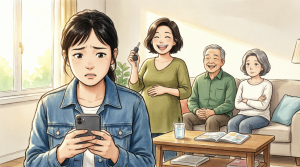
Consequences. The word felt both heavy and strangely clean. Like the universe finally balancing something.
After I hung up, I didn’t cry. I didn’t pace. I just sat there, breathing slowly, because my body had learned what panic felt like and I refused to feed it.
Three days later, my phone rang from an unknown number.
I almost didn’t answer. Then curiosity won.
“This is getting out of hand,” my father said immediately, no greeting, no softness. “The police are talking about charges.”
“This got out of hand when you stole my car and laughed about it,” I said.
Silence.
Then, quieter: “I didn’t think you’d actually go through with the report.”
I let that hang there, because it said everything. He’d counted on me backing down. He’d built his whole strategy on my compliance.
“You thought I’d be angry for a few days and then let it go,” I said.
“I thought you’d calm down,” he said, like my anger was the problem, not his theft.
“Your sister is struggling,” he continued quickly. “The baby has health issues. Brett lost his job. They’re about to lose their house. Please… can’t we work this out as a family?”
“You made it clear I’m not really part of this family,” I said. “I’m just the resource you pull from when Ashley needs something.”
“That’s not fair,” he snapped.
I almost laughed, but it came out as a breath. “Fair? You want to talk about fair? I worked doubles for five years while Ashley made choices that got her license taken away. I paid off my car and two weeks later you stole it.”
“She’s your sister,” he said, voice cracking slightly. “And you’re my daughter.”
“Or at least I thought I was,” I said.
Another long silence.
Finally: “What do you want?” he asked. “Name it. I’ll make it happen.”
I closed my eyes, because this was the moment where I could either soften for his comfort or speak the truth I’d been carrying for years.
“I want you to admit you stole my car,” I said. “Not redistributed resources. Not facilitated a gift. Stole. I want you to tell the entire family what you did and apologize publicly.”
“You’re asking me to humiliate myself,” he said, voice sharp with wounded pride.
“I’m asking you to tell the truth,” I said. “If that’s humiliating, maybe that tells you something.”
He went quiet so long I thought he’d hung up.
“And if I do this,” he said finally, “you’ll drop everything. Talk to the DA. Make this go away.”
“I’ll consider it,” I said. “But you don’t get to bargain like you’re the victim here.”
“That’s not good enough,” he snapped.
“It’s all I’ve got,” I said. “You destroyed my trust. You don’t get to make demands about how it gets rebuilt.”
He hung up.
Easter Sunday, my father sent an email to the entire family.
Aunts, uncles, cousins, people whose birthday texts I’d stopped getting months ago. Everyone.
The email was careful, formal, and obviously rewritten a dozen times. He admitted he and my mother had taken my car without my permission. He acknowledged they had no legal right to give it away. He apologized for dismissing my feelings when confronted.
It wasn’t everything I wanted. It didn’t name the favoritism. It didn’t explain the years of pressure that had made him think my life was available for his decisions.
But it was a confession in writing.
I forwarded it to Gregory Whitman.
“It’s a start,” he replied. “If you want to approach the DA about a non-prosecution agreement, this helps. But you’re not obligated.”
That weekend, my grandmother invited me to dinner.
When I arrived, her small house smelled like roast chicken and lemon cleaner, familiar in a way that made my throat tighten. I stepped into the dining room and froze.
My parents were there.
My mother’s eyes were red like she’d been crying for days. My father stood awkwardly by the window, shoulders tense, like he’d been placed there by force.
Before I could turn and walk out, Grandma Phyllis appeared beside me like a general stepping onto a battlefield.
“Everyone is going to sit down,” she said firmly, “and we’re going to have a civil conversation like adults.”
I looked at her, searching for escape.
Her expression said there would be none.
So I sat.
Phyllis took the head of the table, hands folded. “Lawrence and Denise are going to speak,” she said. “Claire, you’re going to listen without interrupting.”
My father cleared his throat. His hands shook slightly, which I’d never seen before.
“I was wrong,” he said. “Everything I did was wrong. I let my concern for Ashley blind me to the fact that I was stealing from you. I betrayed your trust in the worst possible way.”
My mother looked at me, and when she spoke, her voice broke. “I gave them the spare key. I helped plan when to take the car. I told myself we were helping family, but the truth is we were stealing from our own daughter because it was easier than telling Ashley no.”
The honesty hit like a wave. Not because it healed anything, but because it finally stopped pretending.
“Why?” I asked, and the word came out smaller than I wanted. “Why am I always the one expected to sacrifice?”
My mother swallowed hard. “Because you were strong,” she said. “You were independent. And somewhere along the way, we started thinking that meant you could handle anything. So we leaned on you. Too much. We took advantage of your strength.”
“You took advantage of my love,” I corrected.
My father nodded slowly, eyes shining. “You’re right,” he said. “And I’m sorry. I don’t know how to make this right, but I want to try.”
We talked for two hours.
It wasn’t neat. There were tears. There were moments where my father’s pride flared and my mother tried to retreat into excuses, and Grandma Phyllis shut it down with a look that could stop a storm.
By the end, something had shifted, but it wasn’t forgiveness.
It was leverage turning into boundaries.
I told them what I needed: restitution for legal fees and lost wages, family therapy with me, and an agreement in writing that they would not contact my employer, my building, or anyone in my life to pressure me again.
They agreed.
Gregory worked with the DA’s office on a resolution. With my father’s written confession and proof of restitution, the DA agreed to drop criminal charges in exchange for documented counseling and a formal no-contact order if harassment resumed.
Officer Martinez told me quietly, “Not every case like this resolves. Most families sweep it under the rug. Good for you for standing your ground.”
Therapy was harder than I expected. My parents had to confront patterns that ran deeper than a stolen car. They had to face how they’d protected Ashley from consequences and demanded I stay flexible enough to absorb the impact.
I had to confront my own patterns too: the way I’d said yes when I meant no, the way I’d measured love by how much I could carry without complaint.
In June, a letter arrived from Ashley, handwritten on floral stationery that reminded me of the kind Mom used to keep in a drawer.
Ashley admitted she’d been jealous of me. That my stability felt like an accusation. That when our parents offered her my car, she’d convinced herself I owed her something for being “perfect.”
She didn’t ask for forgiveness.
She said she understood now that she’d been wrong, and she hoped maybe, someday, we could rebuild.
I folded the letter and put it in a drawer. Not as a trophy. Not as a promise. Just as a record that reality had finally cracked through the family story.
By the time fall returned, crisp air sharp against my cheeks, my BMW sat in my assigned spot like it belonged there, because it did.
And when I walked up the stairs to my apartment, I didn’t feel the old fear of disappointing them.
I felt something steadier.
I’d paid for that car. I’d earned it. And when the people who raised me tried to take it, I didn’t beg, didn’t bargain, didn’t collapse into guilt.
I chose the truth.
Some people will take everything you have if you let them.
I didn’t let them.
Part 5
The first thing I did after the legal dust settled was change every lock I could think of.
It wasn’t dramatic. It was practical, like switching out an IV line before it clotted. I replaced the deadbolt on my apartment door, added a small camera that pointed at my parking spot, and changed every password connected to my life. Banking. Email. Insurance. The BMW app. I removed my mother as an emergency contact on anything that wasn’t medically necessary and made sure the spare key lived in a lockbox only I could access.
The old version of me would’ve felt guilty, like I was punishing them.
The new version of me understood that safety isn’t punishment. Safety is maintenance.
Therapy with my parents started in July. Dr. Chen didn’t let anyone hide behind polite language. She sat in her chair with a notebook in her lap and a calm expression that made it impossible to steamroll her.
On the first day, my mother tried to make it about fear.
“You don’t understand how scared we were,” she said, hands twisting in her lap. “Ashley was pregnant. She was struggling. We thought—”
“You thought Claire would absorb it,” Dr. Chen said gently, cutting through the sentence like a scalpel. “Because she always has.”
My father shifted in his seat. “We were trying to help,” he muttered.
“Help who?” Dr. Chen asked.
He opened his mouth, then closed it. My mother answered quickly. “Ashley.”
“And who did your help harm?” Dr. Chen asked.
Silence.
I felt my heart thumping, not from fear, but from the strange discomfort of hearing my pain described plainly while my parents had nowhere to redirect it.
“It harmed me,” I said. “It harmed my trust. It harmed my sense of safety. It harmed the relationship I thought we had.”
My mother’s eyes filled. “We didn’t mean to—”
“But you did,” Dr. Chen said, not unkindly. “Intent isn’t the only thing that matters.”
My father’s jaw worked like he was chewing on words he didn’t want to taste. “I laughed,” he said quietly, and his voice cracked on the last word. “When she called. I laughed.”
Dr. Chen nodded once. “Why?”
He looked at the floor. “Because if I didn’t treat it like a joke,” he said, “then I’d have to admit I was doing something wrong.”
It was the closest thing to a confession I’d ever heard from him. Not an apology. Not yet. A reason.
My mother’s voice shook. “And because if we admitted it was wrong, we’d have to stop,” she said. “And stopping meant telling Ashley no. And we… we got used to not doing that.”
I sat there listening, and part of me wanted to feel satisfaction. They were finally saying the quiet parts out loud. But mostly I felt tired. Tired that it took a police report and a threat of charges for them to treat me like I was real…………………………………………………………………….
 :
: 
