MY FATHER CALLED ME AN EMBARRASSMENT BECAUSE I DROVE TRUCKS, AND ON CHRISTMAS NIGHT HE MADE SURE THE WHOLE FAMILY HEARD IT.
Thirty hands rose in the air like a slow-motion guillotine, and for a heartbeat the only sound in the room was the soft rasp of winter coats shifting as people lifted their arms.
My daughter, Hazel, stood beside my wife with her tiny fingers curled around a gift bag, clutching the drawing she’d spent three days perfecting. Her eyes were wide and confused—more curious than afraid, because six-year-olds don’t understand humiliation until adults teach them what it feels like. She leaned her head toward Ivy and whispered, loud enough that I heard every syllable like it was spoken through a microphone.
“Mommy… why is everyone raising their hands? Should I raise mine too?”
Ivy tightened her arms around Hazel so fast it looked like instinct. Ivy’s face had gone pale. The skin around her eyes was red, but she hadn’t let any tears fall yet. That, too, was instinct—don’t cry in front of them, not where they can mistake it for weakness.
I could feel my own face burning, that sick heat you get when someone shoves you into a spotlight you didn’t ask for. My palms were damp. My throat felt too small for air. And all around me, my family sat in my grandfather’s living room on Christmas Day, holding their hands up to vote me out of the house like I was a stain on the carpet.
It would have been easier if they’d shouted. Easier if they’d thrown plates, if they’d used words sharp enough to cut clean. But this—this quiet, almost organized cruelty—was worse. They were so comfortable with it. They had turned my life into something they could dismiss with a gesture.
My father, Victor, held his hand up first. He looked straight at me while he did it, his face set like a man signing a contract. Next was my younger brother, Trent—beer in one hand, the other hand raised with a crooked smirk as if he’d been waiting years for a moment that finally made him feel taller than me.
Then my uncles—Warren and Edgar—hands up, confident. Their spouses followed. Their kids followed. Distant cousins followed. People I barely knew followed. Some hesitated, but then my grandfather’s voice cut across the room like a whip.
“Come on,” Grandpa Everett snapped. “I don’t have all day.”
That was all it took.
The reluctant hands lifted. The fence-sitters joined in. Even Aunt Miriam—who had once pinched my cheek when I was ten and called me “sweet boy”—raised her hand like she was choosing a side in a game.
I counted without meaning to. My brain clung to numbers because numbers don’t shift. They don’t say one thing and mean another. They don’t smile at you while they stab.
Thirty hands.
Thirty.
Only two people didn’t raise theirs: Uncle Silas and Aunt Lillian, his wife. They sat there stiff-backed, hands in their laps, looking like the only ones in the room who remembered what Christmas was supposed to be.
My chest felt hollow enough to echo.
I had come to my grandfather’s house because he had called me himself a week earlier and asked me to bring Ivy and Hazel for dinner. His voice on the phone had sounded warm, almost relieved, like he had been waiting for this. He told me he missed Hazel. He told me he wanted to see all of us. He told me seven o’clock.
I’d driven here believing—like an idiot, like a man who never learns—that this time might be different.
Now the room was voting on whether I deserved to remain in it.
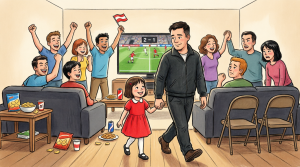
I opened my mouth to speak, but before I could force any words past my throat, my uncle Silas stood up so quickly his chair scraped loudly across the hardwood.
“That’s enough,” he said, voice sharp, shaking with fury. “It’s Christmas. For God’s sake.”
For one brief second, I felt something like relief. Like someone had reached into the water and grabbed my wrist when I was sinking.
But the storm didn’t stop. It just shifted.
Heavy footsteps sounded from the hallway, slow and measured. Grandpa Everett entered the room with the same calm authority he’d always carried—straight posture, gray hair neatly combed, eyes that missed nothing even at seventy-eight. He scanned the raised hands like he was taking attendance.
Silas turned toward him, chest heaving.
“Dad,” Silas said. “You can’t be serious.”
Grandpa didn’t look at Silas at first. He looked at the room. Then, in a tone so flat it felt like a slap, he said, “They’re right.”
The words hit me like something thrown.
For a moment, the air left my lungs. Ivy’s hand found mine and squeezed so hard it hurt. Hazel’s drawing crinkled in the gift bag as she clutched it tighter.
Grandpa’s gaze finally landed on me. There was something in his eyes that wasn’t cruelty. It wasn’t approval either. It was… complicated. Like he was holding something back. Like he was watching for something.
Then he looked away again, back to the room, and said, “We’ll take a vote.
My brain stuttered. I didn’t understand. I didn’t want to.
“If you want Nolan out of this party,” Grandpa said, voice rising, “raise your hand.”
The hands shot up. Thirty of them. A forest of judgment.
Only two stayed down.
My uncle Silas’s face turned red with rage. He grabbed Aunt Lillian’s hand and marched toward the door like he had finally decided peace was no longer worth the price.
As he passed Grandpa, Silas paused. He leaned close and said, in a voice that carried like a knife in quiet air, “I’m ashamed of you.”
Everyone heard it. Even the ones who pretended not to.
Then Silas moved toward me, put a steady hand on my shoulder, and said, “Let’s go, Nolan. These people don’t deserve to be called family.”
My legs felt like they belonged to someone else, but I moved. Ivy moved. Hazel shuffled beside us, still clutching her gift bag like she thought the drawing could fix whatever was happening.
I turned my head once, just once, and looked at the raised hands again. My father’s. Trent’s. Warren’s. Edgar’s. My relatives’ hands hanging in the air like they were offering something to the ceiling.
I realized, in that sick instant, that the vote hadn’t been about my job. Not really.
It was about permission.
Permission to treat me as less.
Permission to make it official.
We were almost at the front door when Grandpa’s voice exploded behind us.
“Stop.”
It wasn’t shouted like anger. It was shouted like command.
We froze automatically. Even Silas stopped mid-step, because there was something in Grandpa’s tone that didn’t allow argument.
The room went so quiet I could hear my heartbeat in my ears.
Grandpa spoke again, louder, each word deliberate.
“The ones who are leaving tonight are not you.”
Silas and I turned at the same time. Confusion flashed across Silas’s face. My own mind felt like it was stuck between terror and disbelief.
Grandpa stared at the room full of raised hands and said, “The people who need to leave are the ones with their hands in the air.”
The room detonated.
Voices erupted from every direction. Chairs scraped. Someone shouted, “What?” Another voice snapped, “Dad, are you serious?” Plates rattled on the table in the next room as people stood up too fast.
My father surged to his feet. His voice shot across the chaos.
“You’ve got to be kidding me.”
Uncle Warren’s face went pale. “Dad, what is this?” he demanded, suddenly less smug.
Uncle Edgar stepped forward, hands up as if he could physically calm the moment. “Now, Dad, we were just—” he began, switching into his fake reasonable voice. “We were just teaching Nolan a lesson. That’s all. No harm meant.”
Aunt Miriam’s voice trembled. “Uncle Everett, I only went along with the others. I didn’t want to upset anyone.”
Uncle Clyde nodded desperately. “Yeah, sir, we thought it was a joke. We didn’t realize—”
Grandpa’s face didn’t soften. Not even a little.
He looked at my father first—Victor, the oldest son, the one who always acted like the family name was his personal property. Then he swept his gaze to Warren and Edgar, and finally to Trent.
“You mocked Nolan,” Grandpa said, voice low and cold, “because he drives a truck.”
My father puffed up, defensive. “I don’t look down on him,” he lied, in the same breath he’d used to insult me. “But he’s thirty-two and still driving trucks. I was trying to motivate him to do better.”
Grandpa’s eyes narrowed.
“Victor,” he said, “aren’t you ashamed of yourself?”
My father’s cheeks flushed. “Why should I be?”
Grandpa waited a beat, like he wanted the silence to make room for the truth.
Then he said the sentence that cracked the room open.
“Because twelve years ago, when you went bankrupt, Nolan—only eighteen—gave up college and became a truck driver so you wouldn’t drown. He didn’t want to be a burden on you. And what did you do? Even while you were broke, you poured every last cent into Trent.”
The room stopped breathing.
It was like someone had yanked the plug on all the noise.
Heads turned toward my father. Trent’s smirk vanished like it had never existed. His face drained of color. Warren’s mouth fell open slightly. Edgar looked down. People stared at me with new eyes, like they were seeing my life for the first time and suddenly realizing there had been a story playing under their jokes all along.
I stood frozen, my hand gripping Ivy’s, and felt old memories rush forward like a flood breaking through a dam.
Twelve years ago.
Eighteen years old.
The year my father’s construction company collapsed.
The year I traded my scholarship for a commercial driver’s license because my family couldn’t survive without someone willing to do work that didn’t look good at a dinner party.
The year I stopped being a son and became a solution.
And now Grandpa had dragged it into the light.
My father opened his mouth, found no words, then grabbed onto the only thing he had left: entitlement.
“I raised him,” he snapped. “It’s only fair he pays us back. That’s a child’s obligation.”
Grandpa’s expression shifted into something I had never seen before.
Not disappointment.
Not anger.
Something harder.
Decision.
He turned slowly, looked around the room, and said, “I was going to split my savings among you today.”
Every head tilted forward like flowers turning toward sunlight.
“But I’ve changed my mind,” Grandpa continued. “You do not deserve a cent.”
The atmosphere changed so fast it was almost physical.
A collective inhale. A tremor of panic. Because suddenly this wasn’t about whether I belonged in the room.
It was about money.
And money, in my family, was religion.
My father stepped forward, voice pleading now. “Dad—”
Grandpa lifted his hand sharply. Silence fell like a curtain.
“Enough,” he said.
Then, in a calm voice that made his words even more frightening, he added, “The four million will be divided between Silas and Nolan.”
A stunned sound rippled through the room.
“What?” Uncle Warren blurted.
Grandpa nodded. “Yes. I sold half the farm two months ago. I was going to split the money equally between my four sons and my six grandchildren. Four hundred thousand each.” His gaze swept across the stunned faces. “But after what I witnessed today, none of you deserve it. Not one of you.”
My father’s knees buckled.
He dropped to the floor in front of Grandpa like a man suddenly remembering how to worship. He clutched Grandpa’s hands so hard Grandpa had to pull back slightly.
“Dad, I’m sorry,” my father choked out. “I was wrong. Please—please give me another chance.”
Uncle Edgar rushed in with his own version of desperation. “Dad, we didn’t intend disrespect. We were encouraging Nolan—”
Trent stumbled toward me, tears suddenly appearing as if a faucet had turned on.
“Nolan,” he said, grabbing my arm. “I’m sorry. I was wrong. Please forgive me.”
His hand on me felt like a stranger’s. Like something grasping at a lifeline, not reaching for a brother.
Grandpa’s face remained stone.
It didn’t matter what they said now. He was done listening.
“Get out of my house,” he said.
My father’s desperation morphed into rage in a single breath. He shot up, face twisted. “You can’t do this. We’ll take you to court.”
Uncle Warren’s voice went sharp and threatening. “You’re elderly, Dad. We can prove you’re not mentally capable of managing your assets.”
Trent shouted, “I won’t let this happen!”
Grandpa let out a dry, almost amused chuckle.
“You are fools,” he said, and his voice had something close to satisfaction in it. “Did you forget I still own the other half of the farm?”
Their faces changed again, like someone had hit them with cold water.
“I’ll transfer the deed to Silas and Nolan in two days,” Grandpa added. “Try to challenge that in court.”
Silence.
They finally understood it wasn’t just four million they’d lost.
The remaining land was worth millions more, and Grandpa’s plan was already moving.
They had no leverage.
One by one, they left.
Some furious. Some crying. Some muttering. Some throwing looks at me like I had personally stolen something from them, as if my existence was the theft.
At the front door, my father turned back.
He looked me dead in the eye and said, voice cold enough to frost glass, “Are you happy now, Nolan? You broke this family apart.”
I didn’t answer.
I didn’t need to.
I pulled Ivy and Hazel into my arms and held them as the door closed behind my father.
After they were gone, the house felt strangely quiet. The kind of quiet that happens after a storm tears through a place and leaves behind broken branches and clean air.
Only six of us remained: Grandpa, Uncle Silas, Aunt Lillian, Ivy, Hazel, and me.
I expected Grandpa to sit down and let grief wash over him. I expected rage or sorrow or the slow trembling of an old man who had just cut off half his bloodline.
Instead, Grandpa turned toward the dining room, looked at the untouched spread of expensive catered food, and said, “Let’s save enough for the six of us.”
Silas blinked. “What?”
“The rest,” Grandpa said, already rolling up his sleeves, “we’re taking downtown.”
We didn’t argue.
We started boxing up food like soldiers moving on instinct.
There were roasted chickens still steaming under foil. Fresh bread. Salads. Desserts in neat plastic containers. Bottles of soda. Enough food to feed a small army. It had all been delivered that afternoon by a high-end place Grandpa always used for family gatherings.
No one had eaten. They’d been too busy raising their hands.
Hazel watched us with wide eyes, then stepped forward and started helping, small fingers carefully holding cookie boxes.
“Daddy,” she asked, voice soft, “who are we giving it to?”
“To people who need it,” I said, brushing hair off her forehead. “People who don’t have a home to go back to tonight.”
She nodded, serious, like she was filing the information away as something important.
We loaded the boxes into Uncle Silas’s pickup and my old car. Then we drove into Rockford’s downtown, where the streets changed from quiet suburban lanes to the harsher geometry of people just trying to make it to morning.
Hazel squeezed my hand when she saw the line of men and women sitting against a brick wall, bundled in worn coats. Her voice trembled.
“Daddy… why don’t they have a house?”
I knelt beside her, looked into her eyes, and spoke gently. “There are a lot of reasons, sweetie. But what matters is we can help them tonight.”
Ivy and Aunt Lillian started handing out meals. Grandpa and Silas moved through the crowd with a calm steadiness that made everyone relax. Hazel hung back at first, shy, then slowly stepped forward and offered a box of cookies to an older man with gray stubble and tired eyes.
He took it like it was something precious.
“Thank you,” he said.
Hazel beamed, as if she’d been given a gift instead.
When the last box was handed out, Hazel wrapped her arms around my waist and said, “Daddy, I’m happy.”
And something in my chest loosened.
Because that, right there—that tiny moment of giving without calculation—felt more like family than anything I’d experienced in my bloodline for years.
We returned to Grandpa’s house and finally ate dinner. Six people at the table, but it felt fuller than any of the crowded holidays I remembered from childhood. The laughter was quieter, realer. The air felt warmer.
After dessert, Hazel pulled out her drawing. She walked to Grandpa, stood on tiptoe, and handed it to him proudly.
“I drew you smiling,” she announced. “And there’s a Christmas tree too!”
Grandpa stared at it for a long moment. His face softened in a way I’d rarely seen. He smiled—a real smile—and said, “This is beautiful. I’m hanging it in the living room so everyone can see it.”
Hazel clapped her hands like she’d won something enormous.
Later, Grandpa disappeared into his office and came back holding two checks.
Two checks.
He handed one to me.
My fingers shook so hard I thought I might drop it.
Two million dollars.
I stared at the number like it was written in another language.
Silas held his own check with the same stunned expression.
“Nolan,” Grandpa said quietly, “in two days, I’m transferring the rest of the farm to you and Silas.”
My breath caught. The remaining land—millions more.
Silas swallowed hard. “Dad… I never wanted it to come to this.”
“I know,” Grandpa said. “But I’ve watched them for years. Today was the final straw. I know who has a good heart. I know who I can trust.”
I couldn’t speak. The gratitude was too big, too tangled with grief.
That night, lying in Grandpa’s guest bedroom with Ivy asleep beside me and Hazel curled like a warm comma between us, I stared at the ceiling and tried to understand how my entire life had pivoted in one evening.
Not just because of the money.
Because someone had finally said out loud what I had carried silently for twelve years: I had sacrificed, and it mattered.
Ivy’s voice came softly in the dark. “I still can’t believe this is real.”
“Me neither,” I whispered. “But we have to use it wisely. We can’t let it change who we are.”
She squeezed my hand. “No boasting,” she agreed. “No showing off. We build something better. Something lasting.”
We fell asleep holding onto that promise like a rope.
The next morning, reality tested it immediately.
When we returned to our Chicago apartment building, my parents and Trent were waiting in the lobby like a trap.
They looked furious, tense, righteous. My father’s eyes were wild with entitlement.
They marched toward us as soon as they saw us.
My mother didn’t bother with fake tenderness this time. “We want our share,” she snapped. “That money should be split four ways. That’s only fair.”
I didn’t argue. I didn’t raise my voice.
I looked at them and said, “If you think you have a case, take it to court. I’m not giving you a penny.”
My father exploded, calling me greedy, selfish, ungrateful, shouting about how he “raised” me, how I “owed” him. Trent chimed in with insults, trying to claw back the power he’d lost the night before.
I didn’t flinch.
I took Ivy’s hand, took Hazel’s, and walked into the elevator without another word.
Security stepped between us and them at the last second when my father lunged forward.
That afternoon Ivy and I changed our numbers. We gave the new ones only to Grandpa and Uncle Silas. We blocked everyone else.
It wasn’t dramatic. It was necessary.
We had peace to protect now.
I didn’t rush out and buy a flashy car or a giant house. The first investment I made was in myself.
I enrolled in a business and asset management program at a community college. Ten thousand dollars. Accounting basics. HR. Marketing. Planning. The unglamorous bones of building something that lasts.
I drove trucks all day and studied at night. I worked through exhaustion with a different kind of fuel now—not desperation, but intention.
When the program ended, I did what I’d dreamed about since the first time I sat behind a wheel at nineteen: I started my own trucking company.
Slowly.
Carefully.
No banners. No champagne. Just paperwork and permits and insurance and a warehouse on the outskirts of town that smelled like oil and possibility.
Grandpa and Uncle Silas came for a small ribbon-cutting in front of the warehouse. Hazel held a tiny pair of scissors and snipped the ribbon like she was opening a door to our future.
Grandpa smiled beside me, pride quiet but unmistakable.
It wasn’t just business. It was proof that I could take his trust and build something worthy of it.
The early months were brutal. Finding reliable drivers. Managing contracts. Clients who doubted us because we were small. A driver quitting without notice. A shipment delayed by weather. Insurance premiums that made my stomach clench. I lost a major client once because they decided we were “too new.” That night I sat in my office staring at the wall, wondering if I’d made a mistake.
Then Grandpa called.
“Talk me through it,” he said, voice steady. “What happened? What did you learn? What will you do next?”
Silas reviewed contracts with me like a teacher, showing me what to watch for, where companies hide traps in fine print. He never made me feel stupid. He made me feel capable.
Slowly, the company grew.
One truck became two.
Two became five.
Five became ten.
Drivers began referring friends. Clients returned because we delivered what we promised. My name started to mean something in our small corner of the industry—not legacy, not reputation, just reliability.
A year and a half after that Christmas, we moved out of our tiny, unsafe apartment into a two-story house in a quiet suburb outside Chicago. It had a backyard big enough for Hazel to run barefoot without me worrying about broken glass. It had a fireplace in the living room that Hazel insisted we use even when the weather wasn’t cold enough, because she liked the way it made everything feel like a story.
Hazel was seven then, thriving in second grade. Ivy left her sales job and started helping with our accounting. She was brilliant with numbers in a way she’d never had space to be when her commission checks controlled her life.
Every weekend we drove to Rockford to see Grandpa. He was eighty by then, still sharp, still stubborn, still proud. Hazel’s drawing still hung on his wall like a masterpiece. He pointed it out to visitors as if it were proof of something he could not put into words.
Uncle Silas became our unofficial adviser. He looked over big contracts, helped plan expansion, asked careful questions about sustainability. He never let me drift into arrogance. He reminded me constantly what money was for—security, not status.
I didn’t see my parents again for over a year.
I thought maybe that was it.
Then yesterday, they showed up at my front door.
Both of them. Trent too.
Pale. Worn. Desperate.
No insults this time. No mocking. No talk of filthy work. Just pleading.
They asked for four hundred thousand dollars.
My father, it turned out, had mortgaged their house for some “investment opportunity.” A questionable real estate deal. The kind of thing men like him get into when they believe they deserve to win. Now they were drowning and wanted the one person they’d tried to exile to throw them a rope.
They stood on my porch crying and apologizing, telling me they were wrong, telling me family should stick together, telling me they had nowhere else to turn.
I listened. Quietly.
Then I said, “If you can tell me my birthday, I’ll help.”
Five minutes of silence followed.
They looked at each other, confused, scrambling through memory like it was a messy drawer.
My father guessed October.
Trent guessed the fifteenth.
My mother stared at the porch railing like the answer might be written there.
None of them knew that my birthday is December 23rd.
They lived with me for eighteen years. They raised me. They watched me blow out candles. They signed permission slips. They held Christmas mornings. They knew my favorite cereal and my shoe size and what time I woke up for school.
But they didn’t know my birthday.
That’s what broke whatever tiny thread of sympathy might have still existed.
Because it wasn’t a mistake.
It was the proof of what I had always been to them: useful, but not worth knowing.
I didn’t say anything else.
I closed the door calmly.
No anger. No shouting. Just the kind of quiet that comes when you finally stop expecting someone to become a person they’ve never been.
Later I called Grandpa and told him what happened.
His voice came through the phone warm and steady, like it had that day on the highway a week before Christmas.
“Good job, Nolan,” he said simply. “I’m proud of you.”
I hung up and stood in my kitchen for a long time, listening to the sound of Hazel laughing in the living room, Ivy humming softly as she balanced the checkbook.
From the outside, people might see our house, our trucks, our stability, and think we must have everything figured out.
What they won’t see is the night thirty hands rose to exile me.
They won’t see my daughter clutching a drawing while grown adults tried to teach her that her father didn’t belong.
They won’t see the moment Grandpa rewrote the future on the spot—not just with money, but with truth.
And they won’t see the lesson it burned into me so deeply I’ll never forget it:
Family isn’t the crowd that votes you out.
Family is the one who stands up when everyone else raises their hand.

