The last thing my husband said before he locked us in sounded casual: “You and Leo won’t starve in three days.” I laughed, kissed him goodbye — then found the pantry scrubbed bare, my phone blocked, and every window sealed behind iron bars. By the time our water cut off and my three-year-old’s fever spiked, I was clawing at the walls. Forty-eight hours later, my mother-in-law arrived with a sledgehammer… and a truth that shattered everything.
The last thing my husband said before he locked us in was casual, almost cheerful.
“You guys won’t starve for three days. Be good at home, and I’ll bring you a present when I get back.”
I heard the deadbolt slide home twice. A dry, final sound. I stood behind the oak door with my ear pressed to the wood, listening to his footsteps fade down the front walk, brisk and purposeful, a man with somewhere to be. An engine turned over, revved, and pulled away into the pale morning light. And then there was nothing. Just the house settling around me and the distant sound of a neighbor’s lawn sprinkler somewhere down the street.
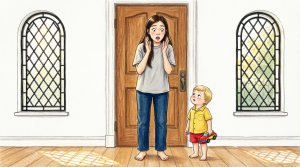
My name is Emily. I was twenty-nine years old on the morning my husband sealed me and our three-year-old son inside our own home, and the story of what happened over the next forty-eight hours is not something I have ever been able to summarize neatly. It is not a story about a wife who was foolish or a husband who was simply cruel. It is a story about what accumulates quietly in a marriage, layer by layer, until you can no longer see what you started with.
By the time I understood what Michael had done, I had already screamed myself hoarse, bled from my hands, and watched my son’s face flush with fever while I stood in a kitchen without a single grain of rice. And the person who finally broke down our front door with a sledgehammer was the woman I had always believed barely tolerated me.
My mother-in-law, Carol.
But I’m getting ahead of myself.
Five years of marriage had given me a life that looked, from the outside, like everything a person could reasonably want. Michael was a vice president of sales, handsome in the way that made people instinctively trust him, the kind of man who could walk into a room and rearrange its energy without appearing to try. We had our son, Leo, who was three years old and already the gravitational center of everything I did. We had a house in a quiet suburb, a yard, a second car, Saturday mornings that smelled like coffee and clean laundry. People told us we looked like a complete family. I believed them.
But only the person sleeping in the bed knows what the sheets are like.
Things had been fraying for over a year, quietly at first and then with more speed, ever since Valerie reappeared. She was Michael’s college girlfriend, a woman he had told me, more than once, was a closed chapter. She was beautiful in an unsettling way, with a kind of deliberate fragility that I understood, on the night of the reunion where I first saw her, was entirely calculated. Michael drank too much that night. When we got home, he muttered her name in his sleep. I lay beside him in the dark and told myself it was just the wine talking, just old nostalgia with no real weight to it. I chose to believe that because the alternative was something I wasn’t ready to look at.
The changes came gradually. He started leaving earlier and coming home later. Business trips became more frequent and vaguer in their details. He stopped sharing stories from his day. The easy physical warmth between us, the shoulder touch, the hand at the small of my back, simply disappeared as if it had never existed. Twice I noticed the faint trace of unfamiliar perfume on his collar. Once I came into the kitchen to find him stepping away from a hushed phone call, deleting messages with a practiced flick of his thumb. When I asked about it, he looked at me with something close to contempt and said I was trying to control him.
I was afraid to push harder. I kept telling myself that if I made a scene, our family would break. I had a son. I wanted Leo to have both his parents. So I swallowed what I knew and kept setting the table for two each night, pretending not to notice how rarely we sat down at it together anymore.
The morning of the lock, Michael told me he had an urgent business trip to Miami. Three days. A critical project with his partner. He would be difficult to reach. His tone was matter-of-fact, slightly impatient in the way it always was when he was in the middle of something more important than our household.
I woke up early and pressed his best suit. I made him breakfast. I walked him to the door.
I had no suspicion whatsoever. That is the part that still stings the most.
When the sound of his car disappeared completely, I tried the doorknob out of some reflex I cannot explain, and it did not turn. I tried it again, harder. I rattled it, then pounded on the wood with my palm, then with my fist, then with both fists.
The back door had a heavy padlock secured from outside.
Every window had iron security bars. They had always been there, part of the house’s original design, something I had never thought about beyond a vague sense of additional security. Now they were a cage.
I called Michael’s number. The operator’s voice told me it was unavailable. I opened WhatsApp and saw the line that made me go cold from the chest outward: You have been blocked by this contact. He had deactivated my SIM card somehow, possibly by reporting it lost. The house Wi-Fi still functioned, but every app that could have connected me to another person required phone verification. I was completely isolated. Not just locked in, but cut off.
It was when I ran to the refrigerator that I understood the full architecture of what he had done.
Two bottles of water. A half-empty carton of milk. Nothing else. The vegetable drawer was bare. The bag of rice I had bought a few days ago was gone. I went to the pantry and opened the anniversary rice dispenser Michael had given me with a tender little speech about never worrying about running out. It was spotless. Scrubbed clean. He had not forgotten to buy groceries. He had removed them.
He had left enough for us not to die immediately. Just enough for the suffering to be slow.
I found half a package of stale crackers in a cabinet. A slightly wrinkled apple in the bowl on the counter. I gave Leo a cracker and peeled the apple and gave him half, saving the other half, and I did not eat. I told myself I had to conserve. I poured him a small glass of milk and told him to drink slowly. He nodded with those clear, earnest eyes, not understanding anything except that his mother seemed worried about something.
Seeing him eat that cracker with gratitude was the moment I stopped crying and started thinking about how to get out.
I went back to the windows and examined the iron bars, specifically the screws securing them to the wall. They were embedded in concrete but the plaster around some of them was old, slightly cracked. In the corner behind the television stand I found an old golf club, a gift from some business associate that Michael had never once used. Long, heavy, thick through the shaft.
For nearly two hours I worked at the bars on the living room window, wedging the club head into the gap and using my whole body as a lever. My hands blistered and split. I did not stop. Every time I was tempted to, I looked at Leo on the sofa. The plaster crumbled and the screws bent and finally the first bar came loose enough to create a gap, not large enough for me, but large enough for a small child. The drop to the ground was over six feet. I could not lower him safely and leaving him alone outside while sick and frightened was not an option. That particular door had closed.
Then the water stopped……………….TO BE CONTINUED IN BELOW 👇
CLICK HERE READ FINAL PART 👉– “Husband Locked Us In For 3 Days With No Food! When My Son Got Sick, I Was Trapped – Then My Mother-In-Law Broke Down The Door With A Shocking Secret!”