Part 1
When I pulled into the gravel driveway that Saturday morning, the orchard looked just the way I’d pictured it when I first bought the place: five acres of calm, fruit trees spaced like promises, and a three-bedroom house sitting quietly under a wide sky.
It should have felt like peace.
Instead, I stepped through the front door and walked straight into my worst mistake.
My daughter Sasha was in the kitchen, shoulders caved inward, hands sunk in soapy water at the sink. She wasn’t sobbing loudly. She was crying the way women cry when they’re past the point of making noise—tears sliding down without any fight left in them. Her hair, usually neat, was pulled back in a messy ponytail. Dark circles dug into her face like bruises. She looked like she hadn’t slept in a week.
Behind her, in the open-plan living room that connected to the kitchen, there were people everywhere. Not two visitors. Not one couple stopping by.
Eight.
Omar’s mother, Denise, lounged on the couch like a queen. His sisters, Taylor and Morgan, stretched out on my daughter’s furniture like it belonged to them. His brother Derek was somewhere in the back with his wife, and their two children were running wild through the house, leaving toys and crumbs in their wake.
They were laughing, shouting, demanding.
“Sasha, where’s the sugar?” Taylor called without looking away from the TV.
“These eggs are cold,” Denise ordered, voice sharp as a knife. “Make me new ones.”
Morgan kicked her feet up on the coffee table. One of the kids ran past with sticky hands and slapped a toy against the wall. Nobody corrected them.
And my Sasha—my sweet, hardworking, forty-three-year-old Sasha—was serving them. Moving like a ghost. Obeying every command. Washing every plate. Taking every insult.
I stood in the doorway and felt rage rise from the pit of my seventy-year-old stomach like something waking up.
This wasn’t what I bought this house for.
One and a half years ago, Sasha left her first marriage. Eighteen years with a man who never hit her, but somehow managed to break her anyway. He ignored her for days. He told her she was useless. He convinced her she was lucky he tolerated her. When she finally asked for a divorce, he took everything: their house, their savings, even the car I’d gifted her on her thirtieth birthday.
She came to my apartment with two suitcases and a soul that looked… emptied out.
For months, I watched her wander through my living room like a sleepwalker. She cried every night. She whispered that she was too old to start over, that she’d missed her chance to have a real home and a real life. And I—after a lifetime of surviving and saving and keeping my head down—decided to do something loud.
I had five thousand dollars saved. Money I’d tucked away over thirty years of bookkeeping, one careful deposit at a time, so I wouldn’t be a burden when my body finally demanded rest.
But when I looked at my daughter, I knew what that money was actually for.
I found this acreage on the outskirts of the city. Not huge, but beautiful. Fruit trees, a big kitchen with windows looking out onto the garden, three bedrooms, and the kind of quiet you can’t buy in town.
It cost fifty-two thousand dollars. I drained my savings and took a small bank loan for the rest.
When I handed Sasha the keys, she stared at them like they were magic.
“It’s mine?” she asked, voice trembling. “Really mine?”
“Yours,” I told her, holding her tight. “Yours and no one else’s.”
I put it in her name only. Not mine. Not “ours.” Not shared. Only Sasha. I’d learned the hard way that women needed something no one could touch.
That day, we cried together with relief and hope. I pictured Sasha healing here—baking like she always dreamed, tending the garden, sleeping without fear.
I never pictured this.
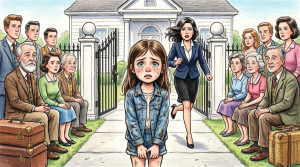
Six months later, she met Omar in a grocery store. He was charming. Attentive. Different from her ex-husband in all the ways that felt like rescue. They married quickly—four months after meeting—and I told myself not to judge. Maybe she deserved a fast happiness after slow suffering.
But happiness can be rushed into a trap.
Now Denise looked up and smiled when she finally noticed me standing there.
“Vivien,” she said sweetly, eyes cold. “What a surprise. We didn’t know you were coming.”
“It’s my daughter’s property,” I said, keeping my voice calm even as my chest burned. “I can come whenever I like.”
Denise rose from the couch with the confidence of someone who thought she’d already won.
“Of course,” she said. “Although technically it belongs to your daughter and my son now. They’re married after all. What belongs to one belongs to the other.”
My skin prickled.
Sasha glanced at me like she was desperate for help but terrified of what help might trigger.
“Sasha,” I said firmly, “come here.”
“I’m busy, Mom,” she whispered, eyes flicking to the sink. “I need to finish cleaning—”
“Let someone else clean,” I said. “Come here now.”
Denise laughed in my face. “Oh, don’t be dramatic. We’re family. Families help each other.”
I looked around at the mess, the feet on the table, the children tearing through the house, and my daughter’s cracked hands.
“How long have you been here?” I asked.
“Two weeks,” Denise answered like that was normal. “And we’ll be staying all summer. Omar invited us. He said there’s plenty of room.”
Two weeks.
My daughter had been living this for two weeks and hadn’t told me.
“And where is Omar?” I asked, voice tight.
“He went out with his father to look at some land,” Denise said, settling back down. “They’ll be back for lunch.”
Then she lifted her chin toward Sasha like she was calling a maid.
“Sasha, it’s almost eleven. Start preparing something. You know my son doesn’t like to eat late.”
Sasha nodded silently and reached for pots, hands moving like she didn’t belong to herself anymore.
Something inside me snapped into place.
I walked to Sasha, touched her arm gently. She flinched.
That flinch told me everything.
“Sasha,” I said low, “we need to talk. Alone.”
Taylor rolled her eyes. “Why don’t you sit down and watch TV with us? Sasha, bring your mom coffee.”
I didn’t even look at her. “Not happening.”
I took Sasha by the arm—not rough, just firm—and guided her out the back door into the yard, away from Denise’s ears.
Sasha moved like her feet weighed a hundred pounds.
When we reached the old swing set I’d installed the first week after buying the property, I made her sit. I knelt in front of her and took her hands in mine.
They were swollen. Cracked. Nails broken. Red marks on her wrists.
“Tell me,” I said simply. “Everything.”
And then Sasha broke open like a dam.
Part 2
“I don’t know how it happened, Mom,” Sasha sobbed, her voice thick with exhaustion. “It was so good at first. Omar was so good.”
I held her hands and let her speak.
“He made me feel special,” she continued. “He never talked about his family like this. When we got married, they visited a little—just Sundays, short things. Denise made comments, but Omar said that was ‘just her way.’”
Her laugh came out bitter. “I tried to get along. I really did.”
I nodded. “I know you did.”
“Then three weeks ago,” Sasha said, wiping her face with the back of her wrist, “Denise called Omar. She said her landlord raised her rent and she needed a place to stay for a few days until she found something cheaper.”
Sasha’s shoulders collapsed. “Omar asked me if she could come. I didn’t want to, but how do you say no to someone’s mother?”
“And then?” I prompted.
“She showed up with two suitcases,” Sasha said. “She said it would be one week. But on the third day, Taylor arrived, crying about her boyfriend. Then Morgan showed up saying her apartment was being remodeled. Then Derek came with his wife and kids for ‘a few days in the country.’”
Sasha’s eyes filled again. “And Omar just… kept saying yes.”
“Did you tell him no?” I asked gently.
“I tried,” Sasha whispered. “I told him I was overwhelmed. I told him I needed space. He said I was overreacting. That the house is big enough. That we owe his family hospitality.”
My mouth went tight. “And Denise?”
Sasha looked away. “Denise says it’s my obligation as a wife. That a good wife takes care of her husband’s family. That this is how ‘real families’ do things.”
The way she said real made my throat burn.
Sasha swallowed hard. “And I started thinking… maybe she was right. Maybe I’m selfish. Maybe I don’t know what’s normal because it was just you and me growing up.”
Those words hit me like a slap.
My daughter—my child who had survived eighteen years of emotional abuse—was still being trained to doubt her own reality.
“Sasha,” I said firmly, cupping her face so she couldn’t look away, “none of this is normal.”
“But—”
“I don’t care what Omar says,” I cut in. “This is your home. Not theirs.”
Sasha’s eyes widened. “But we’re married. What’s mine is his—”
“No,” I said, voice hard. “This property is in your name only. You acquired it before the marriage. Legally, it’s yours.”
I watched something flicker behind her eyes—hope, fear, disbelief.
“I can’t kick them out,” she whispered. “Omar will never forgive me.”
“And is he forgiving you for being miserable?” I asked, keeping my voice steady. “For crying in your own kitchen? For sleeping on the sofa?”
Sasha froze.
“Where are you sleeping?” I asked.
She lowered her gaze. “On the small sofa in the living room.”
“And your bed?”
Sasha’s voice shrank. “Denise said the master mattress is better for her back.”
My vision blurred with anger.
I stood up slowly, joints aching, but my spine felt straight as steel.
“Get up,” I told her, offering my hand.
Sasha stared at me. “Mom… what are you going to do?”
“I’m going to remind them whose house this is,” I said.
We walked back inside.
The scene was worse than before. Juice spilled on the floor. Crumbs everywhere. Dirty dishes piled high. The TV blared. Denise looked up and ordered, “Sasha, make me chamomile tea. Hot this time.”
I stepped in front of the television and blocked the screen.
Taylor blinked. “Excuse me. We’re watching that.”
“Not anymore,” I said, and turned the TV off.
Denise stood up, indignation rising like performance. “What do you think you’re doing?”
“I’m having a conversation,” I said calmly. “About rules.”
Denise laughed, scornful. “Rules? Vivien, you don’t understand how family works.”
“Visit,” I said, letting the word hang. “You’re calling this a visit?”
Denise’s smile faltered.
“A visit is a day. Maybe two. You’ve been here two weeks,” I said. “That’s not a visit. That’s an invasion.”
Taylor’s chin lifted. “Omar invited us.”
“And Omar doesn’t own this property,” I said, turning my head toward Sasha. “Tell them, sweetheart. Whose name is on the deed?”
Sasha swallowed, eyes darting, fear warring with something new.
Then she lifted her chin a fraction.
“It’s mine,” she said, voice shaking but clear. “Only mine.”
For the first time since I walked in, Denise looked uncertain.
But she recovered fast. “That doesn’t matter,” she said brightly. “Sasha wants us here. She’s generous. She understands family.”
Guilt. The old weapon.
I turned to my daughter. “Sasha,” I said softly. “Do you want them here?”
Silence.
Sasha’s hands clenched.
Then she inhaled like she was choosing life.
“No,” she said. “I don’t want them here.”
Denise gasped like she’d been slapped.
“You cannot be serious,” Denise hissed. “After everything my son has done for you—after he saved you from being divorced and lonely—”
“Saved?” I repeated, and my voice went cold. “Your son didn’t save anyone. Sasha didn’t need saving.”
Denise’s eyes flashed. “Omar pays the bills!”
“What bills?” I asked. “Because my daughter has been paying utilities and groceries since you arrived, hasn’t she?”
Sasha’s gaze dropped. “I have,” she admitted. “Omar said his money is tight this month.”
“How much did you spend on food?” I asked.
Sasha’s cheeks flushed with shame. “Around eight hundred dollars. Two weeks.”
The room went quiet.
I looked at Denise and smiled, not warmly.
“So,” I said, “you’ve moved in, eaten her food, used her utilities, taken her bedroom, and turned her into your servant. And you’ve contributed nothing.”
Denise’s voice went thin. “We are family.”
“Family doesn’t exploit,” I said. “You have one hour to pack and leave.”
Morgan stood up, outraged. “You can’t kick us out!”
I pulled my phone out. “I’m not calling the police,” I said, dialing. “I’m calling my lawyer.”
The word lawyer changed the air.
Attorney Miller answered on the second ring. I spoke loudly so everyone heard.
He confirmed exactly what I already knew: the deed was only in Sasha’s name. Anyone refusing to leave after being asked was trespassing. Police could remove them.
When I hung up, Denise’s face had gone pale.
“You have fifty minutes,” I said, checking my watch.
That was when Derek walked in from outside, smelling like smoke and entitlement.
“What’s going on?” he demanded.
“Your mother’s getting kicked out,” Derek’s wife snapped.
Derek squared up to me like size mattered. “Ma’am, you’re confused. This is my brother’s house.”
“No,” I said simply. “It’s not.”
Derek sneered. “And who’s going to make us leave? You?”
I stepped close enough for him to see I wasn’t afraid. “Be careful underestimating older women,” I said quietly. “We’ve survived too much.”
Then the driveway crunch sounded again.
A car door slammed.
Omar had arrived.
Part 3
Sasha stiffened beside me like her body had been wired to brace for conflict.
The front door opened, and Omar walked in with his father behind him—quiet man, tired eyes. Omar’s face was confused as he took in the suitcases, the tension, the grim, silent stares.
“What is going on?” Omar asked, looking between everyone like he expected someone to tell him this was a joke.
Denise stormed forward, fury wearing the costume of victimhood. “Thank goodness you’re here. Your mother-in-law has gone crazy. She’s kicking us out!”
Omar looked at me, then Sasha. “What?” he said, voice rising. “Why?”
Sasha opened her mouth, but the words stuck. I could see years of training—be quiet, don’t make it worse, don’t be the problem—trying to clamp her throat shut.
So I spoke first.
“I asked your family to leave,” I said, voice calm, “because they’ve been abusing Sasha’s hospitality for two weeks.”
“Abusing?” Omar repeated like the word didn’t fit in his mouth. “They’re my family. I invited them.”
“And you don’t have the right to invite people into a house that isn’t yours,” I said.
Omar blinked, offended. “What do you mean it isn’t mine? I’m her husband. I live here.”
“Living here doesn’t make it yours,” I said. “This property is solely in Sasha’s name. It was acquired before the marriage.”
Omar’s face changed—surprise, then something like panic.
“That doesn’t matter,” he said quickly. “We’re married. What’s hers is mine.”
“No,” I said. “Not legally. And even if it were shared, you still wouldn’t have the right to let anyone treat your wife like hired help.”
Omar turned to Sasha. “Is that true?” he asked, voice tight. “Are you… saying my family treated you badly?”
Denise swooped in. “Of course not, sweetheart. She’s overreacting. She’s sensitive. You know how she is.”
Sasha’s head lifted slowly, like she’d heard enough.
“How I am?” she repeated, voice shaking.
Omar flinched at her tone.
Sasha stood up from the sofa. Her hands were still cracked, her eyes still swollen, but her spine rose inch by inch.
“How am I, Omar?” she asked. “Tell me.”
Omar opened his mouth. No answer.
Sasha took a step toward him. “Am I overreacting because your mother sleeps in our bed and I sleep on the sofa?”
Denise’s face twitched. Omar’s father looked down.
Sasha’s voice gained strength. “Am I overreacting because I’ve spent eight hundred dollars feeding your family while you say you’re ‘saving for a project’?”
Omar’s eyes widened. “Eight hundred?”
“Yes,” Sasha snapped, and the word landed like a door slam. “Am I overreacting because I wake up at five to cook and go to bed at eleven cleaning up after everyone while they treat me like I’m lucky to be here?”
Omar’s hands went to his temples. He looked like he was trying to hold his brain together.
“Sasha,” he started, “I didn’t know you felt—”
“I told you,” Sasha said, and tears finally spilled, but the tears didn’t weaken her voice. “Three times. The first time you said I was overreacting. The second time you said your mother was ‘just trying to help.’ The third time you got angry and told me I was the problem.”
Denise jumped in, voice syrupy. “Heavenly Father, look at her manipulating you. Tears, Omar. She’s using tears.”
And then, unexpectedly, Omar shouted.
“Stop it!”
The room froze.
Denise recoiled like she’d been slapped. Omar’s father looked up sharply.
Omar’s chest heaved. “Did you know she’s been sleeping on the sofa?” he demanded, looking at his mother. “Did you even care?”
Denise stammered. “I… I have back problems.”
“Then sleep in a guest room,” Omar snapped. “Why take our bedroom?”
Denise’s mouth opened. No answer.
Because the answer was control.
Omar turned slowly, taking in the mess—crumbs, spilled juice, toys, dirty dishes, Sasha’s ruined hands. He looked like someone finally seeing a picture that had been in front of him the whole time.
His father spoke quietly, surprising everyone.
“Denise,” he said, voice tired, “what we did is wrong.”
Denise whipped her head toward him. “You too?”
“I watched Sasha work like a slave,” her husband admitted, voice cracking with shame. “And I did nothing. I’m ashamed.”
Denise stared as if her world was tipping.
Omar exhaled hard. “Mom,” he said, voice strained but firm, “I think you should go.”
Denise’s eyes went wide. “Omar—”
“I love you,” Omar said, and his voice shook, “but Sasha is right. You took advantage. I allowed it because I didn’t want to fight you. And I was wrong.”
Denise’s face hardened into rage. “If we leave, you come with us,” she snapped. “That’s the only option.”
Sasha’s breath hitched.
This was the moment that would decide everything.
Omar looked at his mother. Then he looked at Sasha, tears on her cheeks, but her head held high for the first time in weeks. Then he looked at me, and I saw the struggle—the conditioning of a lifetime versus the truth standing in his living room.
Finally, he shook his head.
“No,” he said. “I’m staying here with my wife.”
Denise gasped, furious, wounded, powerless all at once. “You’ll regret this,” she hissed. “When she disappoints you, when this marriage fails like her first—”
“Sasha is not a stranger,” Omar said, voice solidifying. “She is my wife. And if this marriage fails, it will be because I didn’t protect her when I should have. Not because she wasn’t worth it.”
Denise stared at him like she’d never seen him before.
Then, as if she understood the battle was lost, she turned on her heel and marched toward the bedroom to finish packing.
Taylor and Morgan followed, muttering insults. Derek’s wife yanked toys off the floor like she was being robbed.
Omar’s father paused at Sasha and touched her shoulder gently. “I’m sorry,” he said. “I should’ve defended you.”
Sasha nodded, unable to speak.
Thirty minutes later, the cars rolled down the gravel driveway and disappeared.
The silence afterward was so sudden it felt unreal.
Sasha turned and clung to Omar, sobbing into his chest. Omar held her tight, repeating, “I’m sorry. I’m sorry. I’m sorry.”
I stayed back and watched them, not triumphant, just relieved in a way that felt heavy.
When Sasha finally pulled away, she looked at me with red eyes.
“Did we do the right thing?” she whispered. “Or did I destroy my marriage?”
I held her like I held her when she was five and had nightmares.
“A marriage that survives only if you agree to be mistreated isn’t worth saving,” I said gently. “If Omar wants this marriage, he’ll protect you. Not just today. Every day.”
Omar looked at me, eyes wet. “Vivien… you were right,” he said hoarsely. “I was a coward.”
“You were conditioned,” I said honestly. “The important thing is you chose differently.”
Omar turned to Sasha, holding her face. “I will never let anyone treat you like that again,” he said. “Not my mother. Not anyone.”
Sasha searched his eyes. “Really?”
“Really,” he promised.
I left soon after, because they needed space to rebuild without my shadow in every corner.
But before I walked to my car, I turned back and met Omar’s gaze.
“If I ever find her crying in that kitchen again,” I said calmly, “next time I won’t just kick out your family. I’ll kick you out too.”
Omar nodded, sober. “It won’t happen again,” he said.
As I drove away, I saw them on the porch in my rearview mirror, small but together.
For the first time that day, I let myself breathe……………………….To be continued in below
 :
: