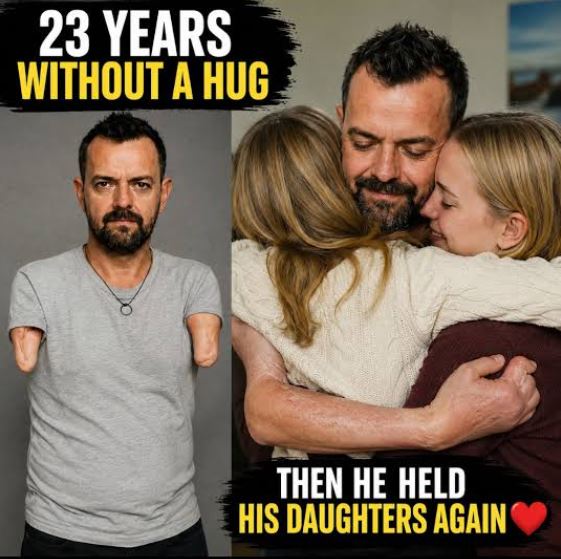
When Felix Gretarsson went home to Iceland for Christmas in 2021, his daughters were grown. One had been four years old when he last held her in his arms. The other had been three months old. In the years between those embraces, Felix had survived a devastating electrical accident, moved to France, and undergone an operation that took nearly 15 hours. And there, during a holiday visit to the country where he had lost both arms, he could finally put them around his daughters again.
A photograph from the reunion shows Felix hugging one of his daughters while a granddaughter waits nearby for her turn. The granddaughter is a detail worth lingering on. When Felix was injured, he was a young father with two small children. By the time the transplant made this hug possible, those children had lives and families of their own. The years in that photograph are visible in the people gathered around him.
Eleven months before the visit, reporters in Lyon had heard a far more modest hope from his lead surgeon. If Felix could someday bend an elbow on his own, Dr. Aram Gazarian said, that alone would make a substantial difference in his life. At the time, the transplant was attracting international attention, and the doctors had little way of knowing how much movement he would eventually recover.
Between that cautious prediction and the hug stood months of rehabilitation. Before the operation came a much longer stretch of uncertainty, beginning on an icy January morning in Iceland.
The morning an electrical accident changed his life
On January 12, 1998, Guðmundur Felix Grétarsson was a 26-year-old electrician working on a high-voltage line. In a later interview, he remembered bitter cold and wind that made it hard to see. He had gone to investigate a fault. When he reached the line, an electrical discharge of 11,000 volts severely burned his hands and arms and sent him falling to the frozen ground. He suffered fractures and internal injuries along with the damage caused by the electricity.
The violence of the fall was only part of the emergency. The burns had damaged tissue so severely that doctors had to amputate both arms. Felix spent about three months in a coma. While his family was living through those first weeks, watching developments he would only learn about later, surgeons were dealing with injuries across his body. He woke to the consequences of decisions that had to be made while he was unconscious.
Years later, Felix told 7NEWS that his parents and other loved ones had been called to the hospital because doctors feared he would die. In his telling, his father came away from that first encounter convinced that his son would survive. Felix remembered the confidence his father had in him, a memory that would take on particular weight after the transplant.
The accident changed what Felix needed to do to get through an ordinary day. A shirt has to be pulled into place. A meal arrives in packaging somebody has to open. Work, travel and childcare bring their own practical demands. Any one of those things can be adapted, but all of them come around again the next morning. Felix would spend years finding ways to manage daily life. His daughters were growing up during those years, and he has spoken about how deeply he missed being able to hold them as he had before the accident.
A liver transplant before the operation that made headlines
Another major medical crisis followed. In 2002, Felix received a liver transplant. In interviews about his life after the accident, he has spoken openly about using drugs and alcohol as he struggled with pain and about seeking help for addiction. His account of those years gives the eventual transplant story a longer and more difficult beginning than the operating-room photographs suggest. Some of the work of getting to Lyon happened at a time when replacing his arms was still a distant prospect.
The liver transplant would matter again when his French doctors considered the arm surgery. Felix was already taking medication to suppress his immune system and protect the transplanted organ. That treatment was part of his everyday life before his team had to weigh the particular risks of adding two donor limbs.
An immune system protects the body by recognizing things that are foreign to it. After a transplant, the same defense can attack donated tissue. Suppressing that response requires ongoing medication and follow-up. The prospect of long-term medication and close monitoring is therefore central to decisions about limb transplants, where the intended benefits are improvements in function and quality of life. Felix’s prior transplant gave his team an actual treatment history to work from as they considered what a second transplant might mean for him.
The question he took to a hotel lobby
In 2007, Felix learned that Jean-Michel Dubernard, a French surgeon associated with pioneering hand transplantation, was in Reykjavík. Felix had been following developments in the field. He tracked Dubernard down and arranged to meet him in a hotel lobby. The question he wanted the surgeon to consider was whether a person with amputations as high as his might someday receive whole arms.
Felix later recalled that Dubernard examined him and asked to see his records. That was something he could act on. The records would show the doctors what the earlier operations had left them to work with. The level of each amputation, the condition of the remaining structures and the effects of other injuries all mattered to whether surgeons could build a workable plan.
A surgeon considering a hand transplant has a shorter distance to bridge between the point of attachment and the fingertips. Felix’s arms would have to be attached much higher, making the shoulder and upper arm part of the problem. His two sides also presented different challenges. By 2011, the team in Lyon was considering a transplant for him. The project that began with a conversation in Reykjavík would now involve specialists who had to decide whether both arms could be attached and what kind of function might be possible afterward.
He moved to France without knowing when the call would come
There were airline tickets and tests before there was a move. Felix traveled to France for assessment and sold his possessions in Iceland as he prepared to pursue the transplant. Fundraising efforts back home helped him take the next step. The hospital in Lyon described charity sales and appeals for donations as Icelanders rallied around his plans. For the people who contributed, there was no surgery date to circle. Their support helped him get to the place where it could happen.
He moved to Lyon in 2013. A surgery date depended on finding a suitable donor, so preparation came with the possibility of months or years of delay. A donor would have to be compatible, and the donation would have to be authorized. A team able to carry out an unusual operation had to be ready when that moment arrived. Felix kept up his physical preparation while he waited.
His life in France acquired its own shape during those years. He met Sylwia, who became his wife. Asked about the transplant after the surgery, she told reporters that it was a dream of his and that she had always felt he was whole as he was. Her account belongs in the story because so much of the public attention centered on what he hoped to gain. She had fallen in love with the man who was there throughout the waiting.
The wait also affected time with his relatives in Iceland. When he returned for the 2021 holidays, he told Iceland’s public broadcaster that it was his first Christmas there since 2014. Seven years separated those two Christmas visits. That absence gives another dimension to the homecoming, even before considering what Felix could do with his arms by the time he came through the door.
A call on the anniversary of the accident
Felix told 7NEWS that the call about the donor came on January 12, 2021, exactly 23 years after the accident. The following day, at Édouard Herriot Hospital in Lyon, the team began the operation. He was 48. On the left, surgeons had to reconstruct the shoulder and attach an entire arm. On the right, they attached the donor arm high on the upper arm. That combination is what made the procedure a world first.
The work began in parallel. While some clinicians prepared Felix, others worked on the donor side. The hospital’s surgical account describes rehearsals and careful coordination because muscle can tolerate only a limited time without an adequate blood supply. The teams had to line up those stages so they could restore circulation once the donor limbs reached the recipient operating room. Every additional step needed for the shoulder reconstruction had to fit into a procedure that also depended on moving quickly.
The transplanted arms contained many kinds of tissue. Bone had to be secured, blood vessels joined, and nerves linked. Muscles, tendons and skin all had a place in the reconstruction. In medical terms, this is a composite transplant. The word captures how many structures move together from donor to recipient. It also helps explain why each side presented its own work. At the highest part of the left arm, surgeons had to build the connection at a different level than they did on the right.
The hospital said the donor had agreed to multi-organ donation. His death and Felix’s opportunity were bound together on the day of the operation. For years, Felix and the team could train, raise funds, run tests and rehearse. The donation supplied something none of that effort could produce. When Felix later spoke about his new abilities, the movements he described were also a way to understand the reach of that decision.
Why a working elbow was enough to hope for
After nearly 15 hours, Felix had two arms attached to his body. The question of how much he would be able to do with them remained open. At the first news conference, Gazarian spoke of the difference it would make if Felix could actively bend an elbow. Clinicians saw a better early outlook for function on the right, where the shoulder had required less reconstruction. At that point, there was a considerable distance between seeing the arms in place and being able to draw conclusions about their eventual use.
Bending an elbow is easy to overlook because it happens so often between a decision and an action. You bend it when a hand comes toward your face or when you pull an object toward your body. A change in that one joint can expand the area of the world you can reach. Gazarian’s example gave the public a way to understand the kinds of changes that would matter to Felix even if recovery stopped short of the most ambitious possibilities.
Nerves help explain the uncertainty. Restored circulation keeps transplanted tissue supplied with blood. Movement and sensation also require nerves to connect with structures in the new limbs over time. Nerve fibers have farther to travel to the hand than to the upper arm when the connection is near the shoulder. The surgeons could establish a route during the operation. Felix and his rehabilitation team would have to find out, month by month, what signals could make it through and what he could learn to do with them.
Learning to make the movements his arms allowed
Rehabilitation continued at Henry Gabrielle Hospital, where France 3 later filmed Felix working with his care team. Rehabilitation medicine and occupational therapy were both part of the follow-up. Over time, recovery could be seen in two ways. Clinicians could observe the motion he gained at a joint. Felix could also judge a movement by whether it helped him do something he wanted to do in his own life. A useful bend, turn or reach might depend on several small gains working together.
Felix described a schedule of rehabilitation that took up much of the working week during the period covered by a 2022 interview. Some gains were easier to see in the therapy room, where a clinician could compare a movement with how he had performed it the week before. The work could only proceed from what his body was able to do at that stage. He could practice getting a movement under control, build on it as strength improved, and test whether it was becoming dependable.
There was also the question of feeling. Sensation gives you information about what your hand has met, how hard your fingers are pressing, or whether something is slipping. Think about picking up an object while looking somewhere else. The information that lets you adjust the grip is part of the task, along with muscle strength and coordination. For Felix, gains in movement and feeling could each widen what he was able to do, and the available reports describe gradual changes across both.
A little under two years after the operation, Felix spoke to the French newspaper Le Progrès about being able to scratch his head. He treated it with humor, and the example tells you something about what progress looks like outside a hospital. An itch comes and goes. The freedom to deal with it immediately can be easy to overlook until you’ve spent years having to find another way. That was one of the changes he could describe from his home, in the middle of a life that still included long rehabilitation sessions.
By spring 2023, a follow-up report described another change. Felix could ride a bicycle. Cycling makes a good example of how several gains can come together in one activity. Your hands have to stay on the bars as your shoulders and elbows adjust to the road. To turn or slow down, you have to coordinate what your arms are doing with the rest of your body. A person watching a short clip might see a few seconds on a bike. Behind that ride were months of learning what kinds of movement the arms could sustain.
The bike also offers a window into the difference between an exercise and an activity someone wants to spend time doing. In a therapy session, a movement can be repeated with the aim of making it more controlled. Out on a bicycle, the movement has somewhere to take you. Felix could also return to the gym, the same sort of setting in which he had worked to prepare for the possibility of surgery. By then he had concrete ways to see how far the preparation and rehabilitation had carried him.
Those activities help explain why rehabilitation teams ask what people want to do with the function they gain. For one person, being able to steer a bike might top the list. Another might care most about bringing a cup to their mouth or doing something with their children. The same movement can serve several of those goals. A stronger grip, for example, can matter for a bike ride in the afternoon and for something as routine as carrying an object around the house. Johns Hopkins Medicine describes rehabilitation after a hand or arm transplant as intensive, with some form of therapy continuing long term. In Felix’s case, the experiences he talked about in interviews gave people ways to see what that time could add up to.
The Christmas when he could hold his family
By December 2021, Felix could travel home to Iceland and put his arms around his family. His daughters, Rebekka and Dilja, were adults. His grandchildren belonged to a generation that had only known him after the accident. The photograph of the embrace, published with his account of the visit, puts the youngest generation right beside the oldest part of the story. One daughter could lean into his arms while a granddaughter waited close enough to watch.
That December, Icelandic readers were also encountering Felix through his book, 11,000 Volts. Its title recalled the electrical discharge in 1998. The homecoming happened in a season when many people in Iceland were revisiting the beginning of his story, even as he was giving interviews about what he could do with his arms that year.
Felix also got time with his parents during the trip. His father died the following January, according to Felix’s account to 7NEWS. Looking back, Felix spoke about how much it meant that they had been together at Christmas. His father had been at the hospital in the aftermath of the accident and had believed he would survive. More than two decades later, he was there for the visit Felix had finally been able to make after the transplant.
There is an intimacy to that homecoming that the surgical story alone can miss. A clinician can measure how far an elbow bends. What a daughter feels when her father reaches around her is something else for the family to carry. They had been in each other’s lives through years when he couldn’t make that gesture. In the photograph, you can see the result of a piece of medical work they experienced on a far more personal scale.
Five years later, care continued
In January 2026, Hospices Civils de Lyon marked the fifth anniversary of the operation and shared a France 3 report that followed Felix at his annual checkup. The anniversary offered a view of transplantation that the original headlines could only begin to show. Years after the achievement in the operating room, his care still involved specialists keeping track of the transplanted tissues and his health. The reports from two and five years after the operation also show how long it takes to tell the story of a surgery whose outcomes emerge in ordinary life.
A French newspaper reported in September 2026 that Felix had settled near Strasbourg and started a business. It also reported that he had undergone surgery for cancer. In October, Felix publicly said he was being treated for signs of rejection in his transplanted arms while undergoing radiation for nasal cancer, according to Iceland Monitor. The announcement described treatment in progress. It gave readers another view of what it means to live for years with a transplant, as medical priorities can change and different teams may have to address problems at the same time.
When Felix first walked into that hotel lobby in Reykjavík, he wanted to know whether surgeons might one day give him arms. No one in that room could have described the result in advance. The surgery eventually answered the question in one way. The photograph from Christmas answered it in another. His daughter was already in his arms. His granddaughter was waiting for her turn.