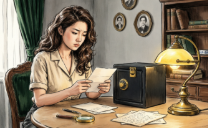
PART 5 — THE LAST LETTER FROM MY HUSBAND (FINAL PART)
I was seventy years old, sitting in a three-thousand-dollar Cape Cod beach house on my birthday, when I discovered that the man I had loved for forty-eight years might have taken a terrible secret to his grave.
And now someone wanted me to come to an abandoned lighthouse at midnight.
Alone.
I stared at the message on David’s phone.
“Margaret must never know what happened here.”
Those seven words were written in Harold’s handwriting.
I knew every curve of those letters.
I had seen that handwriting on birthday cards, grocery lists, anniversary notes, and the little messages he used to leave beside my morning coffee.
But I had never imagined seeing it attached to a threat.
David reached for my hand.
“Mom, you’re not going.”
I looked at him.
“David—”
“No. Absolutely not. Someone has already broken into your house and threatened you. You’re not walking into a trap.”
For once, my son wasn’t trying to avoid an uncomfortable conversation.
He was trying to protect me.
And although part of me wanted to hug him, another part remembered how easily he had allowed Ashley to push me aside.
Love, I was learning, could survive disappointment.
But trust had to be rebuilt.
Patricia Williams took the phone from David.
“Nobody is going to that lighthouse alone,” she said firmly.
She photographed the messages, preserved the sender’s number, and contacted the investigator.
Then she turned toward me.
“Margaret, whatever Harold left behind, we can investigate it without putting you in danger.”
I nodded.
But my mind was somewhere else.
Twenty-seven years earlier.
Harold coming home late.
His pale face.
His locked study.
His refusal to explain the argument over the land.
And that strange sentence he had spoken before his final surgery.
“If anyone ever comes asking about the lighthouse, don’t trust them.”
For three years, I had thought those were the confused words of a frightened man.
Now I wondered whether he had been trying to warn me.
An hour later, Patricia received a call from her colleague.
The original law office that had held Harold’s letter had closed years earlier, but its records had been transferred to another firm.
The successor firm had located a sealed envelope bearing my name.
And there was something unusual about the instructions.
The envelope could be released to me upon verification of my identity and the circumstances Harold had specified.
Patricia explained that the firm wanted to meet with us the following morning.
I looked at her.
“Tomorrow?”
“Yes.”
I glanced toward the ocean.
For seventy years, I had been patient.
I had waited for David to grow up.
I had waited for Harold to come home from long shifts.
I had waited for grief to become something I could carry without crying.
I could wait one more night.
But then the front door opened.
Ashley stood in the doorway.
Her eyes were red.
Her hair was disheveled.
And for the first time since I had known her, she looked genuinely frightened.
“Margaret,” she whispered, “there’s something I need to tell you before the police get here.”
David stood.
“Ashley, what now?”
She looked at him.
Then at me.
“Michael isn’t the person you think he is.”
Patricia immediately became attentive.
“What do you mean?”
Ashley swallowed.
“His name isn’t Michael.”
A terrible silence settled over the room.
“Then who is he?” I asked.
Ashley looked toward the photograph of Walter Bennett on David’s phone.
And whispered:
“His name is Daniel Bennett.”
David frowned.
“Bennett?”
Ashley nodded.
“He’s Walter’s son.”
I felt the blood drain from my face.
Walter’s son.
Harold’s nephew.
A man I had never met.
Someone who would have known about our family history.
Someone who might have understood exactly which documents to look for.
Patricia asked Ashley how she knew.
“He told me last night,” she answered. “After I started asking questions about the money. He said his family had been cheated out of something and that Harold had left proof.”
David stared at her.
“And you didn’t think to mention that earlier?”
Ashley began crying.
“Because he threatened me!”
“What did he threaten?”
She looked at me.
“He said if I told anyone his real name, he’d send David everything.”
David’s expression changed.
“Everything about what?”
Ashley covered her face.
And then, in a broken voice, she admitted something that destroyed the last illusion of her marriage.
“I’ve been hiding debts from you for almost two years.”
David went completely still.
“How much?”
Ashley shook her head.
“Please.”
“How much, Ashley?”
She whispered:
“Nearly ninety thousand dollars.”
Linda gasped.
Richard closed his eyes.
David stepped backward as though someone had struck him.
Ninety thousand dollars.
The seventy thousand I had willingly given them.
The fifteen thousand from Ashley’s parents.
The disputed transfers.
The losses she had concealed.
And now another enormous amount of debt.
The figures were tangled together, and none of us yet knew which payments overlapped.
But one thing was clear.
Ashley had been hiding a financial disaster behind a carefully maintained appearance of success.
The expensive clothes.
The luxury car.
The beautiful photographs.
The endless insistence that everything was wonderful.
All while she quietly borrowed, lied, and took risks with other people’s money.
David looked at her for a long time.
Then he said something that made her begin sobbing.
“I would have lived in a one-bedroom apartment with you.”
She looked up.
“I would have sold the car. I would have worked weekends. I would have done whatever it took to fix our finances.”
His voice cracked.
“But you never gave me the truth.”
Ashley reached for him.
He stepped away.
“I don’t know how to be married to someone I don’t know.”
For the first time that day, Ashley had no answer.
Patricia asked her to preserve every message from Daniel and cooperate with the investigators.
Then she turned toward me.
“Margaret, we should focus on the letter. Whatever Daniel is claiming, Harold’s original documents may explain the property dispute.”
I nodded.
But my heart was breaking for my son.
Not because his marriage might end.
Because he was finally discovering that keeping the peace was not the same as protecting a family.
That evening, after the investigators had spoken with us and arranged further follow-up, the birthday guests were gone.
The white roses still stood beneath the pergola.
The ocean continued its steady rhythm.
And I sat alone on the deck, holding a cup of tea.
David came outside.
“Can I sit with you, Mom?”
I nodded.
He lowered himself into the chair beside mine.
For several minutes, neither of us spoke.
Then he said:
“I heard what Ashley said about you yesterday.”
I looked at him.
“Which part?”
His eyes filled.
“The part about you being a lonely old widow who could sleep on the floor.”
I looked toward the darkening water.
“And you laughed.”
He lowered his head.
“Yes.”
I waited.
“Mom, I don’t have an excuse.”
Those words surprised me.
For years, David had explained away every hurtful remark.
Ashley was stressed.
Ashley didn’t mean it.
Ashley was tired.
Ashley had a difficult childhood.
There was always a reason.
But that night, he didn’t offer one.
“I was ashamed of myself,” he continued. “And instead of standing up for you, I laughed because it was easier.”
I swallowed.
“David, do you know what hurt the most?”
He shook his head.
“It wasn’t the sofa.”
He looked at me.
“It wasn’t even the money.”
My voice trembled.
“It was realizing that the little boy I raised had become a man who could hear someone humiliate his mother and decide it wasn’t worth correcting.”
Tears rolled down his face.
“I’m sorry.”
I nodded slowly.
“I believe you.”
He reached for my hand.
This time, I let him take it.
“But believing you’re sorry isn’t the same as pretending nothing happened.”
He nodded.
“I know.”
We sat together until the stars appeared.
And for the first time in years, I didn’t feel responsible for making my son comfortable with the consequences of his own choices.
The following morning, Patricia drove me to the law office in Hyannis.
David came with us.
Richard and Linda remained at the beach house, while Ashley arranged to speak with her own attorney.
The office was small and quiet.
An older attorney named Eleanor Price greeted us.
She had inherited Harold’s file when the original firm closed.
After checking my identification and reviewing the release instructions, she placed a thick envelope on the table.
My name was written across the front.
Margaret Bennett.
In Harold’s handwriting.
I touched it with trembling fingers.
For three years, I had wished for one more letter from my husband.
One more chance to hear him say he loved me.
And now I had it.
But I was terrified of what it might contain.
Eleanor spoke gently.
“Mrs. Bennett, your husband left instructions for this letter to be delivered if the property dispute resurfaced or if someone attempted to claim ownership through the family.”
I nodded.
“Did he explain why?”
“He included supporting documents.”
She placed a second folder beside the envelope.
“These concern an old parcel near the lighthouse.”
Patricia examined the documents.
Then her expression changed.
“Margaret,” she said softly, “I think Harold was trying to protect something very specific.”
I opened the letter.
The first line made me cry.
“My dearest Maggie, if you’re reading this, then I have failed to explain something while I was alive, and for that, I am sorry.”
I pressed my hand over my mouth.
David moved closer.
I continued reading.
“Twenty-seven years ago, my brother Walter and I inherited a small piece of coastal land from our father. Walter wanted to sell it immediately. I refused.”
I looked up.
The old argument.
The meeting.
The secret.
It was all there.
I read on.
“The land was not valuable then. It was rocky, difficult to access, and overlooked by almost everyone. But there was something about it that Walter never understood.”
My hands trembled.
“Years before, when we were young and had nothing, you told me that your greatest dream was to open a little place by the sea where widows, elderly people, and families who couldn’t afford a holiday could spend a few peaceful days.”
I stopped reading.
A memory came rushing back.
I was twenty-four.
Harold and I had been married for two years.
We were sitting on the beach, sharing a sandwich because we couldn’t afford dinner at a restaurant.
I had seen an elderly woman sitting alone on a bench.
She told us her husband had died the previous winter.
She had saved for years to return to the beach where they spent their honeymoon.
I remember telling Harold that nobody should have to choose between paying bills and having one beautiful memory.
And I had said, laughing:
“One day, when we’re rich, we’ll build a little house by the sea and let lonely people stay there for free.”
Harold had smiled.
“Then that’s what we’ll do, Maggie.”
I had forgotten.
But he hadn’t.
Tears blurred the page.
I continued.
“I bought Walter’s interest in the property under a written agreement. He later disputed the transaction, and the matter became tied up in years of legal arguments. I kept the records because I knew the truth might one day be questioned.”
Patricia nodded as she reviewed the documents.
The folder contained copies of the old agreement, payment records, correspondence, and a legal opinion.
None of it meant the dispute was automatically settled.
But it gave us a place to begin.
Then I reached the next paragraph.
“Over the years, developers offered money for the land. The offers grew larger. But every time I thought about selling, I remembered the young woman who sat beside me on that beach and dreamed of giving strangers a place to rest.”
I began sobbing.
David put his arm around me.
“Mom…”
I shook my head.
“Let me finish.”
I wiped my eyes.
“After my death, I wanted the property preserved until you were ready to decide what to do with it. I never told you the full story because the legal dispute was unresolved, and I didn’t want you carrying another worry while I was ill.”
Then came the sentence that explained the photograph Daniel had sent.
“If anyone asks about the lighthouse, don’t trust their promises of easy money. Margaret must never know what happened here from someone who wants to use the story against her. She deserves to hear it from me.”
I stared at those words.
The photograph had shown only one sentence.
Seven frightening words.
But without the rest of the paragraph, the meaning had been completely twisted.
Harold hadn’t been hiding some terrible crime.
He had been trying to protect a dream.
My dream.
I turned to the final page.
And there, in the handwriting I had loved for nearly half a century, were the words that broke me completely.
“Maggie, I know you will be lonely when I’m gone. I know you will try to fill that loneliness by taking care of everyone else. You have always loved people more generously than they sometimes deserve.”
I covered my face.
“Please don’t give away your peace just because someone asks for it. Please don’t mistake being needed for being loved. And please remember that you are not valuable because of what you can give.”
I could barely see through my tears.
“You were the greatest gift of my life long before we owned a house, before we had savings, before we had David, and before anyone thought our little piece of land was worth anything.”
Then came his final request.
“If the lighthouse property can ever be secured, build the little house by the sea we dreamed about. Fill it with laughter. Let people who have lost their way find a little peace there. And when the ocean wind blows through the windows, remember that somewhere, somehow, I am still loving you.”
I pressed the letter against my chest.
For three years, I had thought Harold left me behind.
But he hadn’t.
He had left me a purpose.
David was crying openly beside me.
“Mom,” he whispered, “Dad really loved you.”
I smiled through my tears.
“Yes, sweetheart. He did.”
Patricia quietly turned another page in the property folder.
“There is something else.”
I looked up.
“What?”
“The old agreement includes evidence that Harold paid Walter for his share. And the later correspondence suggests Walter continued trying to challenge that sale.”
Eleanor nodded.
“The title issues will still need to be resolved, but the documents are substantial.”
David frowned.
“Then why would Walter’s son try to get the original papers?”
Patricia answered.
“Possibly because those documents could undermine a competing claim. But we shouldn’t assume Daniel’s motives until the investigators establish the facts.”
I looked at Harold’s letter.
For years, I had believed the greatest thing my husband left me was financial security.
Now I understood.
It was the right to choose what happened next.
And I knew exactly what I wanted to do.
But first, there was one final problem.
Walter Bennett.
That afternoon, Patricia arranged a meeting through Walter’s attorney.
We did not go to the lighthouse.
We did not answer Daniel’s threats.
We met in a professional office, with legal representatives present.
Walter entered looking much older than I remembered.
His hair was completely white.
His shoulders were stooped.
And when he saw me, he stopped.
“Margaret.”
“Walter.”
He looked at the letter in my hand.
“So you finally read it.”
I nodded.
“Yes.”
His eyes lowered.
“Harold always said you’d understand.”
I studied him.
“Why did you fight him over that land?”
Walter sighed.
“Because I wanted the money.”
At least he was truthful about that.
He sat down.
“Harold and I inherited the property together. I thought it was worthless. When he offered to buy my share, I took the money.”
“Then why challenge the sale?”
Walter stared at his hands.
“Because years later, when developers started making offers, I realized what I’d given up.”
I felt a deep sadness.
“You tried to take back something you’d already sold.”
He nodded.
“I convinced myself Harold had cheated me.”
“Did he?”
Walter shook his head.
“No.”
For a long moment, nobody spoke.
Then Walter looked at Patricia.
“I told Daniel to leave this alone.”
My heart tightened.
“You knew what your son was doing?”
Walter’s face crumpled.
“Not all of it. I knew he was trying to find the documents. I didn’t know about Margaret’s bank accounts or the threats until your attorney contacted mine.”
Patricia made it clear that those matters were being investigated and that any evidence Walter possessed needed to be preserved.
Walter nodded.
“I’ll cooperate.”
Then he looked at me.
“Margaret, I spent twenty-seven years being angry with my brother over a piece of land.”
His eyes filled.
“And now he’s gone.”
I said nothing.
“He was a better man than I was.”
I looked down at Harold’s letter.
“He wasn’t perfect, Walter.”
Walter nodded.
“No. But he knew what mattered.”
Before we left, Walter agreed through counsel to provide the original records in his possession and work toward resolving the ownership dispute.
It wasn’t a magical ending.
There were still legal questions.
There were still investigations.
And there were still consequences waiting for the people who had hurt me.
But for the first time, the truth was moving forward instead of being buried.
The following weeks were difficult.
The bank continued reviewing the disputed transfers.
Investigators examined Ashley’s communications with Daniel and the records associated with the account opened in Harold’s name.
The threatening messages and unauthorized entry were investigated.
Eventually, investigators identified evidence connecting Daniel to the fraudulent account activity and the threats.
He was arrested and charged.
Ashley cooperated with the investigation, but cooperation did not erase her own decisions.
She faced separate scrutiny over the information she had shared and the financial transactions she had concealed.
I didn’t celebrate any of it.
There is nothing joyful about watching people destroy their lives through greed and dishonesty.
But I refused to rescue them from consequences they needed to face.
David moved out of the house he shared with Ashley.
He began counseling.
He started reviewing his finances, making a realistic budget, and taking responsibility for the choices he had avoided for years.
One evening, he came to my house carrying a small notebook.
“Mom, I made something.”
I looked at it.
Inside was a repayment plan.
Not a promise.
Not another excuse.
A real plan, with dates and amounts he believed he could manage.
“I know I can’t fix everything,” he said. “But I want to repay the money you lent us.”
I looked at him for a long time.
Then I said:
“David, the money matters. But there’s something I need more.”
He nodded.
“What?”
“Respect.”
His eyes filled.
“You have it.”
I shook my head gently.
“Don’t tell me. Show me.”
And he did.
Not perfectly.
Not overnight.
But steadily.
He called without asking for money.
He visited without expecting dinner.
He helped me carry groceries, but he didn’t take over my decisions.
He began treating me like a capable woman instead of an inconvenient responsibility.
And slowly, the relationship between us changed.
Not back into what it had been.
Into something healthier.
Something honest.
As for Ashley, I didn’t hate her.
Hatred would have kept me tied to the pain.
But I didn’t invite her back into my life.
She wrote me a long letter several months later.
She apologized for the money, the lies, the bedroom, and the cruel words she had spoken about me.
At the end, she wrote:
“I thought you were weak because you never fought back. Now I realize you were giving me chances I didn’t deserve.”
I read the letter twice.
Then I placed it in a drawer.
I wished her well.
But I did not confuse forgiveness with permission to hurt me again.
The property dispute took longer to resolve.
There were title searches, negotiations, old records, and months of legal work.
Walter eventually signed a settlement confirming the earlier transfer and releasing his remaining claims.
After the necessary legal work was completed, the lighthouse parcel was finally secured.
The land had considerable value.
But by then, I no longer cared about becoming wealthy.
I had enough.
Harold had made sure of that.
What I wanted was something money alone could never buy.
Meaning.
One year after my seventieth birthday, I stood on a small stretch of Cape Cod coastline overlooking the old lighthouse.
The wind was strong.
The ocean was bright.
And beside me stood David, Richard, Linda, Patricia, and a handful of people who had helped make my dream possible.
Behind us was a beautiful little coastal retreat.
White siding.
Blue shutters.
A wide porch.
A garden filled with roses.
And six cozy guest rooms overlooking the water.
Above the entrance hung a wooden sign.
HAROLD’S HARBOR — A PLACE TO BEGIN AGAIN
It wasn’t a luxury resort.
It wasn’t designed for wealthy tourists.
It was a nonprofit retreat created for widows, widowers, older adults living alone, and families who had experienced loss.
Guests could stay for a few peaceful days without worrying about the cost.
There were meals around a long wooden table.
Books beside the fireplace.
Walking paths through the dunes.
And a little bench facing the ocean.
The very kind of place I had dreamed about when I was twenty-four.
The opening day was beautiful.
But the moment I remember most clearly happened just before sunset.
An elderly woman arrived carrying a small suitcase.
Her name was Evelyn.
She was seventy-six.
Her husband had died eight months earlier.
She stood in the doorway looking uncertain.
“I’m sorry,” she whispered. “I don’t usually go anywhere alone.”
I smiled.
“Neither did I.”
She looked around.
“This place is beautiful.”
“Thank you.”
Then she asked a question that brought tears to my eyes.
“Are you sure I can stay here? I can’t afford a place like this.”
I took her hand.
“Evelyn, you don’t have to earn a place to rest.”
She began crying.
And suddenly, I was back in that Cape Cod beach house.
Seventy years old.
Standing beside a sliding glass door.
Listening to my daughter-in-law say I was just a lonely old widow who could sleep on the floor.
I remembered how small I had felt.
How invisible.
How easily I had accepted being pushed aside.
Then I looked at Evelyn.
And I realized how far I had come.
“Come with me,” I said.
I led her upstairs.
Opened a beautiful bedroom overlooking the ocean.
And handed her the key.
“This is yours for the weekend.”
She stared at the room.
The soft bed.
The fresh flowers.
The sunlight dancing across the water.
“Are you sure?”
I smiled through my tears.
“Absolutely.”
She stepped inside.
Then turned back.
“Why would you do something so kind for a stranger?”
I looked toward the ocean.
And for a moment, I could almost hear Harold laughing beside me.
“Because someone I loved taught me that kindness should never come with a price.”
That evening, after the guests had settled in, David found me sitting on the bench near the lighthouse.
He carried two cups of tea.
“Thought you might want some company.”
I smiled.
“I’d like that.”
He sat beside me.
For a while, we watched the waves.
Then he reached into his coat pocket.
“Mom, I found something.”
He handed me a small wooden object.
It was Harold’s model lighthouse.
The one he had built during his retirement.
David had found it while helping me reorganize the storage closet after the investigation.
The paint was chipped.
One of the tiny windows was crooked.
But it was still beautiful.
I held it carefully.
“I thought I’d lost this.”
David smiled.
“Look underneath.”
I turned it over.
There was a small wooden panel.
A tiny brass screw held it in place.
David handed me a screwdriver.
I opened it.
Inside was a folded piece of paper.
My hands began trembling.
Another letter.
Smaller than the first.
Just a few lines.
I unfolded it.
And read:
“My Maggie, if you’ve found this, I hope you’re smiling. I built this little lighthouse because you always said the world needed more places where people could find their way home. If I can’t be beside you when you finally build yours, promise me one thing.”
Tears slipped down my cheeks.
I read the final sentence.
“Don’t spend the rest of your life missing me so much that you forget to live the life we dreamed about.”
I pressed the note against my heart.
David put his arm around my shoulders.
“Mom?”
I looked at him.
“Are you okay?”
I watched the sun sink slowly toward the horizon.
The lighthouse stood against the evening sky.
Behind us, warm lights glowed through the windows of Harold’s Harbor.
Inside, six people who had arrived carrying grief were sharing dinner, laughter, and stories.
I thought about the woman I had been a year earlier.
The woman who paid for everyone’s happiness and accepted whatever corner was left for her.
The woman who believed being loved meant never saying no.
The woman who thought her life had ended when her husband died.
Then I looked at my son.
And I smiled.
“Yes, David.”
I wiped away my tears.
“For the first time in a very long time, I really am.”
He kissed my forehead.
And we sat together until the stars appeared.
That night, I walked through the retreat one last time before going home.
I checked the kitchen.
Turned off the lights.
Straightened the flowers.
And stopped outside Evelyn’s room.
Her door was slightly open.
She was sitting beside the window, looking at the ocean.
When she saw me, she smiled.
“Margaret?”
“Yes?”
“I just wanted to thank you.”
I shook my head.
“You don’t have to.”
She looked around the room.
“After my husband died, I started believing I was just an old woman taking up space.”
My throat tightened.
She continued.
“My children are busy. My friends have their own lives. Sometimes I feel like there’s nowhere I belong anymore.”
I stepped closer.
Evelyn looked at me with tears in her eyes.
“But tonight, for the first time in months, I feel like someone actually wanted me here.”
I took her hand.
And suddenly, I understood the greatest gift Harold had left me.
It wasn’t the property.
It wasn’t the money.
It wasn’t even the beautiful letters.
It was the chance to make sure another lonely person never felt as worthless as I had felt on my seventieth birthday.
I squeezed Evelyn’s hand.
“You belong here,” I whispered.
She smiled.
And so did I.
Because a year earlier, someone had looked at me and decided that a lonely old widow deserved nothing better than the floor.
They had taken the master bedroom.
They had taken my money.
They had taken my kindness for granted.
But they had never taken the most important thing.
My ability to begin again.
At seventy-one, I finally understood something I wished I had learned at thirty.
You can love your family without allowing them to use you.
You can forgive someone without giving them another chance to hurt you.
And you can grow old without ever becoming invisible.
Before leaving that night, I stopped beneath the wooden sign above the entrance.
I ran my fingers across Harold’s name.
Then I looked up at the stars.
“We did it, sweetheart,” I whispered.
The wind moved gently through the roses.
And for one beautiful moment, it felt as though he were standing beside me.
I smiled.
Then I went inside.
Not because I was afraid of being alone.
But because there were people waiting for me.
People who needed warmth.
People who needed kindness.
People who needed to know their lives still mattered.
And this time, I wasn’t giving everything away to earn a place in someone else’s family.
I was building a place where everyone could belong.
My daughter-in-law once said I could sleep on the floor because I was just a lonely old widow.
One year later, I was opening doors to beautiful oceanfront bedrooms for people who had been made to feel just as unwanted.
And the greatest part wasn’t that I finally owned the rooms.
It was that I no longer needed anyone else’s permission to take up space in this world.
Because my husband hadn’t left me a fortune so I could prove my worth to people who refused to see it.
He had left me a dream so I could remember the worth I had possessed all along.
THE END. ❤️