TWO YEARS LATER, THEY QUIETLY MARRIED
By 1966, Dolly’s career was beginning to move forward.
That created an unexpected complication.
People in the music business worried that marriage could hurt the image of a young female performer who was still trying to establish herself.
But Dolly had already made her decision.
She loved Carl.
On May 30, 1966, Dolly Parton and Carl Dean traveled to Ringgold, Georgia, and married in a small private ceremony.
There were no television cameras.
There was no enormous celebrity guest list.
Dolly’s mother was there, along with the pastor and his wife.
It was almost the opposite of the glamorous life Dolly would eventually lead.
But the marriage became one of the longest relationships associated with American entertainment.
The young couple could not have known what was coming.
Dolly was not yet an international star.
There was no Dollywood.
There were no blockbuster movies.
There was no Imagination Library.
There were no shelves filled with Grammy Awards and other honors.
There was simply Dolly, Carl, and a promise they had made to each other.
THEN DOLLY’S DREAM STARTED COMING TRUE
In 1965, Dolly signed with Monument Records and also secured a songwriting agreement.
Her first album, Hello, I’m Dolly, arrived in 1967.
That same year came the opportunity that dramatically changed her career.
Dolly joined The Porter Wagoner Show.
Suddenly, millions of country-music viewers were being introduced to the young blonde singer from Tennessee.
From 1967 until 1974, Dolly and Porter Wagoner became one of country music’s best-known performing partnerships.
Dolly was moving toward the life she had dreamed about since childhood.
Carl was watching it happen from home.
And that was exactly where he preferred to be.
While other celebrity spouses appeared on carpets, posed for photographers and sat beside their famous partners at industry events, Carl largely refused that life.
He ran his own asphalt and paving business around Nashville and preferred ordinary routines.
Dolly later explained that Carl was supportive of her career; he simply had no desire to become part of the entertainment industry himself.
That distinction mattered.
Carl did not ask Dolly to stop being Dolly.
And Dolly did not demand that Carl become a celebrity husband.
They allowed each other to remain themselves.
THE WORLD GOT DOLLY PARTON. CARL GOT THE WOMAN BEHIND HER
As Dolly’s fame increased, she created one of the most recognizable public images in entertainment.
Huge blonde hair.
Rhinestones.
Bright clothes.
High heels.
Big personality.
Quick humor.
But celebrity Dolly was only one part of Dolly Parton.
Carl knew the woman who came home after the costumes were removed.
Their private life could be surprisingly ordinary.
Dolly’s official biography describes them taking sightseeing trips together in an RV, staying in roadside motels, eating at drive-through restaurants and returning near the church where they had married for simple anniversary picnics.
They did not need Hollywood to entertain them.
Sometimes they simply drove somewhere.
Sometimes they found a quiet place near the water.
Sometimes Dolly cooked.
Sometimes they ate something simple.
For a woman whose professional life became increasingly extraordinary, that normality mattered.
Carl became the place where fame stopped.
DOLLY BECAME A STAR IN HER OWN RIGHT
By the early 1970s, Dolly was no longer simply Porter Wagoner’s television partner.
She was becoming one of country music’s most distinctive songwriters.
In 1971, “Joshua” became her first No. 1 country single.
Songs including “Coat of Many Colors,” “My Tennessee Mountain Home” and “Jolene” demonstrated that Dolly could turn ordinary emotions and memories into stories millions of people understood.
Then came one of the most difficult professional decisions of her career.
Dolly wanted to leave The Porter Wagoner Show and work independently.
The separation was emotional and complicated.
Dolly expressed what she felt through songwriting.
The result was “I Will Always Love You.”
The song reached No. 1 on the country chart in 1974 and again in 1982. Years later, Whitney Houston’s recording transformed it into one of the most recognizable songs in popular music.
Dolly was becoming something much larger than anyone had predicted when she and Carl married.
But Carl remained Carl.
THEIR TIME APART MAY HAVE HELPED THEM STAY TOGETHER
Dolly frequently traveled.
She recorded.
She toured.
She appeared on television.
Eventually she made movies.
There were periods when Dolly and Carl spent substantial time apart because of her work.
Some people might imagine that would weaken a marriage.
Dolly sometimes suggested the opposite.
Distance meant they had opportunities to miss one another.
When she returned home, they had things to talk about.
They had not spent every hour living inside each other’s worlds.
Dolly had her career.
Carl had his interests and business.
And they had their marriage.
For decades, people kept asking Dolly for the secret.
There was never one magical answer.
Humor mattered.
Independence mattered.
Respect mattered.
Privacy mattered.
And perhaps most importantly, they apparently never tried to turn one another into different people.
CARL WAS SURROUNDED BY FAME WITHOUT WANTING ANY OF IT
As Dolly’s career expanded beyond country music, remaining anonymous became increasingly difficult.
By the late 1970s, Dolly was crossing onto pop charts.
Then Hollywood called.
In 1980 she starred with Jane Fonda and Lily Tomlin in 9 to 5.
The movie was a major success, and Dolly wrote and performed its famous title song.
More films followed, including The Best Little Whorehouse in Texas and Steel Magnolias.
Dolly was no longer merely a country star.
She was becoming an American cultural icon.
Yet Carl continued avoiding the spotlight.
There was something almost remarkable about it.
Millions of people knew Dolly’s face.
Many fans could have walked past her husband without recognizing him.
Dolly respected his decision.
Instead of using her fame to force him into public life, she protected his privacy.
THEY BUILT A FAMILY WITHOUT CHILDREN OF THEIR OWN
As Part 1 explained, Dolly and Carl never became parents.
But family remained enormously important to Dolly.
She had grown up as one of twelve children, so relatives surrounded much of her life.
Nieces, nephews and younger family members became important to her.
She also became famously close to Miley Cyrus as her godmother.
Eventually, Dolly’s relationship with children reached far beyond relatives.
In 1995, she founded Dolly Parton’s Imagination Library.
The program was inspired partly by her father, Robert Lee Parton, who had never learned to read and write.
What began as an effort to give books to young children in her Tennessee home county grew into an international literacy program.
By the time Dolly died, the program had distributed more than 300 million books to children.
Dolly sometimes reflected that although she had never raised children herself, perhaps her life had allowed her to care for children in another way.
CARL SAW DOLLY BUILD AN EMPIRE
Their marriage survived transformations neither could have imagined in 1966.
Dolly became a recording legend.
She became a movie star.
She became a businesswoman.
Dollywood grew into one of Tennessee’s best-known tourist destinations.
Her songs crossed generations.
Her songwriting became respected far beyond country music.
Her philanthropy affected millions of families.
She received the Kennedy Center Honors.
She entered the Country Music Hall of Fame.
She won Grammy Awards.
She eventually entered the Rock & Roll Hall of Fame.
Her records sold more than 100 million copies worldwide.
And through all of that, Carl remained largely outside the public story.
But he was deeply inside Dolly’s story.
FIFTY YEARS AFTER THEIR SMALL WEDDING, THEY DID IT AGAIN
In 2016, Dolly and Carl reached an extraordinary milestone.
Fifty years of marriage.
This time Dolly decided she wanted something she had not really experienced in 1966.
A beautiful wedding dress.
Carl wore a suit.
They renewed their vows in a private ceremony.
Afterward, Dolly joked that after surviving fifty years together, they might as well do it again.
There was also a charitable purpose.
Photos connected with their anniversary were used to help raise money for Dolly’s Imagination Library.
Then, in classic Dolly-and-Carl fashion, they returned to something simple.
They traveled.
They spent time together away from the cameras.
The celebrity wedding anniversary was temporary.
Their private marriage remained the real thing.
THE LITTLE THINGS STILL MATTERED
Even after decades together, Dolly described ordinary gestures as some of the things she loved most.
Carl might bring her flowers.
They could have a quiet meal.
They might take an RV trip.
A picnic beside a river could mean more than an expensive celebrity event.
This was one of the contradictions that made Dolly’s life fascinating.
She loved glamour.
She loved rhinestones.
She loved putting on a show.
But some of her happiest memories with Carl involved almost no show at all.
The woman who could command an arena also treasured sitting quietly beside the man she met when she was eighteen.
THEY GREW OLD TOGETHER
Eventually, the young couple from 1964 became an elderly married couple.
Dolly kept working at an age when many entertainers would have retired.
Carl became even less visible publicly.
Fans occasionally wondered about him because there were so few photographs and appearances.
Dolly continued speaking about him affectionately while also refusing to drag him into a world he had avoided for decades.
By then, their marriage had survived things that destroy many relationships.
Fame.
Money.
Long separations.
Rumors.
Career pressure.
Age.
Illness.
Loss.
And more than half a century of change.
Then came the goodbye Dolly had always known would someday arrive.
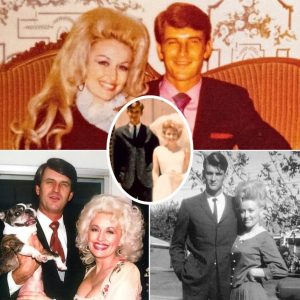
MARCH 3, 2025 — CARL DEAN DIED
Carl Thomas Dean died in Nashville on March 3, 2025.
He was 82 years old.
He and Dolly had been married for nearly 59 years.
The family announced that Carl would be laid to rest in a private ceremony attended by immediate family.
That was fitting.
Carl had spent most of his adult life avoiding public attention.
Even his farewell remained private.
Dolly had lost the person who knew her before most of the world did.
The man who had met an ambitious eighteen-year-old girl outside a laundromat had lived long enough to see that girl become one of the most successful entertainers of her generation.
But for Dolly, Carl had never simply been “Dolly Parton’s husband.”
He was home.
DOLLY DID WHAT SHE HAD ALWAYS DONE WITH EMOTION — SHE TURNED IT INTO MUSIC
Only days after Carl’s death, Dolly released “If You Hadn’t Been There,” a song dedicated to him.
She explained that she had fallen in love with Carl when she was eighteen and that they had shared sixty precious and meaningful years together.
She described their love story as something that would continue through memories and music.
The song was not simply another release.
It was Dolly’s way of acknowledging the person who had quietly existed behind much of her extraordinary public life.
For almost sixty years, Dolly had written about love.
Now she was writing from the experience of losing the man with whom she had shared almost her entire adult life.
BUT DOLLY KEPT WORKING
Grief did not completely stop Dolly.
Less than two weeks after Carl’s death, she participated in events surrounding Dollywood’s 40th anniversary season.
Projects she had begun continued moving forward.
Her life story was being developed into a stage musical.
The Imagination Library continued sending books to children.
She continued developing music and business projects.
That persistence reflected something that had characterized Dolly since childhood.
She kept moving.
She had survived poverty.
Career rejection.
Professional battles.
Health struggles.
Family deaths.
And now the loss of Carl.
Work did not erase grief.
But work had always been one of the ways Dolly moved through life.
JANUARY 19, 2026 — DOLLY TURNED 80
Dolly reached her 80th birthday on January 19, 2026.
Instead of treating the milestone only as a celebration of herself, she again connected music with giving.
A new version of “Light of a Clear Blue Morning,” featuring Lainey Wilson, Miley Cyrus, Queen Latifah and Reba McEntire with David Foster on piano, was released to benefit pediatric cancer research at Monroe Carell Jr. Children’s Hospital at Vanderbilt.
It was a fitting example of what Dolly’s later life had become.
Music.
Friends.
Legacy.
And giving.
By then, Carl had been gone for less than a year.
The person who had been beside Dolly for almost her entire adulthood was no longer there to celebrate the milestone with her.
Yet Dolly continued.
SHE WAS STILL PLANNING FOR THE FUTURE
One of the most striking facts about Dolly’s final year is that she was not living as though her life’s work had ended.
She continued planning.
Her musical, DOLLY: A True Original Musical, was scheduled to reach Broadway in December 2026.
Her businesses continued expanding.
Dollywood continued.
The Imagination Library continued.
In June 2026, the literacy program was still announcing new milestones.
In July, Dolly’s organization announced plans for the Broadway production.
Even in August 2026, only days before her death, Dolly’s official site was celebrating new global sales certifications for her music.
There was no neat moment when Dolly simply declared her story complete.
She continued creating.
AUGUST 25, 2026 — DOLLY PARTON DIED
Then, less than nineteen months after Carl’s death, Dolly’s own journey ended.
On August 25, 2026, Dolly Rebecca Parton died peacefully in Nashville, Tennessee.
She was 80 years old.
Her official announcement described her not only as a singer but as a songwriter, philanthropist, actress, playwright and author.
It also identified Carl as her beloved husband of 59 years.
At Dolly’s request, her family planned a small private service for immediate family.
Instead of flowers, people were encouraged to donate to Dolly Parton’s Imagination Library.
It was difficult to imagine a more appropriate final request.
The girl who had grown up poor in a one-bedroom home in the Smoky Mountains was leaving behind an organization that had placed hundreds of millions of books into children’s hands.
AND SO THE LOVE STORY THAT BEGAN OUTSIDE A LAUNDROMAT CAME TO ITS FINAL CHAPTER
Carl went first.
Dolly followed the next year.
For most of the world, Dolly Parton was the star.
For Carl Dean, she was the young woman he had met before the fame.
And for Dolly, Carl represented something fame could never provide.
Continuity.
Privacy.
Normality.
Someone who remembered who she had been before everyone knew her name.
Their marriage was not perfect because no real marriage is perfect.
It lasted because two very different people apparently found a way to give one another enough room to remain themselves.
Dolly never stopped chasing enormous dreams.
Carl never developed an interest in chasing fame.
Neither demanded that the other change.
That may be one of the most important parts of their story.
Dolly’s name appeared in lights around the world.
Carl was happiest far away from those lights.
But when Dolly came home, he was there.
For nearly six decades.
From the Wishy Washy Laundromat in 1964…
To a tiny wedding in Georgia in 1966…
To Dolly’s rise through country music…
To “Jolene,” “9 to 5,” “I Will Always Love You,” Dollywood and the Imagination Library…
To their 50th wedding anniversary…
To old age…
To Carl’s death in March 2025…
And finally to Dolly’s death on August 25, 2026.
The public story belonged to Dolly Parton.
But behind much of it stood a man who rarely wanted anyone to see him.
Carl Dean.
And perhaps that is why their story remains so unusual.
One became one of the most recognizable women in the world.
The other spent decades successfully avoiding becoming famous.
Yet they chose each other again and again.
When Dolly finally had to continue without him, she turned their love into one last song.
And when her own life ended the following year, the official story of Dolly Parton listed Carl exactly where anyone who had listened to her talk about him would expect him to be:
Her beloved husband.
The man she met when she was eighteen.
The man who knew her before the rhinestones, before the millions of records, before Dollywood, before Hollywood and before the world learned the name Dolly Parton.
Their time together ended.
But the story they created lasted almost sixty years.
And just as Dolly believed songs could keep memories alive, their story did not disappear when they did.
It simply became part of the extraordinary legacy they left behind.
CLICK HERE CONTINUE TO READ PART 3: THE DOLLY PARTON FANS THOUGHT THEY KNEW — FUN, SURPRISING AND TOUCHING FACTS FROM HER LIFE

