“If that little girl doesn’t finish those dishes, neither she nor her mother eats until my guests have been served.”
My mother said those words without realizing I was standing less than thirty feet away.
I had come home two days early from a business trip.
And within the next hour, almost everything I believed about my family would change.
My name is Everett Calloway. I was thirty-six then, working as a senior operations manager for a software company in Raleigh, North Carolina.
My wife, Laurel, and I lived with our five-year-old daughter, Maisie, in a large suburban home outside Cary. It was the kind of neighborhood where the lawns looked combed, the mailboxes matched, and people apologized if their trash cans remained at the curb ten minutes after sunset.
We had bought the house six years earlier.
Laurel chose it because of the maple tree in the backyard.
I chose it because the commute was manageable.
Maisie loved it because the upstairs hallway had a little window seat she insisted was her “reading castle,” even before she could read.
My mother, Darlene, had been staying with us for almost a year.
She was sixty-three, recently retired, and constantly reminded me how lonely life had become since she started living by herself.
When she first asked to move in, Laurel agreed before I did.
“She’s your mother, Everett,” Laurel told me. “We have enough room. Maybe having Maisie around will be good for her.”
I should have remembered those words later.
Laurel had opened our home to my mother.
And I had allowed my mother to slowly make Laurel feel like a guest inside it.
I was supposed to be in Denver until Friday, but the final two days of my conference were unexpectedly canceled. Instead of calling home, I changed my flight.
I imagined walking through the door and hearing Maisie scream, “Daddy!”
Maybe we would order pizza.
Maybe Laurel and I would sit on the back porch after Maisie went to bed, drinking the cheap red wine she liked while she told me everything I had missed.|Instead, when I opened the front door shortly after four on Wednesday afternoon, I heard laughter.
Lots of it.
The entryway was crowded with purses, coats, umbrellas, and shoes that did not belong to us.
A beige cardigan had been tossed over the antique bench Laurel’s grandfather made.
Someone’s high heels were under Maisie’s raincoat.
The smell of roasted meat, baked casseroles, perfume, and coffee filled the house.
Then I heard my mother laughing from the dining room.
“Everett bought me this dress,” she was telling someone. “My son believes his mother deserves nice things.”
Another woman laughed.
“And this house! Darlene, you’re living better than the rest of us.”
My mother answered proudly.
“Well, my son has done very well for himself.”
I quietly set my suitcase beside the stairs.
Something felt wrong.
Not because my mother had guests.
She entertained occasionally. Usually bridge friends or women from her old church.
But she always asked first.
At least, I thought she did.
Then one of the women said, “Where’s Laurel? I haven’t seen her all afternoon.”
My mother laughed.
“Where do you think? In the kitchen. Maisie is helping her. Children need to learn responsibility while they’re young.”
There was something in the way she said helping.
Something flat.
Satisfied.
I moved down the hallway.
Through the dining room doorway, I could see nearly twenty people seated around our dining table and two folding tables that had been added beside it.
Our best dishes were out.
The crystal glasses from our wedding registry were being used.
My mother stood at the head of the table in a navy dress I did remember buying her.
She was holding a wineglass in one hand.
She looked radiant.
Comfortable.
At home.
Too much at home.
I remained in the hallway where she could not see me and looked past the dining room toward the kitchen.
That was when I saw my daughter.
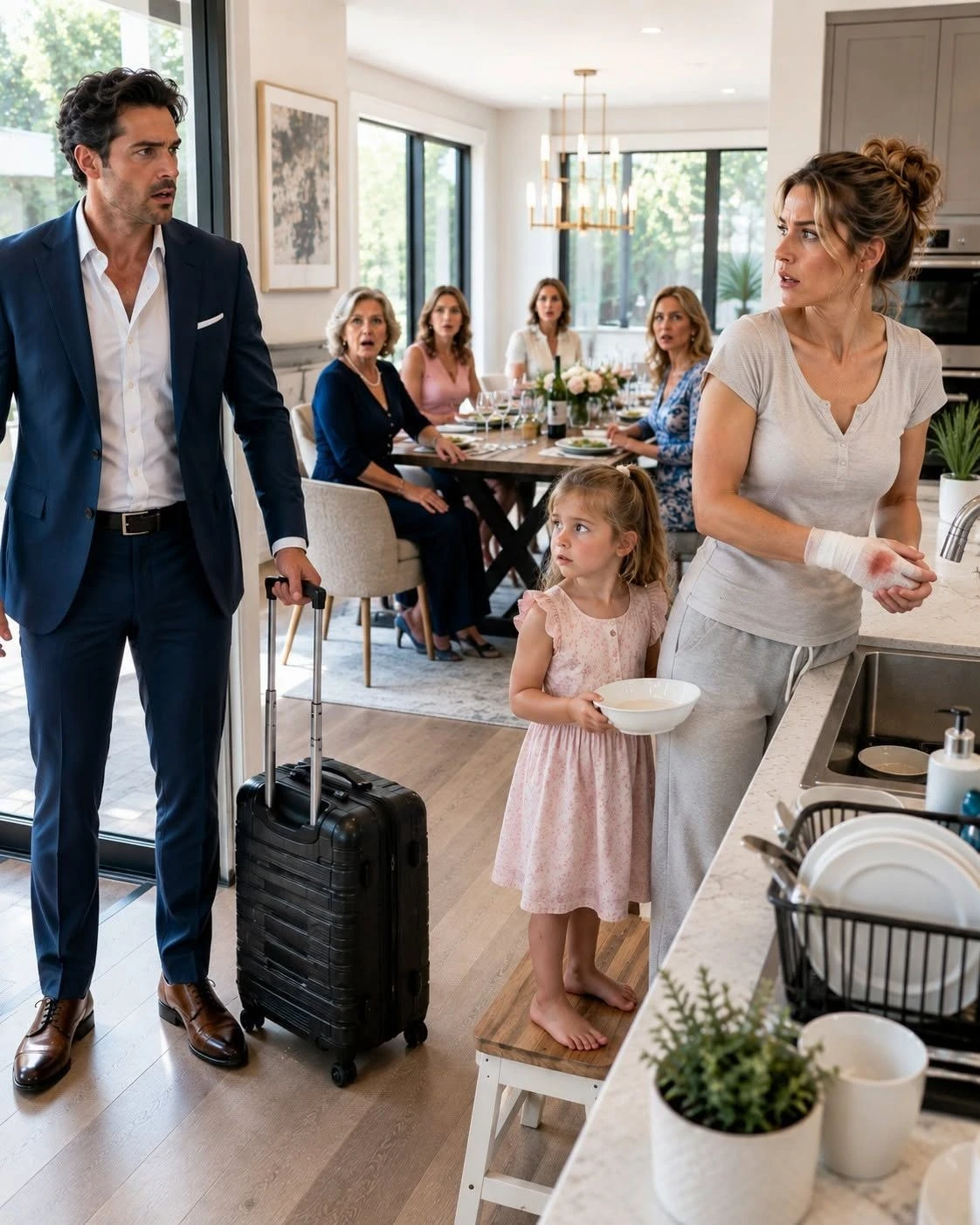
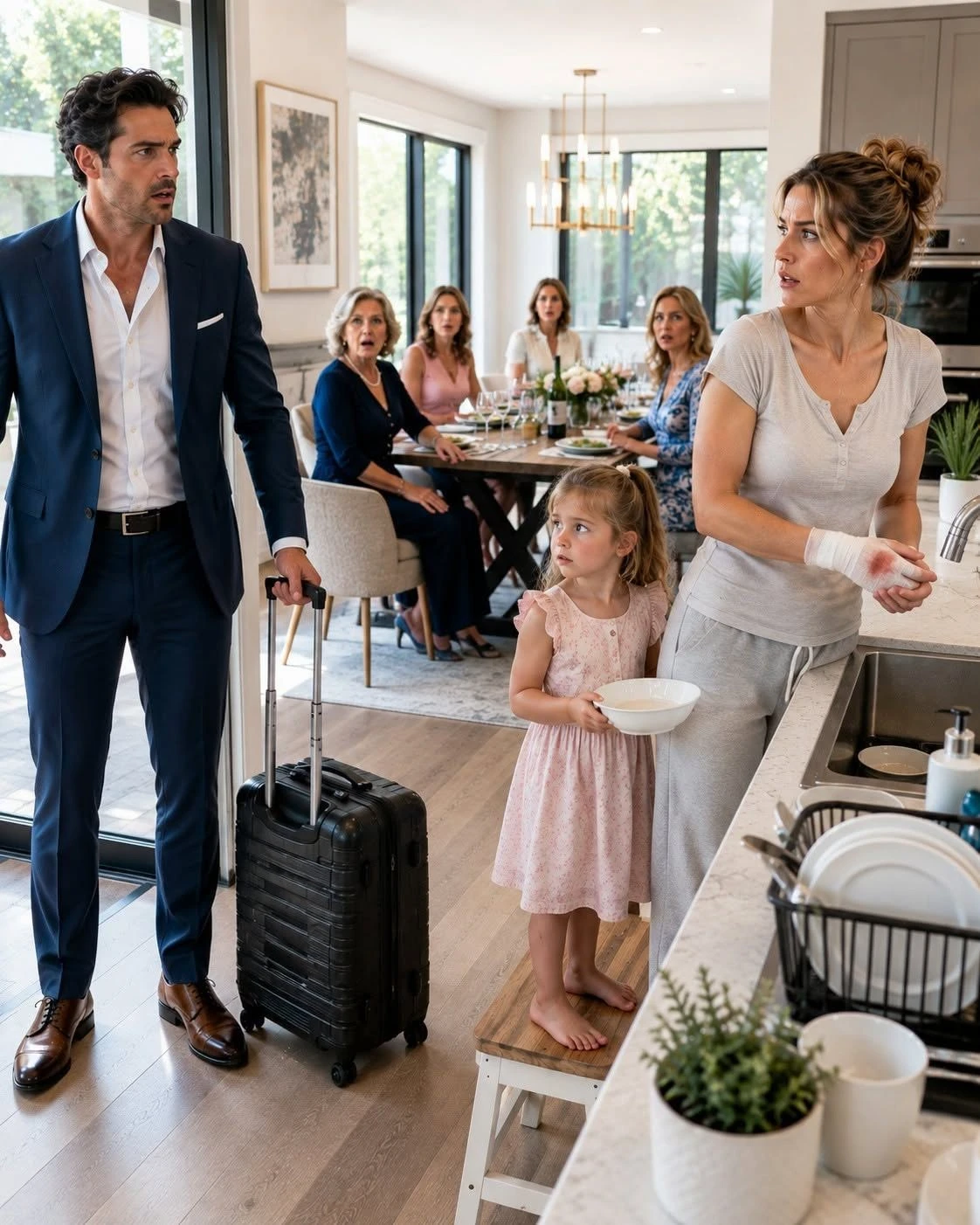
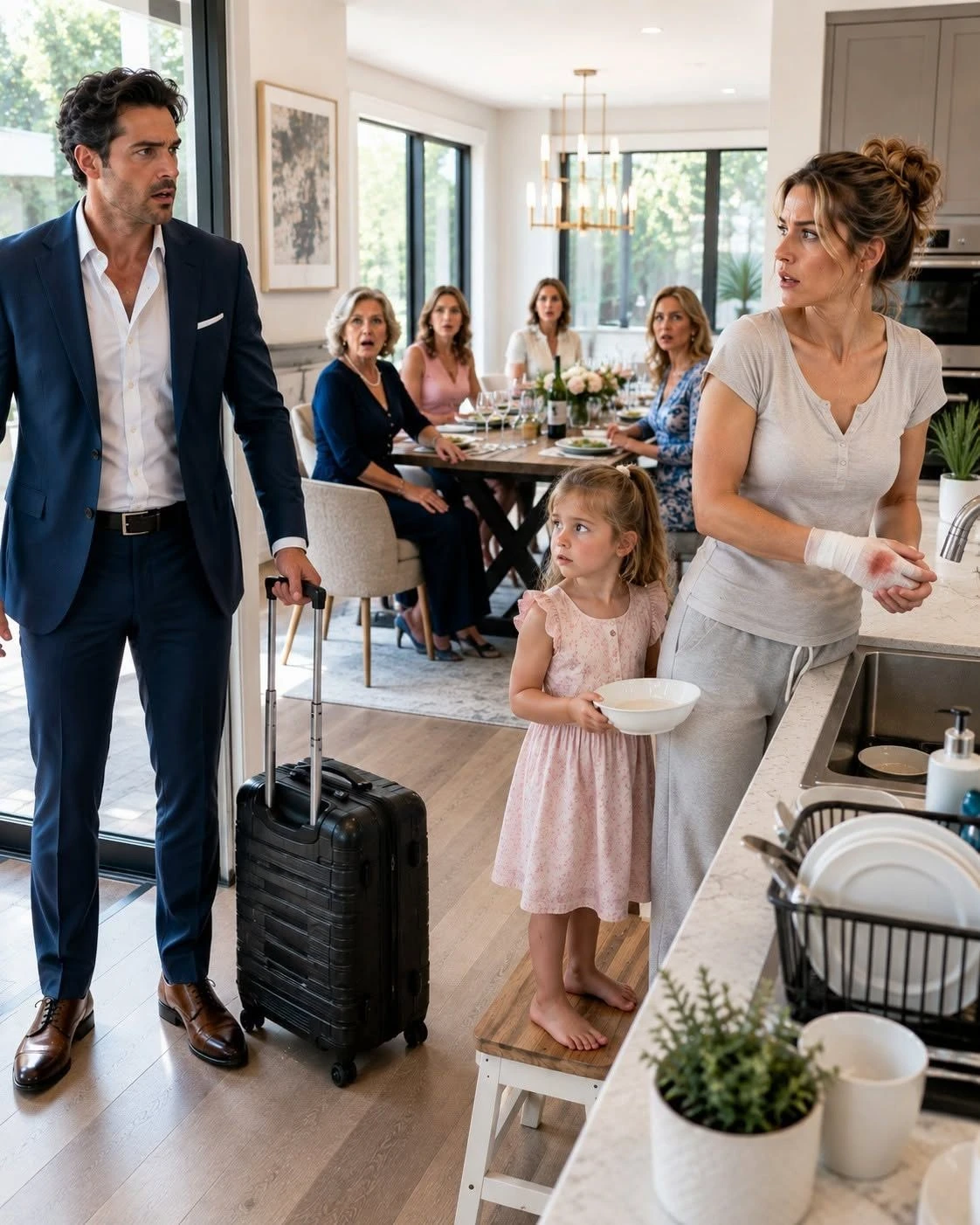
Maisie was standing on a wooden step stool in front of the sink.
Her strawberry-blond hair was tied back badly, as though she had done it herself. Wisps clung damply to her cheeks.
She wore the yellow T-shirt with the cartoon ladybug she slept in sometimes.
Her small hands were buried in gray dishwater.
A stack of dinner plates stood beside her.
Not plastic plates.
Our heavy stoneware.
The ones Laurel barely let Maisie carry from the table.
My daughter lifted one with both hands, struggled beneath its weight, rinsed it, and placed it shakily on the drying rack.
Behind her stood my wife.
For half a second, I did not understand what I was seeing.
Then my eyes found Laurel’s hands.
Both were wrapped in gauze.
The bandaging extended from her palms almost to her wrists.
A reddish stain had seeped through one side near her left thumb.
Her face looked pale.
Not tired.
Hollow.
There is a particular kind of fear that does not arrive loudly.
It moves through the body like ice water.
That was what I felt.
I stepped closer.
Laurel was whispering to Maisie.
“Careful, baby. Both hands. That’s it.”
“I’m trying.”
“I know.”
“Grandma said faster.”
Laurel’s mouth tightened.
“You don’t have to listen to every cruel thing someone says.”
Then my mother entered the kitchen.
I stopped behind the wall.
“You’re still on those?”
Maisie immediately stiffened.
“I’m doing them.”
“You’ve been doing them for twenty minutes.”
“There’s a lot.”
My mother sighed.
“Well, you wanted cake, didn’t you?”
Maisie looked toward Laurel.
My mother followed her gaze.
“And don’t look at your mother. She made her own choices.”
Laurel’s voice was low.
“She’s five, Darlene.”
“And five is old enough not to be lazy.”
“Stop calling her lazy.”
“You stop undermining me in my son’s house.”
My wife stared at her.
“My husband’s house is also my house.”
My mother’s smile was almost imperceptible.
“Is it?”
There are moments that divide a life into before and after.
That one word did it.
Is it?
My hands closed into fists.
But before I could enter the kitchen, one of the guests called my mother from the dining room.
“Darlene, are we eating soon?”
My mother raised her voice.
“Almost!”
Then she looked at Laurel.
“If that little girl doesn’t finish those dishes, neither she nor her mother eats until my guests have been served.”
She turned.
And saw me.
The color drained from her face so quickly it seemed as though someone had switched off a light behind her skin.
“Everett.”
No one moved.
The faucet kept running.
Water struck a half-submerged casserole dish with a soft, relentless hiss.
Maisie slowly turned.
Her eyes widened.
“Daddy?”
She stepped off the stool so fast she nearly slipped.
I crossed the kitchen in three strides and caught her.
Then she was in my arms.
Her wet hands grabbed my shirt.
“Daddy!”
Her voice cracked.
That sound nearly broke me.
Not joy.
Relief.
My five-year-old daughter was relieved that I had come home.
I held her tightly.
“I’ve got you.”
She buried her face against my shoulder.
Behind us, my mother said, “Everett, this looks much worse than it is.”
I looked at Laurel.
“What happened to your hands?”
She lowered her eyes.
“Burns.”
“How?”
Silence.
“Laurel.”
My mother interrupted.
“It was an accident.”
I turned toward her.
“I asked my wife.”
Mother’s lips parted.
I had never spoken to her that way.
Not once.
Laurel swallowed.
“Monday night. Your mother was making caramel for the dessert today. The pot slipped.”
My mother immediately said, “Exactly. I told you.”
But Laurel continued.
“She told me I had to catch it because it would ruin the floor.”
My stomach dropped.
“What?”
“I tried to move the pot before it fell.”
“With your bare hands?”
“I grabbed the handles. They’d been on the stove.”
I stared at the bandages.
“You went to a doctor?”
Laurel hesitated.
My mother answered for her.
“They’re just burns, Everett. People don’t need emergency rooms for every little—”
“Did you go to a doctor?”
Laurel shook her head.
“Urgent care yesterday.”
“Who drove you?”
“No one. I used a rideshare.”
Maisie’s arms tightened around my neck.
I could hear voices in the dining room becoming quieter.
They were listening now.
Every single one of them.
I turned to my mother.
“You had Laurel cooking for your party today with burns on both hands?”
“She volunteered.”
Laurel gave a small laugh.
It contained no humor.
“I begged you to cancel.”
My mother’s jaw tightened.
“Because you enjoy making everything dramatic.”
I felt something inside me settle.
It was not anger anymore.
Anger is hot.
This was colder.
Clearer.
I pointed toward the dining room.
“Party’s over.”
Mother blinked.
“Excuse me?”
“You heard me.”
“Everett, these people have driven from all over—”
“Then they can drive home.”
Her cheeks reddened.
“Do not humiliate me in front of my friends.”
I almost laughed.
“Humiliate you?”
I looked at my daughter’s pruned fingers.
Then at Laurel’s bandaged hands.
“You made my injured wife cook for twenty people and put my five-year-old at a sink full of dishes as punishment.”
“You’re twisting everything.”
“No.”
For perhaps the first time in my life, I looked at my mother without automatically searching for the version of events that would make her reasonable.
“I’m finally looking at it straight.”
She stared at me.
Then she used the sentence she had used whenever I challenged her since childhood.
“After everything I have sacrificed for you.”
There it was.
The old key.
The old lock.
The phrase that had opened guilt inside me since I was eight years old.
After everything I have sacrificed.
After your father left.
After I worked two jobs.
After I gave up dating.
After I gave you everything.
I had spent most of my adult life paying installments on a debt no one had ever calculated.
A new refrigerator for her condo.
Vacations.
Medical deductibles.
Car repairs.
The blue dress she was wearing.
And finally a bedroom in my house.
But that afternoon, with my daughter clinging to me, the key no longer fit.
“You have fifteen minutes to ask your guests to leave.”
Mother’s face hardened.
“This is my home too.”
“No.”
I heard Laurel inhale behind me.
I had never said it before.
I said it again.
“This is Laurel’s home. This is Maisie’s home. You were invited into it.”
Mother’s eyes became glassy.
“Oh, I see.”
“No, I don’t think you do.”
She looked toward the dining room.
Twenty people were pretending not to listen.
“Everett, we will discuss this when you’ve calmed down.”
“I am calm.”
That frightened her more than shouting would have.
She walked out of the kitchen.
A few seconds later, I heard her telling her guests that there had been an unexpected family matter.
Chairs scraped.
Murmurs filled the house.
Laurel leaned against the counter.
I shifted Maisie to one arm and reached toward her, stopping before I touched the bandage.
“How bad are they?”
“Second-degree burns in places.”
I closed my eyes.
“Why didn’t you tell me?”
Her expression changed.
That question hurt her.
I saw it instantly.
“I tried.”
“What do you mean?”
“I called Monday night.”
“I talked to you Monday.”
“For six minutes.”
I remembered.
I had been stepping into a client dinner.
Laurel had sounded strange.
I had asked whether everything was okay.
She had said, “I don’t know.”
And I had replied, “Can we talk Friday? This week is insane.”
The memory hit like a slap.
“Laurel…”
“You were busy.”
“That doesn’t excuse—”
“No. It doesn’t.”
Her voice was gentle.
That made it worse.
“I called again Tuesday morning. You texted that you were going into a presentation.”
I remembered that too.
I had sent a thumbs-up emoji.
My chest tightened.
“How long has this been happening?”
Laurel looked toward the dining room.
My mother was saying goodbye loudly.
Too loudly.
“A while.”
“How long?”
She met my eyes.
“Everett, your daughter flinches when your mother walks into a room.”
I could not speak.
Maisie lifted her head from my shoulder.
Then she whispered into my ear.
“Daddy?”
“Yes, bug?”
She glanced toward the hallway.
“Grandma has a bad drawer.”
Laurel went still.
“What?”
Maisie put one damp finger to her lips.
“Shh.”
I looked at her.
“What bad drawer?”
“The locked one.”
My mother kept a small writing desk in the downstairs guest room.
I knew the desk.
It had belonged to my grandmother.
There were three drawers along the right side.
I had never noticed one was locked.
Maisie leaned closer.
“Grandma puts Mommy’s things there.”
Laurel’s face lost what little color remained.
“My things?”
Maisie nodded.
“And letters.”
“What letters?”
“She said they’re bad letters.”
A chair scraped loudly in the dining room.
Laurel and I looked at each other.
“Everett,” she whispered, “my passport disappeared three months ago.”
The front door opened.
Guests began leaving.
I carried Maisie upstairs and asked her to stay in her room for a few minutes.
She grabbed my sleeve.
“Don’t let Grandma be mean to Mommy.”
“I won’t.”
“Promise?”
The word landed heavier than it should have needed to.
“I promise.”
Back downstairs, Laurel was standing outside the guest room.
Mother was still escorting people out.
I entered.
The room smelled like her rose lotion.
Everything was immaculate.
The bedspread lay perfectly smooth.
Two porcelain birds sat on the dresser.
Her Bible rested on the nightstand.
I crossed to the writing desk.
The bottom drawer had a small brass keyhole.
Locked.
“Laurel?”
“I don’t know where she keeps the key.”
I tried the drawer once.
Solid.
From the foyer, my mother laughed falsely.
“Thank you for understanding, Susan.”
The door closed.
Then silence.
Footsteps approached.
My mother appeared in the guest-room doorway.
She saw my hand on the drawer.
And stopped.
I watched panic flicker across her face.
It lasted less than a second.
But it was there.
“What are you doing?”
I straightened.
“Open this.”
Her expression settled.
“No.”
My heartbeat accelerated.
“What’s inside?”
“Private belongings.”
“Maisie says you’ve been putting Laurel’s things in there.”
Mother gave a dismissive laugh.
“Maisie is five.”
“Open it.”
“Absolutely not.”
Laurel stepped beside me.
“Is my passport in there?”
My mother looked at her.
There was naked contempt in her eyes now.
“I don’t know where you lose your belongings.”
“Open the drawer.”
“This is ridiculous.”
She turned to leave.
I said, “Then I’ll break it.”
She stopped.
“Everett.”
I pulled the desk chair aside.
“If there’s nothing in there, I’ll buy you another desk.”
“Your grandmother gave me that.”
“Then give me the key.”
Mother stared at me for several long seconds.
Finally, she reached beneath the neckline of her dress.
A thin gold chain emerged.
At the bottom hung a brass key.
Something about that chilled me more than the locked drawer itself.
She wore the key around her neck.
I held out my hand.
“No.”
“Mom.”
“I said no.”
Laurel whispered, “Everett.”
I turned.
She was staring at the top of the desk.
“What?”
She pointed.
A framed photograph of my mother and me stood there.
I was eleven.
She was hugging me from behind.
At first, I did not understand.
Then Laurel said, “The desk drawer in that picture.”
The photograph had been taken in our old house.
The same desk was visible behind us.
And the key was already hanging around my mother’s neck.
Thirty years earlier.
My mother followed my gaze.
Her hand flew to the chain.
I felt the room tilt.
“What have you been keeping in that drawer for thirty years?”
She backed toward the door.
“Nothing that concerns you.”
I moved faster.
Not toward her.
Toward my toolbox in the garage.
Two minutes later, I returned with a pry bar.
Mother stood in front of the desk.
“If you break that drawer, I will never forgive you.”
I looked at Laurel’s bandaged hands.
At the doorway where my daughter had stood whispering about a bad drawer.
Then at my mother.
“I think we’re past forgiveness being your weapon.”
I wedged the pry bar beside the lock.
Mother lunged.
Laurel stepped between us.
“Don’t touch him.”
“Get out of my way.”
“No.”
For the first time that day, Laurel’s voice sounded strong.
My mother stared at her.
Then I pulled.
Old wood groaned.
The lock held.
I pulled again.
The drawer cracked open.
My mother made a sound I had never heard before.
Not anger.
Fear.
Inside were envelopes.
Dozens of them.
Some yellowed.
Some new.
A blue folder.
A passport.
Laurel’s passport.
A silver bracelet I had given her for our tenth anniversary.
Three birthday cards addressed to Maisie.
And letters.
So many letters.
I picked up the passport.
Laurel whispered, “Oh my God.”
Mother said nothing.
I opened the blue folder.
The first page was typed.
At the top:
OBSERVATIONS REGARDING LAUREL CALLOWAY.
There were dates.
Times.
Notes.
“Raised voice in front of child.”
“Forgot library day.”
“Ordered takeout two nights consecutively.”
“Child cried during bedtime routine.”
“Consuming wine on weekday.”
I looked up.
“What is this?”
Mother folded her arms.
“Documentation.”
“For what?”
“If things deteriorated.”
“What things?”
“Your marriage.”
Laurel made a broken sound.
I kept reading.
There were printed photographs of unwashed dishes.
Maisie sleeping on our couch.
An empty wine bottle in the recycling bin.
Screenshots of texts Laurel had sent Mother during arguments.
Then I found an email printout from a family-law firm.
My eyes moved down the page.
Grandparent custody.
Parental instability.
Temporary guardianship.
My hands began shaking.
“You were trying to take our daughter?”
Mother’s expression sharpened.
“I was preparing to protect her.”
“From whom?”
She looked directly at Laurel.
“Her.”
Laurel stumbled backward.
I had seen my wife angry.
I had seen her frightened.
I had seen her in labor for nineteen hours.
I had never seen the expression on her face then.
It was the expression of someone discovering that a shadow she had feared was not imaginary.
Mother spoke rapidly.
“You’re never home, Everett. You don’t see how disorganized she is. Maisie needs structure. Laurel lets her talk back. She allows her to leave toys everywhere. She—”
“Stop.”
“I am trying to help you.”
“You stole my wife’s passport.”
“She was talking about taking Maisie to her sister’s.”
“For Christmas.”
Mother ignored Laurel.
“I knew someday you would understand.”
Then I noticed another envelope.
Older.
Brown around the edges.
My name was written across the front.
Everett.
The handwriting was unfamiliar.
The postmark was 1998.
I was eight years old in 1998.
I opened it.
Mother moved toward me.
“Don’t.”
That single word told me everything.
Inside was a sheet of paper covered in blue ink.
Dear Everett,
I don’t know if your mother will let you read this.
I am still trying.
I came to your school last Tuesday, but they said I was not permitted to see you.
I want you to know something in case you are being told otherwise.
I did not leave because I stopped loving you.
I left because your mother said she would make sure I never saw you again if I stayed and fought in the house.
I am working through the court.
You are my son.
Nothing will change that.
Love,
Dad.
I read it twice.
Then a third time.
The room disappeared around me.
My father’s name was Jonathan.
Growing up, I knew him mostly as a warning.
Your father abandoned us.
Your father chose another life.
Your father never sent so much as a birthday card.
When I was ten, I asked why he did not love me.
My mother had pulled me into her arms.
“Some men,” she whispered, “simply aren’t built to stay.”
I had carried those words for twenty-six years.
I picked up another envelope.
Another.
My eighteenth birthday.
The envelopes were all addressed to me.
Some had been opened.
Some had not.
I looked inside the drawer.
There were more.
At least forty.
My knees weakened.
I sat on the bed.
“No.”
My mother whispered, “Everett, you don’t understand.”
I laughed once.
It sounded ugly.
“What part?”
“He manipulated people.”
“So you hid forty letters?”
“You were a child.”
“I was eighteen in some of these.”
“He would have confused you.”
“I was twenty-one here.”
I held up another.
“You were still vulnerable.”
“Twenty-six.”
Silence.
I found a Christmas card dated nine years earlier.
Then a wedding announcement clipping.
Mine.
My father had written on the back.
Saw this online. She looks kind. I hope she makes you happy.
Please tell Everett I would come if I knew I wouldn’t ruin his day.
My throat closed.
Laurel sat beside me.
I could feel her shaking.
I opened another envelope.
There was a photograph inside.
My father stood beside a lake.
Older than I remembered.
Gray at the temples.
Smiling awkwardly into the camera.
On the back he had written:
Still here.
Still hoping.
My eyes blurred.
I wiped them angrily.
Mother stepped forward.
“You don’t know what he did to me.”
“Then tell me.”
Her mouth opened.
Nothing came.
“Tell me what justified this.”
“He betrayed me.”
“How?”
“He wanted to leave.”
“So you made him leave me too?”
“He would have taken you.”
“Did a court say that?”
No answer.
“Did he abuse me?”
“No.”
“Did he hurt me?”
“No.”
“Did he abandon me?”
Mother’s face collapsed.
“He abandoned our marriage.”
“That wasn’t my question.”
Silence filled the room.
I looked into that drawer.
Laurel’s passport.
A custody file.
My father’s letters.
Different decades.
Same drawer.
Same lock.
Same woman deciding which relationships other people were allowed to have.
And suddenly, the last year rearranged itself in my mind.
The comments about Laurel being disorganized.
The little sighs when I came home.
“You know, Laurel was overwhelmed again today.”
“Maisie behaves much better for me.”
“Your wife doesn’t appreciate how hard you work.”
“She spends money like there’s no tomorrow.”
Always mild.
Always concerned.
Never quite an accusation.
Just enough to make me notice every flaw in the woman I loved.
Just enough to make me feel grateful to my mother.
I stood.
“You were doing it again.”
Mother frowned.
“What?”
“With Laurel.”
“That’s completely different.”
“No.”
“You have no idea what your father put me through.”
“You were doing exactly the same thing.”
“I was protecting you.”
“No. You were making sure I belonged to you.”
Her face crumpled.
“I gave you my life.”
There it was again.
But now I heard the sentence differently.
Not love.
Ownership.
“You didn’t give me your life, Mom.”
My voice broke.
“You used mine to justify yours.”
She slapped me.
The sound cracked through the room.
Laurel gasped.
I barely felt it.
Mother stared at her own hand.
Then at me.
And something inside both of us ended.
I stepped to the doorway.
“You need to leave.”
Her face changed.
“You can’t mean that.”
“Tonight.”
“Everett, I have nowhere to go.”
“You own a condo.”
“It’s rented.”
“Then get a hotel.”
“You’re throwing your mother into a hotel because of that woman?”
Laurel closed her eyes.
I looked at my mother.
“That woman is my wife.”
“I am your mother.”
“Yes.”
I paused.
“And I think that’s the excuse I’ve been using for you my entire life.”
She began crying.
Real tears.
That was the worst part.
Because some part of her genuinely believed she was the injured person.
“I raised you alone.”
“I know.”
“I worked until my feet bled.”
“I know.”
“I missed birthdays and vacations and every chance at happiness because of you.”
The old guilt rose automatically.
Then I looked at the drawer.
“No.”
She stopped.
“You did those things because you were my parent. And I’m grateful for what was good.”
My voice trembled.
“But you do not get to invoice me for childhood forever.”
Laurel turned away, crying silently.
Mother packed two suitcases.
She took forty-three minutes.
During those forty-three minutes, I ordered food for Laurel and Maisie.
Pizza.
Maisie chose pineapple, which Laurel hated and I pretended not to.
We sat at the kitchen island.
My daughter ate three slices.
Three.
I had never seen her that hungry.
I watched her chew and felt nausea rise in my throat.
“How often did Grandma make you wait for dinner?”
Maisie stared at her plate.
Laurel said softly, “Honey, you can tell Daddy.”
Maisie counted on her fingers.
“When I’m bad.”
“What does bad mean?”
“Not putting shoes straight.”
My chest tightened.
“What else?”
“Talking when Grandma watches news.”
“What else?”
“Not saying ma’am.”
I looked at Laurel.
She wiped her eyes.
“She started withholding dessert. Then snacks. I stopped it whenever I was here.”
“Whenever?”
Laurel stared at the countertop.
“She started insisting on watching Maisie while I ran errands. I thought she wanted time with her.”
Maisie whispered, “Grandma says Mommy makes Daddy tired.”
I could not breathe for a moment.
“What else does Grandma say?”
“That Daddy works because Mommy spends all the money.”
Laurel covered her mouth.
“And?”
Maisie looked scared.
“That Daddy might go away like Grandpa did.”
The room went silent.
I stood so quickly the stool scraped backward.
My mother was carrying her suitcase through the foyer.
I walked toward her.
She saw my face.
“What now?”
“You talked to my daughter about my father?”
“She asked.”
“She’s five.”
“She’s intelligent.”
“You told her I might abandon her?”
“I said families fall apart when people don’t behave properly.”
My hands shook.
“Get out.”
“Everett—”
“Now.”
She lifted her chin.
“This girl will grow up spoiled.”
“Not by you.”
Mother looked beyond me toward Maisie.
“Sweetheart, Grandma loves—”
“Don’t.”
I stepped between them.
“You do not use love as the last rope when everything else fails.”
My mother looked at me for a long moment.
Then she walked out.
The front door closed.
Maisie flinched anyway.
That nearly destroyed me.
Later that night, after Laurel finally fell asleep with her hands elevated on pillows, I sat at the dining table surrounded by my father’s letters.
Forty-seven in total.
I arranged them by date.
The earliest was from 1998.
The newest had been mailed eleven days earlier.
Eleven days.
My pulse began hammering.
I tore it open.
Everett,
I don’t know whether writing still makes sense.
Darlene has returned every letter or ignored every message I’ve sent through the years. I found your business profile online. I know where you work now, but I don’t want to embarrass you or arrive in your life like an intruder.
I am seventy-one.
I have been diagnosed with Lewy body dementia.
Some days are still mine.
Some aren’t.
I am moving into Hawthorne Memory Care near Durham next month.
If you ever want to see me, I would be grateful.
If you don’t, I understand.
Your mother probably gave you reasons.
Maybe some were even true.
I was not a perfect husband.
But Everett, I need you to know before I lose the ability to say it clearly:
I never stopped being your father.
Love,
Dad.
I read the letter sitting completely still.
Then I checked the envelope again.
There was a phone number.
My hand shook as I dialed.
It was almost eleven.
I expected voicemail.
A woman answered.
“Hawthorne Residence.”
I could barely speak.
“I’m looking for Jonathan Calloway.”
There was a pause.
“Are you family?”
“I’m his son.”
Another pause.
This one longer.
“Oh.”
That one syllable carried something I did not understand.
“Is he there?”
“Yes.”
My chest filled so fast with hope it hurt.
“Can I speak with him?”
The woman hesitated.
“It’s late, but he’s awake. Tonight has been a difficult night.”
“I’m sorry. I can call tomorrow.”
“No.”
Her voice softened.
“I think you should speak to him.”
There was rustling.
Footsteps.
Then silence.
A man breathed on the line.
“Hello?”
Every childhood memory I had of my father arrived at once.
A hand lifting me onto a bicycle.
Coffee on his breath.
A yellow raincoat.
A voice reading The Wind in the Willows.
I could not move.
“Dad?”
Silence.
Then:
“Who is this?”
My heart cracked.
“It’s Everett.”
Nothing.
“Your son.”
Another long pause.
“Oh.”
I closed my eyes.
He sounded confused.
“I have a boy named Everett.”
My throat closed.
“I know.”
“He’s little.”
I pressed my fist against my mouth.
“He was.”
“My wife took him somewhere.”
Tears slid down my face.
I had not cried when my father left.
Not really.
My mother had taught me anger too quickly.
But that night, at thirty-six years old, sitting under the light above my dining table, I cried for the eight-year-old boy who had waited at a window for a father who was writing letters into a locked drawer.
Then my father said, very quietly, “Ev?”
I stopped breathing.
“Yeah.”
“Everett?”
“Yes.”
His voice changed.
Just slightly.
As though a curtain moved.
“My God.”
I bent forward over the table.
“Dad.”
“You got one.”
“One what?”
“One of my letters.”
I laughed and sobbed at the same time.
“I got all of them.”
Silence.
Then I heard him crying.
For a few miraculous seconds, he was completely there.
“I thought you hated me.”
“No.”
“I thought maybe she made you hate me.”
“She did.”
I hated myself as soon as I said it.
But he answered gently.
“I understand.”
“I’m sorry.”
“No, no.”
His voice trembled.
“You were a boy. Children believe the parent who stays.”
I stared at the sleeping house around me.
“I have a daughter.”
“I know.”
“How?”
“I found a picture online.”
His voice warmed.
“Red hair?”
“Almost.”
“She looks happy.”
That sentence hurt.
“She is.”
I looked toward the stairs.
“She will be.”
My father was silent.
Then he said, “Don’t make her choose.”
“What?”
“If you and her mother ever hurt each other. If anything happens.”
His words were becoming slower.
“Don’t make that little girl choose who she gets to love.”
My forehead touched the table.
“I won’t.”
“Promise me.”
“I promise.”
There was a long breath.
Then his voice became confused again.
“Who is this?”
The moment was gone.
I sat there with the phone against my ear.
A nurse eventually took it from him.
“He has lucid windows,” she explained. “Sometimes minutes. Sometimes longer.”
“Can I come tomorrow?”
“Of course.”
The next morning, Laurel came with me.
I tried to tell her she should stay home.
Her hands were hurting.
She shook her head.
“You’ve spent your whole life going through hard things alone because somebody taught you that love was a debt.”
She touched my arm with the edge of her bandage.
“I’m coming.”
Maisie stayed with Laurel’s sister.
Hawthorne Memory Care sat behind a line of oak trees outside Durham.
The building smelled like lemon cleaner, coffee, and something medicinal underneath.
My father was in the activity room.
He sat beside a window with a puzzle in front of him.
He looked smaller than the man in the photograph.
White hair.
Thin wrists.
A navy cardigan buttoned incorrectly.
I stopped in the doorway.
Laurel squeezed my arm.
He looked up.
For one terrible second, there was nothing in his face.
Then he smiled politely.
“Hello.”
I walked toward him.
“Hi.”
“You visiting someone?”
“Yes.”
“Good.”
He looked back at his puzzle.
I sat across from him.
My hands would not stop trembling.
After several minutes, he pointed toward a puzzle piece.
“Sky.”
I handed it to him.
“It looks like water.”
“No.”
He shook his head.
“Sky.”
He placed it correctly.
I laughed.
“You always hated being wrong.”
He looked at me.
Something stirred behind his eyes.
“Do I know you?”
I swallowed.
“My name’s Everett.”
He frowned.
Then slowly, painfully, recognition opened.
“Ev?”
I nodded.
His lower lip trembled.
“You got tall.”
I laughed through tears.
“Took me a while.”
He reached across the table.
I gave him my hand.
His grip was weak.
But it was my father’s hand.
For twelve minutes, I had him back.
He asked about my job.
He asked about Laurel.
When I showed him a photograph of Maisie, he touched the screen with one finger.
“Beautiful.”
“She likes dinosaurs.”
“So did you.”
“I did?”
“Terrible obsession.”
He smiled.
“You corrected museum guides.”
Laurel laughed.
I had forgotten that.
Or maybe I had been forced to forget.
Then my father’s eyes drifted.
He looked around the room.
Confusion returned.
“Where’s Darlene?”
My body tensed.
“She isn’t here.”
“She gets angry when I’m late.”
He rubbed his thumb nervously over my hand.
“She hides things.”
I looked at Laurel.
“What things?”
“Keys.”
His eyes wandered.
“Mail.”
My heartbeat slowed.
“What mail?”
He looked at me as though the question were strange.
“Anything she doesn’t want people to have.”
Then he pulled his hand away.
The window closed again.
“Who are you?”
I went into the hallway and cried against Laurel’s shoulder.
Not quietly.
Not gracefully.
Years came out of me.
Birthdays.
Graduations.
My wedding.
Maisie’s birth.
Every moment I had thought my father had chosen to miss.
The strange thing about discovering you were lied to as a child is that the truth does not give the stolen years back.
It only gives them names.
We visited him every Sunday after that.
Sometimes he knew me.
Sometimes he did not.
Maisie met him three weeks later.
She carried a plastic dinosaur under one arm.
My father stared at it.
“Triceratops.”
Maisie gasped.
“You know dinosaurs?”
He smiled.
For almost forty minutes, they sat together discussing creatures that had vanished millions of years ago.
I watched them from across the room.
Happy.
Completely, helplessly happy.
Then my father looked at me and asked the nurse who the strange man was.
That became the rhythm.
Joy.
Loss.
Joy.
Loss.
Meanwhile, my mother called.
At first, dozens of times.
Then emails.
Then letters.
She apologized without apologizing.
I am sorry you misunderstood.
I was protecting you.
You will regret abandoning your mother.
Laurel has poisoned you against me.
That final sentence told me she had learned nothing.
I blocked her.
Six weeks later, a certified letter arrived.
My mother had hired an attorney demanding repayment for “household contributions” she claimed she had made while living with us.
Her accounting included groceries she had purchased, furniture she had chosen without asking us, and more than eleven thousand dollars in “childcare services.”
Our attorney responded with copies of the photographs from her drawer, the custody research, and Laurel’s stolen passport.
The demand disappeared.
Then something unexpected happened.
My mother’s friend Susan called Laurel.
Susan had attended the party.
She cried through most of the conversation.
“I thought Darlene was helping you,” she said. “She told us your hands were injured because you were careless. She told us you insisted Maisie do chores because you wanted her to be independent.”
Laurel closed her eyes.
Susan continued.
“And Everett… she told us he was considering divorce.”
Laurel looked at me.
I took the phone.
“What?”
“She said you were exhausted with Laurel. That you didn’t know how to leave because of Maisie.”
I felt physically sick.
My mother had not merely been documenting a marriage falling apart.
She had been narrating one into existence.
Piece by piece.
Audience by audience.
She told me Laurel was unstable.
She told Laurel I was tired of her.
She told Maisie families disappeared when mothers misbehaved.
She told her friends divorce was coming.
Then she collected evidence for the disaster she was manufacturing.
Exactly as she had done decades earlier.
My father had not simply vanished.
He had been edited out.
Now she had been trying to edit Laurel out too.
The realization changed the way I understood evil.
I had always imagined cruelty as something dramatic.
Shouting.
Violence.
Doors slammed.
But some cruelty wears slippers.
Some cruelty clears the table after dinner.
Some cruelty says, “I’m only trying to help.”
Some cruelty never tells one enormous lie.
It tells one thousand small ones until everyone starts living inside them.
Laurel and I began therapy.
Not because our marriage was ending.
Because we finally understood how close we had come to letting someone else write its ending.
One evening, several months later, Laurel said something that I still hear.
“We were both scared of disappointing your mother.”
I looked at her.
“You too?”
She smiled sadly.
“Especially me.”
“Why?”
“Because I knew how much you believed you owed her.”
I looked down.
“She knew too.”
“Yes.”
That was the mechanism.
My mother did not control our house because she was stronger than all of us.
She controlled it because she knew where each person’s guilt lived.
Mine was being an ungrateful son.
Laurel’s was making me choose.
Maisie’s was being a bad girl.
Different locks.
Same key.
Winter came.
My father declined quickly.
By December, he rarely recognized me.
One Sunday, I arrived with Maisie and found him sleeping near the window.
She climbed onto the chair beside him and whispered, “Grandpa?”
His eyes opened.
He stared at her for several seconds.
Then smiled.
“Dinosaur girl.”
Maisie beamed.
“That’s me.”
She showed him a drawing she had made.
A green triceratops beneath a purple sun.
He studied it as if it belonged in a museum.
“You did this?”
“Yep.”
“It’s very good.”
“The legs are bad.”
“No.”
He shook his head.
“They’re standing.”
Maisie seemed to consider this profoundly.
Then she leaned against his shoulder.
I stood near the doorway.
My father lifted his eyes.
For one impossible moment, they were clear.
He looked directly at me.
“Ev.”
I walked closer.
“Hey, Dad.”
He glanced at Maisie.
“You kept your promise.”
My throat tightened.
“What promise?”
He looked confused by my question.
Then smiled.
“Didn’t make her choose.”
I could not answer.
He closed his eyes.
That was the last coherent sentence my father ever said to me.
He died eleven days later.
I was beside him.
So was Laurel.
Maisie was at school.
His breathing became shallow just after dawn.
The room was gray with winter light.
I held his hand.
I told him I was there.
I told him I had read every letter.
I told him I was sorry.
I told him none of those years meant he had not been loved.
I do not know how much he understood.
Maybe none of it.
Maybe all of it.
The nurse told me hearing often remains when other things fade.
So I kept talking.
His final breath was almost silent.
Afterward, I sat there holding the hand of a man I had been given back just long enough to lose properly.
It hurt more than hatred ever had.
And I was grateful for every second.
My mother learned of his death through a mutual acquaintance.
She sent one message.
I’m sorry.
Nothing more.
For months, I could not decide whether that made things better or worse.
Then, almost a year after the party, a package arrived.
No return address.
Inside was the brass key from the chain around my mother’s neck.
And one folded sheet of paper.
Everett,
I have spent my whole life believing that if people left me, it meant I had failed.
So I learned to make leaving impossible.
Your father wanted a different marriage than the one we had. I thought if I could keep you from him, at least one person would belong to me completely.
I told myself it was protection.
Eventually I believed myself.
When Laurel came into your life, I saw how you looked at her.
I hated her for being loved without having earned it through suffering.
That sentence stopped me cold.
I kept reading.
When Maisie was born, I thought I had another chance to matter.
Then she preferred her mother.
Children usually do.
I knew that.
But knowing something and surviving what it awakens in you are different things.
I became the kind of woman I always insisted I was protecting everyone from.
I do not expect forgiveness.
The drawer is empty now.
Mom.
I read the letter twice.
Then I took it outside.
Laurel found me sitting beneath the maple tree.
“Is she asking to come back?”
“No.”
“Money?”
“No.”
“Then what?”
I handed her the letter.
She read it.
When she finished, she sat beside me.
For a while, neither of us spoke.
Finally Laurel said, “Do you believe her?”
“I believe she believes it.”
“That’s different.”
“Yeah.”
I looked toward the kitchen window.
Inside, Maisie was drawing at the table.
She was six now.
Her hair was longer.
There was chocolate around her mouth.
A plate sat beside her.
Food she was allowed to eat simply because she was hungry.
No conditions.
No good behavior.
No earning.
Laurel rested her head against my shoulder.
“Are you going to answer?”
I thought about it.
My father’s letters.
My mother’s drawer.
The chain around her neck.
The years she had spent guarding pieces of other people’s lives.
“No.”
Laurel nodded.
“Not yet.”
Maybe one day I will.
Forgiveness is complicated.
People like clean endings because clean endings make pain feel organized.
Real families are rarely that generous.
I can believe my mother suffered and still refuse to let her cause suffering.
I can acknowledge that she worked hard to raise me and still condemn what she stole.
I can miss the mother who sat beside me when I had pneumonia at nine without inviting the woman who starved my daughter as punishment back into our home.
Love does not require amnesia.
That may have been the most important lesson of all.
Years have passed.
Maisie barely remembers the party now.
Sometimes I wish I could say the same.
She remembers Grandpa Jonathan mostly through photographs.
Her favorite is the one of them sitting together at Hawthorne with the green plastic triceratops between them.
She keeps it beside her bed.
My mother lives two states away.
We have spoken four times.
The conversations are brief.
There are boundaries.
Real ones.
She has never again been alone with Maisie.
Laurel’s hands healed.
Two faint scars remain near her thumbs.
Every now and then I catch myself looking at them.
She notices.
“You’re doing it again.”
“What?”
“Punishing yourself.”
I smile.
“Occupational hazard.”
She takes my hand.
“Then stop.”
I’m getting better at it.
The old desk belongs to me now.
My mother mailed it six months after the letter.
The broken drawer has been repaired.
But I did not replace the lock.
I never will.
It stands beneath the small window in our upstairs hallway, beside Maisie’s old reading castle.
Inside the drawer are Jonathan’s letters.
All forty-seven.
Laurel’s recovered passport.
The photograph of my father beside the lake.
My mother’s letter.
And one picture Maisie drew after he died.
Four people holding hands beneath a purple sun.
Me.
Laurel.
Maisie.
Grandpa Jonathan.
There is also a fifth figure off to the side.
A woman with gray hair.
The first time I saw it, I asked Maisie who it was.
She looked surprised.
“Grandma.”
I must have reacted because she immediately added, “She did bad things, Daddy. But I can still draw her.”
I sat very still.
Children understand truths adults spend decades making complicated.
“She hurt you.”
“I know.”
“You don’t have to love somebody who hurts you.”
Maisie thought about that.
Then she said, “I know.”
Another pause.
“But I’m allowed to if I want.”
I felt tears rise.
“Yes.”
She picked up her purple crayon.
“And I’m allowed to stay away from her too.”
My breath caught.
“Yes, bug.”
She nodded, satisfied, and went back to coloring.
That afternoon, I understood what my father had been trying to give me all those years ago.
Not access.
Not loyalty.
Freedom.
The freedom to love without surrendering judgment.
The freedom to walk away without rewriting every good memory as a lie.
The freedom to admit someone hurt you without needing to hate them forever.
My mother had believed love meant possession.
My father had learned too late that love sometimes means opening your hand.
And my daughter, at six years old, understood both.
Before bedtime that night, Maisie ran down the hallway carrying a new drawing.
She slid open the old desk drawer without asking anyone’s permission.
No key.
No chain.
No hidden compartment.
Nothing locked.
She placed the picture beside her grandfather’s letters and pushed the drawer closed.
Then she ran toward me.
“Daddy, I’m hungry.”
I looked at the clock.
Almost nine.
Past bedtime.
Years earlier, I might have said no automatically.
Instead, I took her hand.
“What do you want?”
“Toast with strawberry jam.”
“Two pieces?”
She grinned.
“Three.”
Laurel laughed from the bedroom.
“Three pieces of toast at nine o’clock?”
Maisie shouted back, “I’m growing!”
I carried her downstairs.
She sat on the kitchen counter while I made the toast.
The same kitchen.
The same sink.
The same stoneware dishes.
But nothing felt the same.
Maisie swung her bare feet against the cabinet.
When the toaster popped, she jumped.
I spread strawberry jam all the way to the edges because she complained when adults left “sad dry corners.”
She ate the first piece in four bites.
I watched her.
“Why are you staring at me?”
“I like looking at you.”
“That’s weird.”
“I know.”
She smiled.
Then she held out the last piece.
“Want some?”
“No, thanks.”
She shrugged and ate it herself.
A little jam remained on her cheek.
The dishwasher hummed behind us.
A machine was doing the dishes.
No child standing on a stool.
No injured mother whispering instructions.
No grandmother measuring obedience against hunger.
Just the low mechanical swish of warm water.
Maisie yawned.
I lifted her from the counter.
As I carried her upstairs, we passed the old desk.
The repaired drawer sat slightly crooked because the wood had never fit perfectly after I broke the lock.
For years I thought that imperfection would bother me.
Now it was my favorite thing about it.
Proof that something sealed could be forced open.
Proof that what was hidden could survive being found.
Proof that broken wood could remain useful without pretending it had never been broken.
Maisie rested her head on my shoulder.
Half asleep, she murmured, “Daddy?”
“Yeah?”
“Grandpa wrote you lots of letters.”
“He did.”
“Even when you didn’t answer?”
“Even then.”
“Why?”
I stopped beside her bedroom door.
Because he loved me.
The answer seemed obvious now.
But for most of my life, someone else had decided I was not allowed to know it.
“He wanted me to know where to find him.”
Maisie considered that with the serious expression children wear when they are rearranging the universe.
Then she wrapped her arms around my neck.
“I’ll always tell you where to find me.”
I closed my eyes.
Held her tighter.
And beneath the hallway window, the old drawer remained unlocked, filled not with secrets anymore, but with every piece of love that had finally been allowed to arrive.

