## PART ONE
## THE BRUISES BENEATH THE SILK
By the time my daughter whispered that her husband intended to murder her on an operating table, I was standing close enough to smell the lavender soap on her skin.
For years afterward, that scent could still stop me in the middle of a grocery aisle.
Lavender soap. Hospital disinfectant. The faint metallic chill of polished instruments waiting behind closed doors.
Those were the smells surrounding us when my world split open.
I had accompanied Chloe to St. Catherine’s Women’s Center for what was supposed to be her final ultrasound before delivery. The clinic looked more like an expensive hotel than a hospital. Sunlight poured through walls of glass, white orchids decorated the reception desks, and soft piano music drifted through hidden speakers.
Everything had been designed to say, **You are safe here.**
That was the first lie.
Chloe was thirty-eight weeks pregnant. Her belly was full and beautifully round beneath a cream-colored blouse, but the rest of her seemed to have faded around it. Her cheeks were pale. Shadows rested beneath her hazel eyes, and her long brown hair was pulled into a careless knot.
“You didn’t sleep again,” I said as we waited for the nurse.
“I’m uncomfortable.”
“That isn’t what I meant.”
She glanced toward the front desk.
It was a small movement, almost nothing. Yet after raising a child, you learn the difference between a wandering glance and a frightened one.
Before I could press her, a nurse called her name.
“Mrs. Thorne?”
Chloe flinched at the sound of her married name.
The nurse led us down a bright corridor and into a private changing room. There was a padded bench, a full-length mirror, and a white hospital gown folded neatly beside a basket of warmed towels. High in one corner, nearly hidden beneath a smoke detector, was a small security camera.
I noticed it.
At the time, I assumed it protected patients from theft or emergencies.
Later, I understood that **Julian had never installed cameras to protect anyone.**
The nurse explained that Chloe needed to remove her blouse and change into the gown. Then she smiled at me.
“You’re welcome to help her, Mrs. Hale.”
“I’ve been helping her change clothes since she was six pounds and furious about being born,” I joked.
The nurse laughed.
Chloe did not.
When the door closed behind us, she stood very still.
“Sweetheart?”
“I’m fine.”
“You’ve said that four times today.”
She turned away from me and began unbuttoning her blouse. Her fingers were clumsy. Twice, she missed a button. The third time, her hands began to shake so badly that I stepped closer.
“Let me.”
“No.”
The answer came too quickly.
She softened it with a strained smile. “I mean, I can do it.”
I watched her reflection in the mirror. She would not meet my eyes.
When the last button came free, Chloe carefully pulled one arm from the blouse. Then the other. The fabric caught beneath her hair. She turned to free it, and the blouse slipped from both shoulders.
For one strange second, my mind refused to understand what I was seeing.
Then it understood all at once.
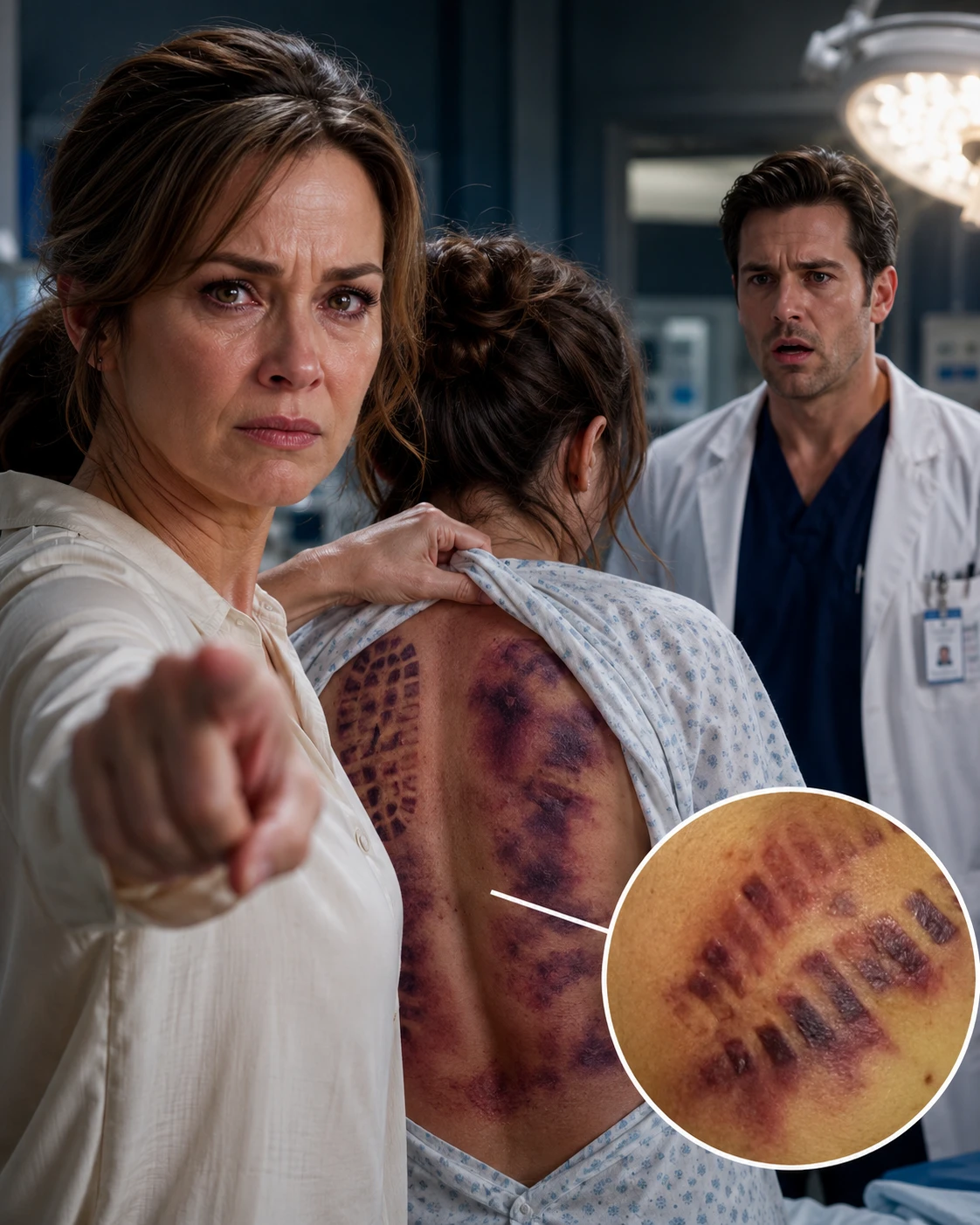
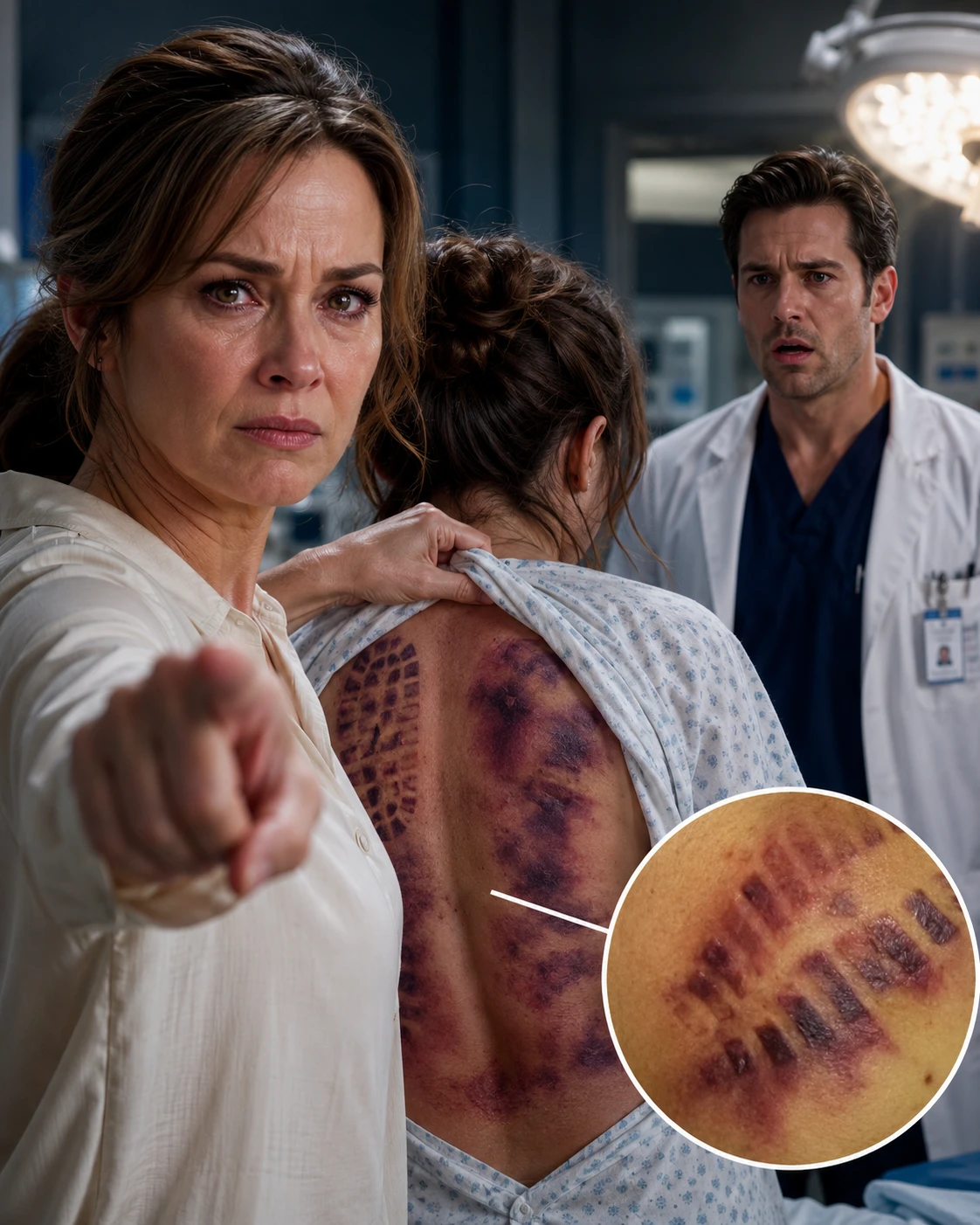
**Deep purple bruises covered her upper back and curved around both sides of her ribs.**
They were not the yellowing marks of an accidental fall. They were swollen, dark, and newly layered over older injuries. Some were shaped like narrow bars. Others carried a pattern so distinct that my stomach turned before my thoughts could form the words.
Boot tread.
The bruises looked like the soles of heavy work boots.
My daughter had been kicked.
Not once.
Not accidentally.
**Someone had kicked a woman who was nearly nine months pregnant and kept kicking her after she fell.**
“Chloe.”
My voice did not sound like mine.
She gasped and yanked the blouse toward her chest.
“Mom, please.”
I reached for her shoulder.
She recoiled.
It was not a dramatic movement. She simply drew back, raised one arm, and turned her face away as if preparing for a blow.
That tiny instinct wounded me more deeply than the bruises.
My child had learned that hands reaching toward her usually brought pain.
I lowered mine.
“Look at me.”
She shook her head.
“Chloe, look at me.”
Slowly, she lifted her face.
Tears stood in her eyes, but she refused to let them fall.
“Who did this?”
Her mouth trembled.
“I fell.”
“You did not fall onto the bottom of a boot.”
“Mom—”
“Who did this to you?”
Her breath broke.
“Julian.”
The room seemed to grow smaller.
Dr. Julian Thorne.
My son-in-law.
The celebrated hospital director whose smiling face appeared on charity billboards and magazine covers. The brilliant physician who raised millions for maternal health programs. The man who had stood in a church seven years earlier and promised to love my daughter in sickness and in health.
I had watched that man place a ring on Chloe’s finger.
Now I was looking at what his boots had done to her body.
“Why?” I whispered.
Chloe pressed one hand beneath her belly as though shielding the baby from the answer.
“He was angry.”
“About what?”
“I told him I wanted to deliver somewhere else.”
A cold sensation moved through me.
“Why would that make him angry?”
“Because he needs it to happen here.”
“Needs what to happen here?”
She stared at the camera.
Only then did I notice how carefully she had positioned herself beneath it, keeping her face turned away.
She stepped close enough that her lips almost touched my ear.
“Mom,” she breathed, “he controls this hospital.”
I could feel her shaking.
“He controls the nurses’ schedules. The security department. The patient records. He chooses which doctors enter the operating rooms.”
I looked toward the closed door.
“Then we’re leaving.”
She caught my wrist.
“No.”
“We are walking out right now.”
“You don’t understand.”
“I understand that he beat you.”
“If I leave before the baby is born, he’ll come after me.”
“Then we’ll call the police.”
Her expression twisted with despair.
“He has dinner with the police chief.”
“We’ll go to the state.”
“He funds their medical training.”
“Then the FBI.”
“He’ll say I’m unstable.”
“You have bruises.”
“He has medical records showing I fell down the stairs.”
I stared at her.
“There are records?”
“He wrote them himself.”
Her tears finally spilled.
“He has been building a story for months, Mom. Anxiety. Depression. Confusion. He says pregnancy has made me irrational. Every time I challenged him, he added something to my chart.”
“Why would he do that?”
She tried to speak, but a sob caught in her throat.
I waited.
Outside, a cart rolled along the hallway. Someone laughed near the nurses’ station. The cheerful piano music continued playing.
Inside the changing room, Chloe whispered, **“Because he told me I’m not going to survive the birth.”**
My blood turned cold.
“What exactly did he say?”
She gripped my wrist tighter.
“He said if I ever tried to leave him, something would go wrong during my C-section.”
“C-section? I thought you were planning a natural delivery.”
“I was.”
“Then why—”
“He changed it.”
“How?”
“He said the baby is too large. Then he said the cord might be wrapped around her neck. Last night, he said there could be a placental problem.”
“Which one is true?”
“I don’t know.”
She covered her mouth, trying to silence another sob.
“He told me the anesthesiologist will do whatever he says. He said I’ll go to sleep and never wake up.”
There are moments when fear makes a person frantic.
This was not one of them.
Something inside me became extraordinarily calm.
The part of me that baked pies for church suppers, mailed birthday cards three weeks early, and spent winter evenings knitting tiny yellow blankets did not disappear.
It stepped aside.
**A colder woman took its place.**
I had spent thirty-four years as an emergency-room nurse before retiring. I knew what injuries looked like. I knew how medical records could be altered and how frightened patients could be dismissed when powerful doctors spoke first.
More importantly, I knew that predators relied on panic.
So I gave Julian none.
I helped Chloe into the gown, carefully guiding the fabric around her bruises.
“Does he know you told me?”
“No.”
“Does he monitor your phone?”
“Yes.”
“Your email?”
“Yes.”
“The house?”
She nodded.
“Cameras?”
“In the front rooms. He says they’re for security.”
“Does he listen?”
“I think so.”
I tied the gown behind her shoulders.
“Then we will behave normally.”
Her eyes widened.
“Mom—”
“We will go to the ultrasound. We will smile. We will let him believe you are still afraid and I am still ignorant.”
“I am afraid.”
“I know.”
“He can hurt you too.”
“I know that as well.”
I took her face gently between my hands. This time, she did not pull away.
“Listen to me, Chloe. Fear is not surrender. You can be terrified and still take one step. Then another. That is how people walk out of cages.”
“What are you going to do?”
“I’m going to hear my granddaughter’s heartbeat.”
“That’s all?”
“For the next ten minutes.”
She searched my expression.
“What happens after that?”
I looked at the camera.
“After that, we find out how many people Julian thinks he owns.”
When Chloe bent to collect her blouse, I slipped my phone from my purse.
There was one contact I had not called in twelve years.
Samuel Pike had been my late husband’s attorney, closest friend, and the only man David trusted with matters he refused to discuss inside our home. Six months before David died, he had handed me Samuel’s number and one strange instruction.
“If anyone connected to St. Catherine’s ever threatens Chloe,” he had said, “send Sam two words.”
At the time, I thought grief and illness had made David paranoid.
Standing in that changing room, I finally understood that my husband had been afraid.
I typed the words.
**BLACKBIRD. NOW.**
Then I pressed send.
Chloe never saw the message.
Neither did the camera.
I returned the phone to my purse just as the door opened.
A woman in green scrubs entered. She appeared to be in her late forties, with soft gray eyes and dark hair threaded with silver.
“I’m Ruth,” she said. “I’ll be performing the ultrasound.”
Her gaze rested on Chloe’s face for a second longer than necessary.
Then she looked at me.
Something silent passed through her expression.
Recognition.
Not of me.
Of fear.
We followed Ruth into the ultrasound suite. Chloe climbed onto the table, and I sat beside her. When the cold gel touched her stomach, she startled.
“Sorry,” Ruth said gently. “I should have warned you.”
“It’s okay.”
The monitor filled with shifting shadows.
Then the room filled with the rapid, beautiful sound of a heartbeat.
Chloe broke.
She turned her face toward me, and tears ran silently into her hair.
“There she is,” Ruth said. “Strong heartbeat.”
“Is she all right?” I asked.
Ruth studied the screen.
“The measurements look reassuring.”
“What about the placenta?”
Her hand paused.
“What about it?”
“Dr. Thorne mentioned a problem.”
Ruth’s eyes moved toward the door.
“I don’t see evidence of an emergency.”
Chloe gripped my hand.
“Could there be a cord problem?”
“The cord appears normal from this angle.”
“A large baby?”
“She’s healthy-sized, but not unusually large.”
Each answer dismantled one of Julian’s claims.
Ruth printed several images. Before handing them to Chloe, she wrote something on the back of one.
I saw only three words.
**DO NOT GO HOME.**
The door opened.
Julian entered wearing a tailored navy suit beneath his white physician’s coat. He was tall, handsome, and silver beginning to touch his dark hair at the temples. His appearance inspired confidence before he spoke.
That had always been part of his power.
“My two favorite women,” he said warmly.
He kissed Chloe’s forehead.
Her entire body stiffened.
Julian noticed.
So did I.
His smile remained perfect.
“How is our girl?”
“Strong heartbeat,” Ruth answered.
“I’m asking my wife.”
Chloe swallowed. “She’s fine.”
Julian rested one hand on her belly.
To anyone watching, it would have looked tender.
I saw his thumb press hard into the soft space beneath her ribs.
Chloe winced.
“You’re sensitive today,” he said.
I stood.
“Take your hand off her.”
The room went silent.
Julian turned toward me.
For half a second, the charming expression vanished. Something flat and watchful appeared behind his eyes.
Then the smile returned.
“Of course.”
He removed his hand.
“You mothers,” he said lightly. “Always protective.”
“Somebody has to be.”
His gaze sharpened.
Ruth stepped away from the machine.
“I’ll submit the images to the chart.”
Julian did not look at her.
“I’ll review them personally.”
“I’m sure you will,” Ruth said.
The words sounded ordinary.
Her tone did not.
Julian turned back to Chloe.
“We’re moving the C-section to tomorrow morning.”
Chloe stopped breathing.
“What?”
“Six-thirty.”
“You said next week.”
“New information changes the plan.”
“What new information?”
He gestured toward the screen.
“The baby’s position concerns me.”
Ruth spoke quietly.
“She is head down.”
Julian’s eyes flicked toward her.
“And you are a sonographer, not an obstetric surgeon.”
Ruth held his gaze.
“No. I’m not.”
Something passed between them.
It lasted only a moment, but I felt it.
History.
Julian addressed Chloe again.
“You’ll be admitted tonight for monitoring. We need to manage this carefully.”
“I want another opinion.”
He smiled.
“Pregnancy hormones can make last-minute decisions feel frightening.”
“I said I want another opinion.”
“And I said we need to protect the baby.”
The cruelty of his choice was breathtaking. He had made Chloe’s resistance sound like a threat to her own child.
I stepped between them.
“She will have another opinion.”
Julian looked down at me.
“Margaret, I understand you’re emotional.”
“No, Julian. You have never seen me emotional.”
His smile tightened.
“We all want the same outcome.”
I thought of the bruises beneath Chloe’s gown.
“No,” I said. “I don’t believe we do.”
The fetal heartbeat continued pulsing through the speakers.
Fast.
Steady.
Alive.
Julian glanced toward the camera above the ultrasound-room door.
Then he leaned close enough that only Chloe and I could hear him.
“You should both be very careful,” he said softly. “Stress can cause terrible complications.”
He straightened and smiled again.
“Six-thirty tomorrow morning.”
Then he walked out.
Chloe stared after him.
“What did you do?” she whispered.
“I stopped pretending I liked him.”
“No, Mom. You don’t provoke Julian.”
“I didn’t provoke him.”
“You challenged him in his hospital.”
I looked at the door through which he had disappeared.
“That,” I said, “is exactly where he needs to be challenged.”
Ruth began wiping gel from Chloe’s stomach. Her hands were steady, but her face had changed.
She waited until the hallway was quiet.
Then she pressed the ultrasound photographs into my hand.
On the back of the last image, beneath the warning not to go home, she had written another sentence.
I read it twice.
**ANNA THORNE DID NOT DIE IN CHILDBIRTH.**
I looked up.
Ruth’s gray eyes were fixed on mine.
“Who is Anna Thorne?” I asked.
Chloe closed her eyes.
Julian’s first wife had died eight years earlier at St. Catherine’s after an emergency C-section.
At least, that was what the newspapers had reported.
Ruth reached up and locked the ultrasound-room door.
Then she said the words that changed the shape of everything.
**“I am Anna Thorne.”**
—
## PART TWO
## THE BEAUTIFUL CAGE
For a long moment, no one moved.
The ultrasound monitor still displayed the blurred curve of my granddaughter’s face. Her heartbeat continued filling the room while the woman who had supposedly died eight years earlier stood before us wearing hospital scrubs and another woman’s name.
I looked at Chloe.
“You knew?”
Her silence answered.
“How long?”
“Two months.”
I stepped away from the table.
“You have known for two months that Julian’s dead wife is alive?”
“Mom, please.”
Ruth—or Anna—removed her identification badge.
The badge read RUTH MERCER, REGISTERED DIAGNOSTIC MEDICAL SONOGRAPHER.
She turned it over in her hand.
“Ruth was my middle name before I married Julian. Mercer was my mother’s maiden name.”
“You work here under an assumed identity?”
“I work here under a protected identity.”
“Protected by whom?”
“Not enough people.”
Her answer did little to reassure me.
Chloe sat up slowly.
“Anna has been helping me.”
“Helping you do what?”
“Stay alive.”
The sharpness of my anger disappeared.
I looked at my daughter’s bruised body beneath the thin hospital gown and hated myself for directing even one hard word toward her.
Still, fear demanded answers.
“You should have told me.”
“I tried.”
“When?”
“Christmas.”
I remembered Christmas.
Julian had arrived late and spent the evening answering calls in my den. Chloe had followed me into the kitchen while I glazed the ham. She kept twisting her wedding ring and asked whether I ever regretted marrying her father.
I had laughed.
I had told her marriage always came with difficult seasons.
God forgive me.
“You said you and Julian were having problems,” I whispered.
“I was trying to tell you without saying it.”
“Why didn’t you simply say it?”
“Because he had your house watched.”
The room tilted again.
“My house?”
“He sent someone to install the new security system last spring.”
“He said it was a birthday gift.”
“It was surveillance.”
I remembered thanking Julian.
I remembered hugging him.
A wave of nausea rose through me.
Anna stepped closer.
“Julian does not begin with violence. He begins with generosity.”
Her voice had the flat, measured quality of someone repeating a lesson learned through blood.
“He pays bills before you notice them. He remembers your mother’s birthday. He chooses restaurants you love. He makes himself useful until usefulness becomes permission, and permission becomes control.”
Chloe stared at the blanket covering her legs.
“He handled the mortgage.”
Anna nodded.
“Then the insurance.”
“My passwords.”
“Then your appointments.”
“My friends.”
“Then your version of reality.”
The two women looked at each other.
For the first time, I understood that they shared a language built from wounds.
Anna continued.
“By the time he hits you, he has already removed everyone who might believe you.”
I thought back through seven years of family gatherings.
Julian always answered questions for Chloe.
Julian always drove.
Julian always decided when they left.
When Chloe canceled lunches, there was always a reasonable explanation. Fatigue. Work. A headache. A plumbing emergency. Once, she arrived at Thanksgiving wearing a turtleneck in unusually warm weather.
I had teased her about it.
The memory struck me with such force that I gripped the edge of the ultrasound table.
“How long has he been hurting you?”
Chloe looked at her hands.
“The first time was three years ago.”
“What happened?”
“I told him I wanted to go back to work.”
Before marrying Julian, Chloe had been an elementary-school art teacher. She loved children who talked too much, used too much glue, and believed every drawing deserved a gold frame.
Julian had persuaded her to leave the classroom after a miscarriage.
“He said teaching was too stressful,” she continued. “He said we should focus on starting a family.”
“And when you disagreed?”
“He slapped me.”
I closed my eyes.
“He cried afterward. He knelt on the kitchen floor and begged me to forgive him. He said the miscarriage had broken something inside him.”
Anna gave a humorless smile.
“He blamed grief with me too.”
Chloe looked at her.
“What did he blame the second time?”
“Me.”
The room became very quiet.
Anna pulled a chair closer.
“I married Julian when he was thirty-one. He was brilliant, attentive, and ambitious. He made me believe ambition was the same thing as purpose.”
“What did you do?” I asked.
“I was a financial auditor for the hospital foundation.”
That explained the history I had sensed between her and Julian.
“I found irregular payments,” Anna said. “Millions transferred through consulting companies connected to Dr. Helena Voss.”
The name was familiar.
Helena Voss was chairwoman of St. Catherine’s governing board and Julian’s mentor. She had recruited him after medical school and helped propel him from junior surgeon to hospital director in less than a decade.
“She built his career,” I said.
“She built more than that.”
Anna looked toward the door.
“Helena taught Julian how to hide harm inside paperwork. A death does not look suspicious if the correct diagnosis appears in the chart. A frightened wife does not look credible if her husband has documented psychiatric symptoms for months.”
Chloe’s fingers tightened over her belly.
“What happened when you confronted him?” I asked.
“He told me the payments were legitimate.”
“And when you didn’t believe him?”
“He became affectionate.”
Anna’s face hardened.
“That was always the most dangerous sign. Julian is cruel when he is angry, but he is lethal when he is calm.”
She had planned to deliver their son at another hospital. Julian persuaded her to come to St. Catherine’s for one final examination.
My stomach knotted.
“One final ultrasound,” I said.
Anna nodded.
“He told me there was a placental emergency. I was sedated before I could call anyone.”
“What happened to the baby?”
“He was born alive.”
Her voice cracked for the first time.
“He lived for eleven minutes.”
Chloe covered her mouth.
Anna looked at the ultrasound screen.
“I never held him.”
“I’m sorry,” I whispered.
“The chart says I suffered a massive hemorrhage and died forty minutes later.”
“But you didn’t.”
“No.”
A nurse named Naomi Bell had discovered an unmarked syringe on Julian’s tray and switched it before surgery. When Anna stopped breathing from the original sedative combination, Naomi realized someone expected her to die. She moved Anna to an unused recovery room during a hospital electrical failure arranged by an investigator already examining foundation fraud.
“How did they declare you dead without a body?” I asked.
“There was a body.”
The answer chilled me.
“A homeless woman had died in the emergency department that night. No family. No identification. Helena controlled the records.”
I stared at her.
“That sounds impossible.”
“It sounds impossible because most decent people cannot imagine how much damage a small number of powerful people can do when everyone else is afraid of losing a job.”
Anna had entered a protected investigation. But the financial case collapsed after two witnesses recanted and one disappeared. Naomi died in what police called a single-car accident.
Anna remained legally dead.
Julian became a grieving widower.
A year later, he met Chloe at a hospital fundraiser.
“You knew who she was?” I asked.
“Not at first.”
Anna’s eyes moved toward my daughter.
“When I saw her wedding photograph in a magazine, I recognized your family name.”
“Hale.”
“Yes.”
My late husband, David Hale, had helped finance the original St. Catherine’s expansion twenty-five years earlier. He was not a doctor. He had been a civil engineer who made money designing hospital systems and reinvested much of it into community medical projects.
When he died, Chloe inherited his shares in St. Catherine’s through a trust.
My heartbeat quickened.
“This is about the hospital.”
Chloe nodded.
“Julian wants to sell St. Catherine’s to a private investment group.”
“I thought the board rejected the sale.”
“They did because my shares block it.”
“How many?”
“Thirty-eight percent.”
I had known David left Chloe investments, but I had never understood their structure. Samuel Pike managed the trust, and Chloe received income without controlling votes until specific conditions were met.
“The voting rights activate when my first child is born,” Chloe said. “Dad wanted me to be older before I had that kind of responsibility.”
“And if you die?”
“My legal spouse becomes trustee for the child.”
Julian did not need Chloe’s signature.
He needed a living baby and a dead wife.
The room seemed to lose all sound except the pounding of blood in my ears.
“How much is the sale worth?”
“Two hundred forty million dollars,” Anna said. “Julian and Helena would receive nearly sixty million through hidden agreements.”
My eyes returned to Chloe’s belly.
“He wants the baby alive.”
“Yes,” Chloe whispered.
“And you dead.”
She nodded.
I turned away because I could not let her see what moved through my face.
There are forms of rage so large they feel almost holy.
I wanted to find Julian.
I wanted to tear every polished piece of his world apart with my bare hands.
Instead, I remembered something David once told me after an emergency room patient attacked a nurse.
“Anger can start the engine,” he had said, “but it should never be allowed to drive.”
I faced Anna.
“What is the plan?”
“We were still building one.”
“Were?”
“Julian moved the surgery forward.”
Chloe looked at the clock.
“We thought we had a week.”
“What evidence do you have?”
“Financial records,” Anna said. “Copies of altered patient charts. Audio from several conversations.”
“Several?”
“Not enough.”
“Why not take it to the police?”
“Because Julian’s attorneys will say a traumatized former wife fabricated documents and manipulated his pregnant current wife.”
She spoke without bitterness.
That frightened me more.
She had rehearsed every way powerful men would discredit her.
“What would be enough?”
“A direct threat. A confession. Proof that he knowingly intends to cause Chloe’s death.”
I looked at my daughter.
“You want her to enter that operating room wearing a recording device?”
Chloe answered.
“Yes.”
“No.”
“Mom—”
“No. We are not using your body as bait.”
“My body is already the target.”
“Then we remove it.”
“We tried.”
Anna explained that two weeks earlier, Chloe had attempted to leave while Julian attended a conference. The car service canceled. Her bank cards stopped working. Police arrived before Anna could reach her.
“They said Julian reported her as emotionally unstable and at risk of harming herself,” Anna said.
“He had paperwork,” Chloe added. “Signed evaluations.”
“By whom?”
“Doctors who work for him.”
“What did the police do?”
“They brought me home.”
I closed my eyes.
Julian had not merely built a cage.
He had taught the world to guard it for him.
A knock sounded at the door.
“Mrs. Thorne?” a nurse called. “Dr. Voss would like to speak with you.”
Anna quickly replaced her badge.
“Do not react to anything Helena says.”
“Why?”
“She reads fear better than Julian does.”
Anna unlocked the door.
Helena Voss entered with the composed elegance of a woman accustomed to entering rooms where others stood. She was in her late sixties, slender, silver-haired, and dressed in a charcoal suit beneath her white coat.
Her face appeared kind.
Not warmly kind.
Professionally kind.
“Chloe,” she said, taking both of my daughter’s hands. “Julian told me you were anxious.”
Chloe’s shoulders tightened.
“I want a second opinion.”
“Of course.”
Helena glanced toward Anna.
“Ruth, would you give us privacy?”
Anna lowered her eyes.
“Yes, Doctor.”
She left.
Helena waited until the door closed.
Then she sat beside Chloe.
“Pregnancy can make old fears feel enormous,” she said gently.
“I’m not imagining this.”
“I didn’t say you were.”
“I don’t consent to surgery tomorrow.”
Helena sighed.
“My dear, consent becomes complicated when a child’s life may be at risk.”
“There is no emergency.”
“You are not a physician.”
“My ultrasound was normal.”
“Ultrasounds are incomplete.”
I stepped closer.
“Then show us the evidence.”
Helena looked at me as if noticing furniture.
“Margaret, isn’t it?”
“Yes.”
“Julian speaks very highly of you.”
“I doubt that.”
A small smile touched her lips.
“You are protective of your daughter.”
“I am.”
“Then I’m sure you would never interfere with medically necessary care.”
There it was.
A threat disguised as praise.
“Is Chloe free to leave?” I asked.
Helena tilted her head.
“Why would she want to?”
“That isn’t an answer.”
“If she leaves against medical advice, the hospital must document the risk to the baby.”
“And call child protective services after the birth?”
Helena’s smile did not change.
“You understand procedures.”
“I understand intimidation.”
Chloe gripped my hand.
Helena rose.
“The baby will be delivered tomorrow morning. Julian will perform the surgery himself. I will be present.”……………………………….

